Hello again, puzzle friends!
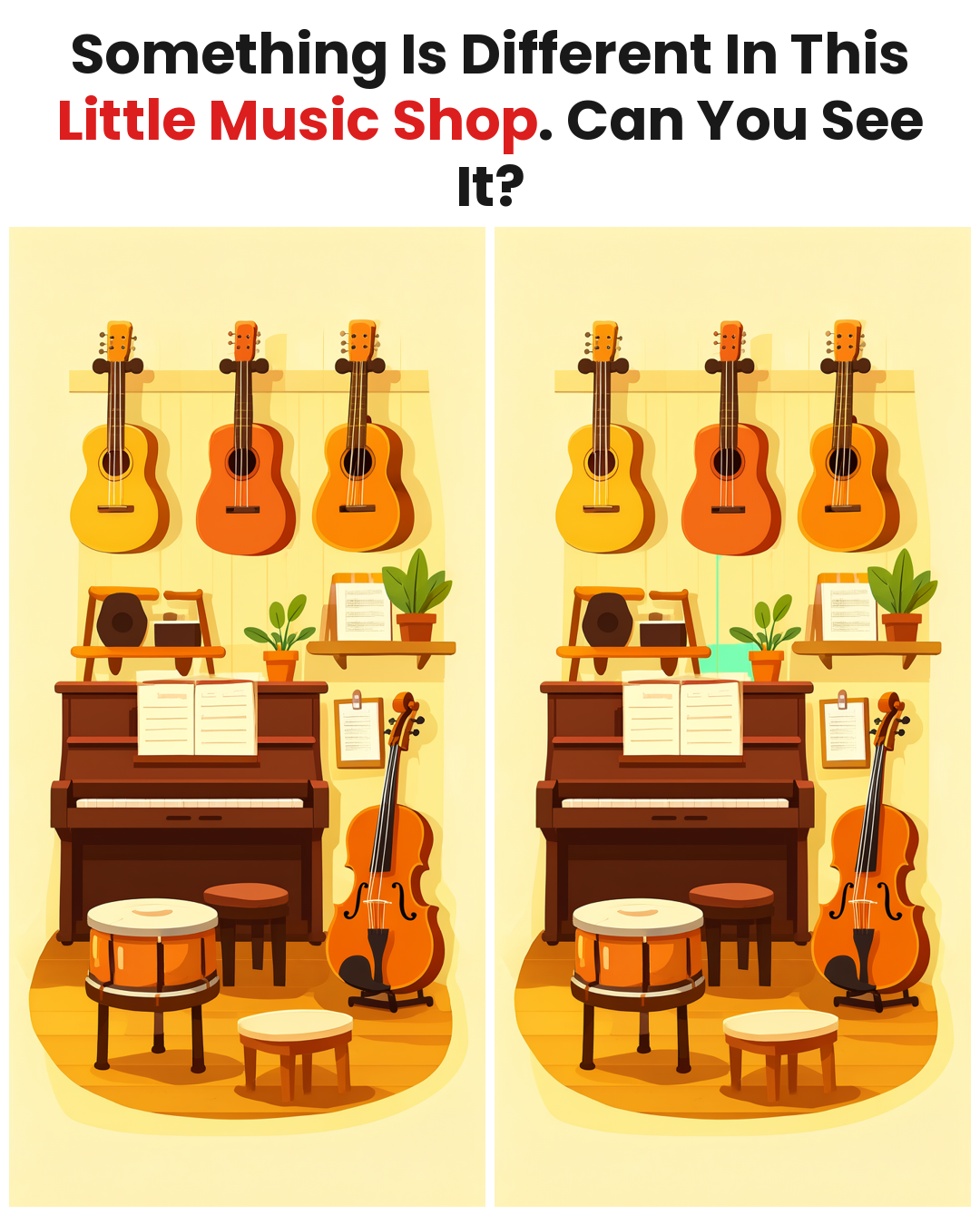
Today we are visiting a quiet little music shop on a sunny afternoon.
Three guitars hang on the wall, an old upright piano waits with its sheet music open, and a violin rests patiently on its stand.
The two pictures look like perfect twins, but they are not.
One single detail in the second picture has been changed, and it is small enough to walk right past.
Look slowly, the way you would look around a real shop, and let your eyes rest on each object for a moment.
Most people take about thirty seconds. Are you quicker than that?
Take your time and look closely before you scroll down!
Look At The Small Things First
When most of us study a picture like this, we start with the biggest, boldest objects. The guitars catch us first, then the piano, then the violin. Those are the stars of the scene, so that is where our attention goes.
The trouble is that puzzle makers know this perfectly well. The change is almost never placed on the star of the picture. It goes somewhere modest, on a background shelf or in a corner where the eye only glances.
So try the opposite order for once. Begin with the quiet items: the little pots, the stool, the clipboard on the wall, the edge of the shelf. Finish with the big instruments. It feels back to front, and that is exactly why it works.
Why Colour Is So Easy To Forget
We remember shapes far better than we remember colours. Ask someone to describe a friend’s kitchen and they will tell you about the table, the window and the chairs long before they mention what shade the cupboards were painted.
The same thing happens here. Your mind files the object away as a plant in a pot. The colour of the pot is treated as background information and is not stored carefully, so when it changes there is nothing in your memory to argue with it.
This is also why a changed colour often feels invisible even when you are staring straight at it. The object is still a plant pot. Nothing about the scene has become impossible, so no alarm bell rings.
Music, Memory And A Little History
Picture puzzles and music have more in common than you might think. Both ask you to notice small differences: a wrong note, a wrong colour, a pattern that breaks. Musicians often turn out to be very good at spot-the-difference games, because years of listening for small changes train the same kind of careful attention.
These twin-picture puzzles have appeared in family magazines since Victorian times, and they travelled around the world without ever needing translation. A picture needs no words, so the same puzzle could amuse readers in any country.
Today doctors recommend them as a gentle daily exercise for the mind, rather like a short walk for the eyes.
Your Friendly Challenge
Give yourself thirty seconds. That is the time most people need for this one. Under fifteen seconds is very sharp indeed.
If you get stuck, try covering the guitars with your hand. With the loudest part of the picture out of the way, the shelf and the little objects on it finally get the attention they deserve.
When you have found it, pass the picture along to a friend or a grandchild and watch them search. Keeping the secret for a minute or two is part of the pleasure.
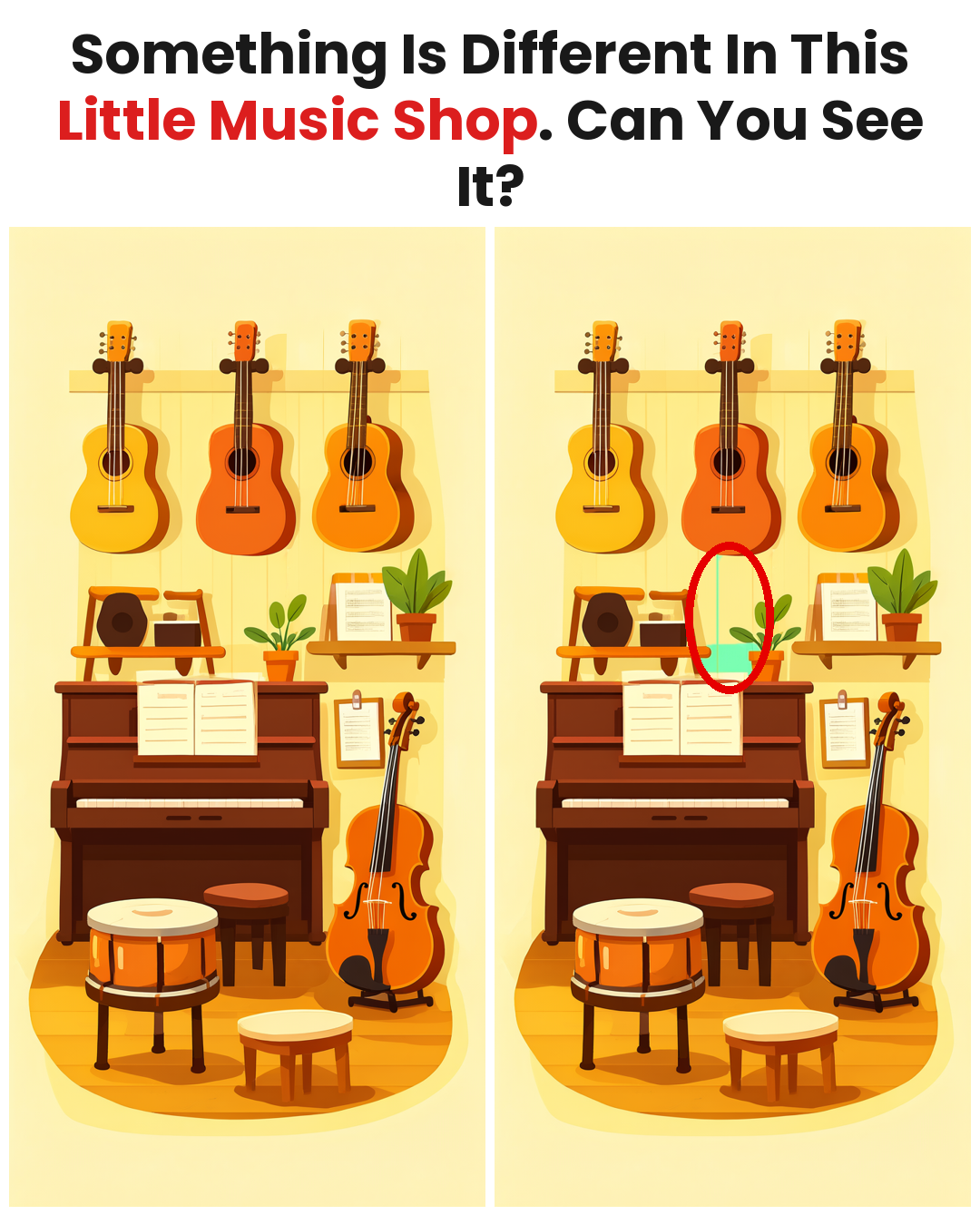
ANSWER: The plant pot on the shelf changed colour – it is terracotta in one picture and green in the other
Where The Change Is Hiding
Look at the small wooden shelf that sits above the piano, between the guitars and the keyboard. There is a leafy green plant standing on the left-hand side of it.
In the first picture that plant sits in a warm terracotta pot, the usual orange-brown colour of a clay flowerpot. In the second picture the very same pot has turned a soft mint green.
The plant itself has not moved. The leaves are the same, the shelf is the same, and every instrument in the shop is untouched. Only the pot has changed its colour.
Why Most People Walk Right Past It
First, the pot is tiny compared with everything around it, and it sits in the busiest band of the picture, squeezed between the hanging guitars above and the piano below.
Second, a green pot under a green plant looks completely natural. Green leaves in a green pot is something you see in any real shop window, so nothing about it feels wrong when you glance at it.
Third, there is a second plant on the right-hand side of the same shelf, still in its orange pot. Many people see that one, decide the pots have been checked, and move on. That little trick of the eye catches almost everybody.
How Did You Do?
Under ten seconds: eagle eyes. You ignored the big instruments and went straight for the details, which is exactly the right instinct.
Ten to thirty seconds: a very good result, and quicker than most readers manage.
Thirty to sixty seconds: completely normal. The guitars are designed to hold your gaze, and they did their job.
Over a minute: no shame at all. Colour changes on small background objects are the hardest kind there is, and now you know to check the corners first.