Hello, puzzle friends!
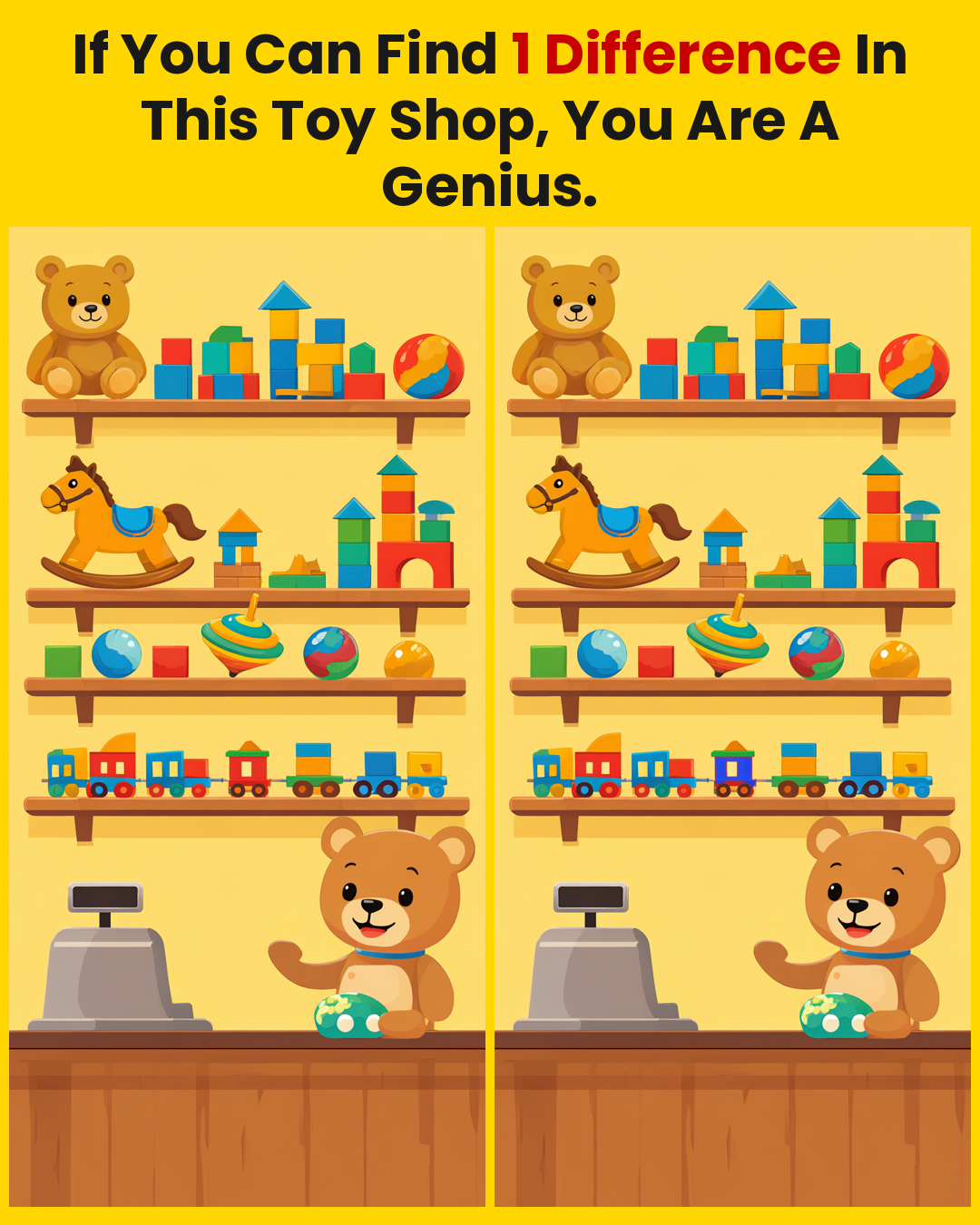
Today we are stepping into a cheerful little toy shop, and both pictures look exactly the same.
The same teddy bears sit on the top shelf, the same rocking horse waits below, and the same long toy train rolls across the wood.
But only one of these pictures is the original. Somewhere in the second one, a single small detail has quietly changed.
There is just one difference, and it is hiding in plain sight.
Let your eyes travel shelf by shelf, from the bears down to the counter, and trust the first thing that feels wrong.
Most people need about thirty seconds. Can you do it faster?
Take your time and look closely before you scroll down!
Start At The Top And Work Down
The easiest mistake with a spot-the-difference picture is to look everywhere at once. Our eyes jump from the brightest colour to the biggest shape and back again, and in all that jumping they skip the quiet corners where the change usually lives.
A much better method is to treat the picture like a shopping list. Begin with the top shelf and compare it in both pictures, left to right. Then move to the second shelf, then the third, then the counter at the bottom. Finish one row completely before you allow yourself to move on.
This slow, orderly sweep feels less exciting than hunting at random, but it works far better. When you compare small matching pieces side by side, a difference in colour or shape jumps out almost on its own.
Why Our Brain Loves To Fill In The Gaps
Your brain is not a camera. It does not store every detail of what you see. Instead it builds a quick summary: shelves, toys, bright colours, a friendly bear at the counter. Once that summary feels complete, the mind happily says that both pictures are the same and moves on.
This habit saves us an enormous amount of effort in daily life. We do not need to study every brick in a wall to know it is a wall. But the same shortcut is exactly what a puzzle like this takes advantage of.
Small repeated objects are the hardest of all. A row of toy blocks or a line of train cars becomes one single pattern in our mind rather than a group of separate items. We remember the pattern, not the pieces, so a change inside the row slips past us.
A Puzzle With A Long History
Spot-the-difference pictures have been entertaining families for well over a hundred years. They first became popular in newspapers and children’s weeklies in the late nineteenth century, when printers discovered they could run the same drawing twice and simply alter one tiny plate detail.
They have never gone out of fashion, and for good reason. They need no special knowledge, no mathematics and no language. A grandmother and a grandchild can lean over the same page and have exactly the same chance of winning.
Doctors and therapists like them too. Comparing two images uses attention, short-term memory and careful looking all at once, which makes it a pleasant and gentle way to keep the mind lively.
Your Friendly Challenge
Here is the test. Most people find this one in about thirty seconds. Anything under fifteen seconds is genuinely sharp eyesight, and if you spot it in under ten you belong in a very small club.
Try it once without hurrying. If the change still hides from you, cover the top half of both pictures with your hand and compare only what is left, then do the same with the bottom half.
When you have found it, send this picture to a friend and keep the answer to yourself for a few minutes. Watching somebody else search the same shelves is half the fun.
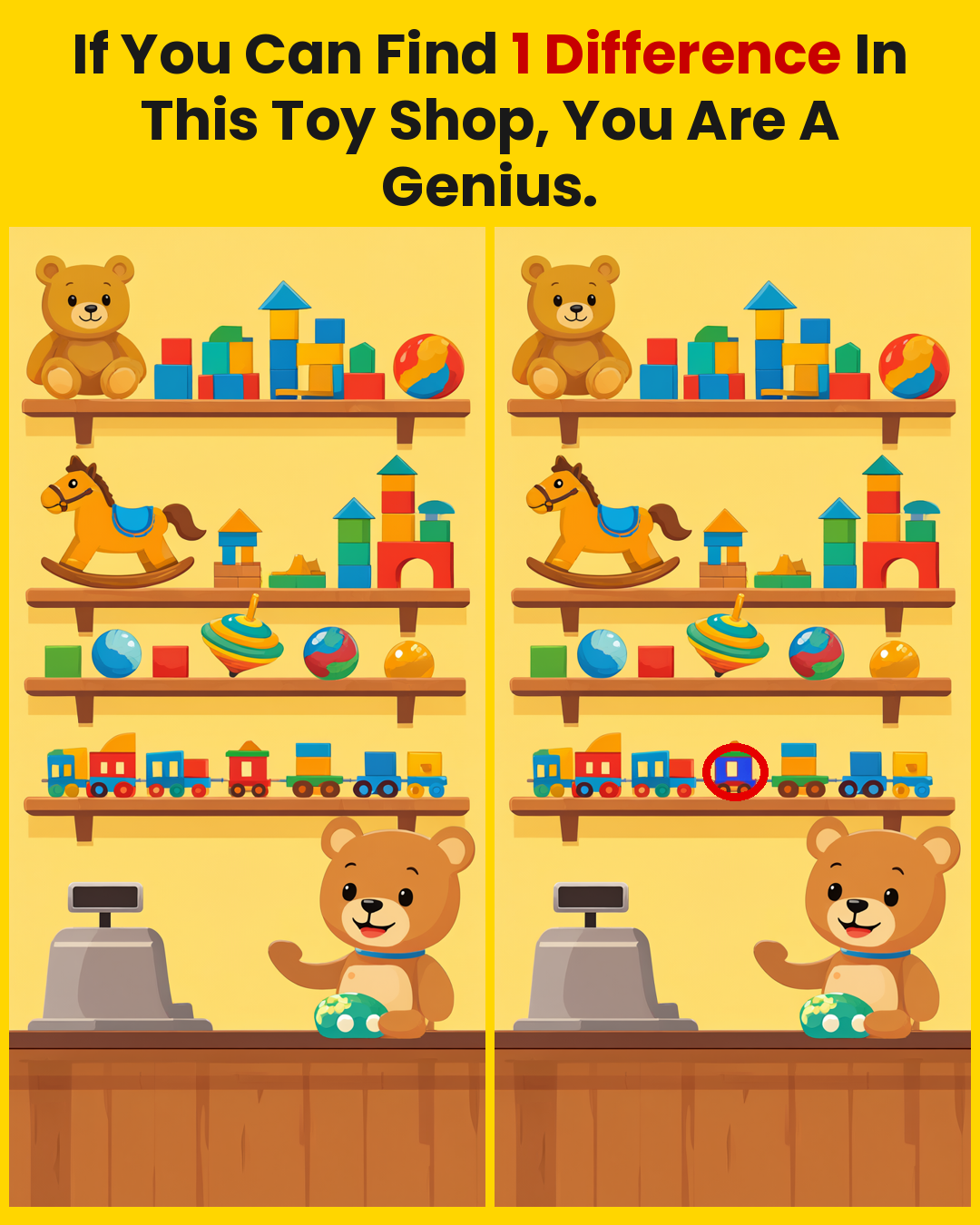
ANSWER: One of the little train cars on the fourth shelf changed colour
Where The Change Is Hiding
Look at the fourth shelf, the one with the long toy train stretching from one side to the other. In the first picture the little wagon just left of the middle is painted in soft green and yellow. In the second picture that very same wagon has turned blue and purple.
Nothing else moved. The engine is the same, the wheels are the same, the shelf is the same. Only the colour of one single carriage is different.
This is a wonderful hiding place because the train is a long line of similar shapes. Our eyes read it as one object, a train, rather than as seven separate cars, so the colour of any one car never gets its own moment of attention.
Why Almost Everybody Misses It
There are two strong distractions in this picture. The first is the big friendly bear at the counter, who is placed low and centre, exactly where our gaze naturally lands. The second is the colourful tower of building blocks on the top shelf, which is the brightest part of the whole scene.
Between those two magnets, the middle shelves get only a quick glance. The train sits in that neglected band, and the changed wagon sits in the middle of the train, which is the quietest spot of all.
There is also the colour itself. Green, yellow, blue and purple all appear elsewhere in the shop, so the new colour never feels out of place in the room as a whole.
How Did You Do?
Under ten seconds: eagle eyes. You compared the pictures in small pieces instead of as a whole, which is exactly what the experts do.
Ten to thirty seconds: excellent work and better than most people manage on a first try.
Thirty to sixty seconds: a perfectly normal, healthy result. Your brain was simply doing its usual helpful summarising.
Over a minute: do not worry in the slightest. Now that you know where the difference likes to hide, the next picture will go much faster.