Hello, puzzle friends!
Autumn has arrived in the park, the leaves are falling, and the squirrels are busy collecting acorns.
At first glance it looks easy. Nine fat grey squirrels sit on the grass, each one hugging an acorn.
But nine is not the answer, and most people give that number far too quickly.
A few little ones are tucked in close to the big squirrels, almost disappearing against those striped bushy tails.
Count carefully, look at the tails as well as the faces, and take your time.
How many squirrels can you really see?
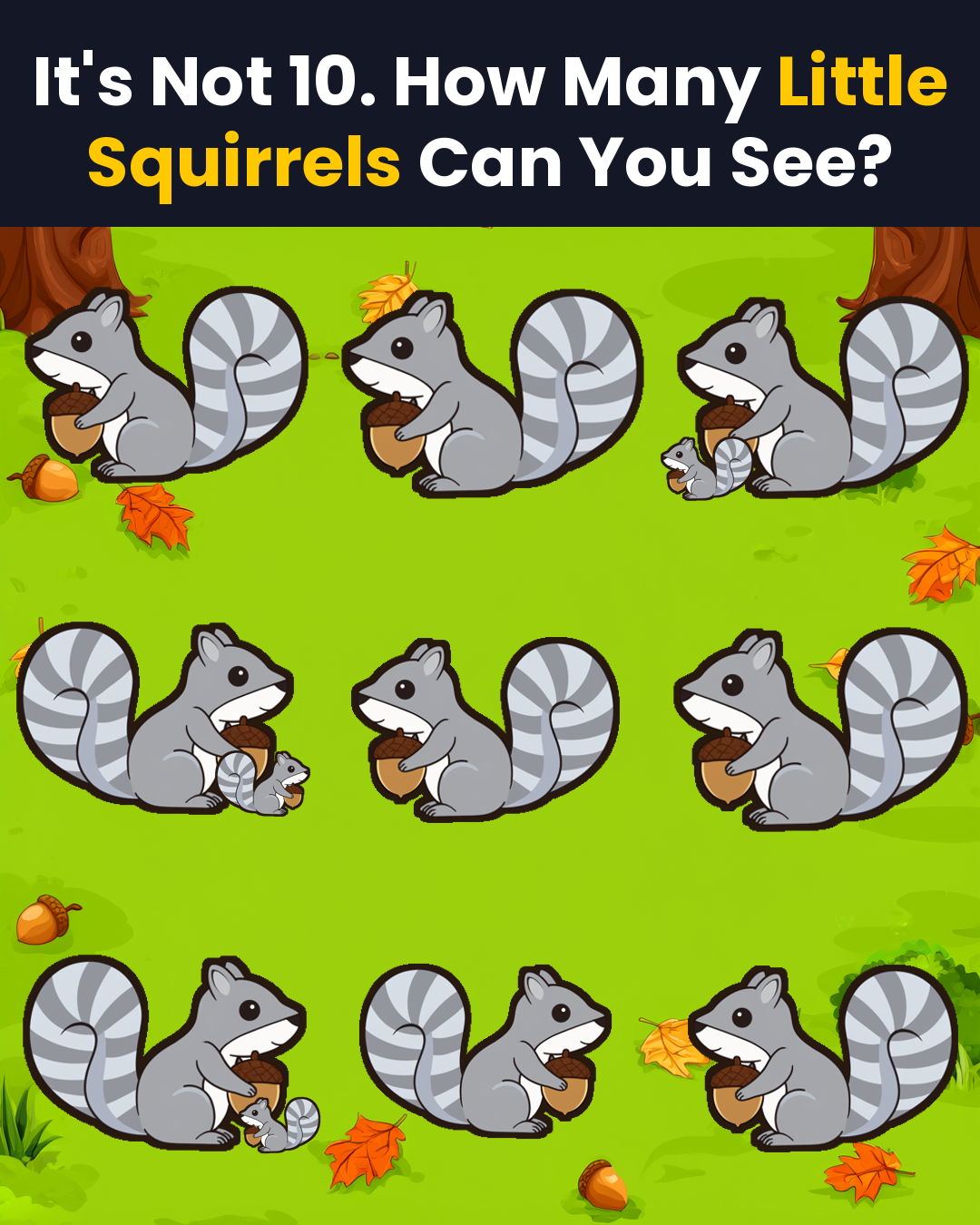
Take your time and look closely before you scroll down!
Count In Rows, Not All At Once
The fastest way to get a counting puzzle wrong is to let your eyes wander around the picture. You lose your place, count one animal twice, miss another completely, and arrive at a number you are not sure of.
The reliable method is to split the picture into bands. Count the top row and remember that number. Then the middle row. Then the bottom row. Add the three numbers together at the end.
And here is the important part: inside each row, do not count faces. Count bodies. A face is easy to spot, but the picture is built so that some of the little ones show hardly any face at all.
Why Our Brain Groups Things Together
Human eyes are wonderful at seeing groups and quite poor at seeing the members of a group. When several similar shapes sit close together, the mind bundles them into a single object and counts that object once.
Psychologists have studied this for a hundred years. Things that are near each other, or that share a colour or a pattern, get glued together in our perception whether we want them to or not.
That is exactly what happens here. A small grey squirrel sitting against the body of a big grey squirrel is not read as two animals. It is read as one animal with a slightly busy outline, and your counting finger sails straight past it.
Nature Invented This Trick First
Hiding against your own kind is a real survival strategy, not just a puzzle idea. Young deer, ducklings and squirrels all stay close to the adults, where their outline blends into a bigger shape and a passing hawk sees one large animal instead of a small, easy meal.
Animal colouring works the same way. The broken grey and white stripes on a squirrel’s tail break up its shape against bark and dry leaves. Soldiers and painters later borrowed exactly this idea and called it camouflage.
So when the little squirrels in this picture fool you, remember that they are using a trick that has been tested by nature for millions of years.
Your Friendly Challenge
Most people need about forty seconds to get the right number, and a surprising share of them answer nine in the first two seconds and never check again.
So here is the challenge: count once quickly, then count again slowly, row by row, looking at the gaps between the big squirrels. If your two answers differ, trust the slow one.
Then send the picture to a friend, let them answer first, and see whether they fall for the easy number.
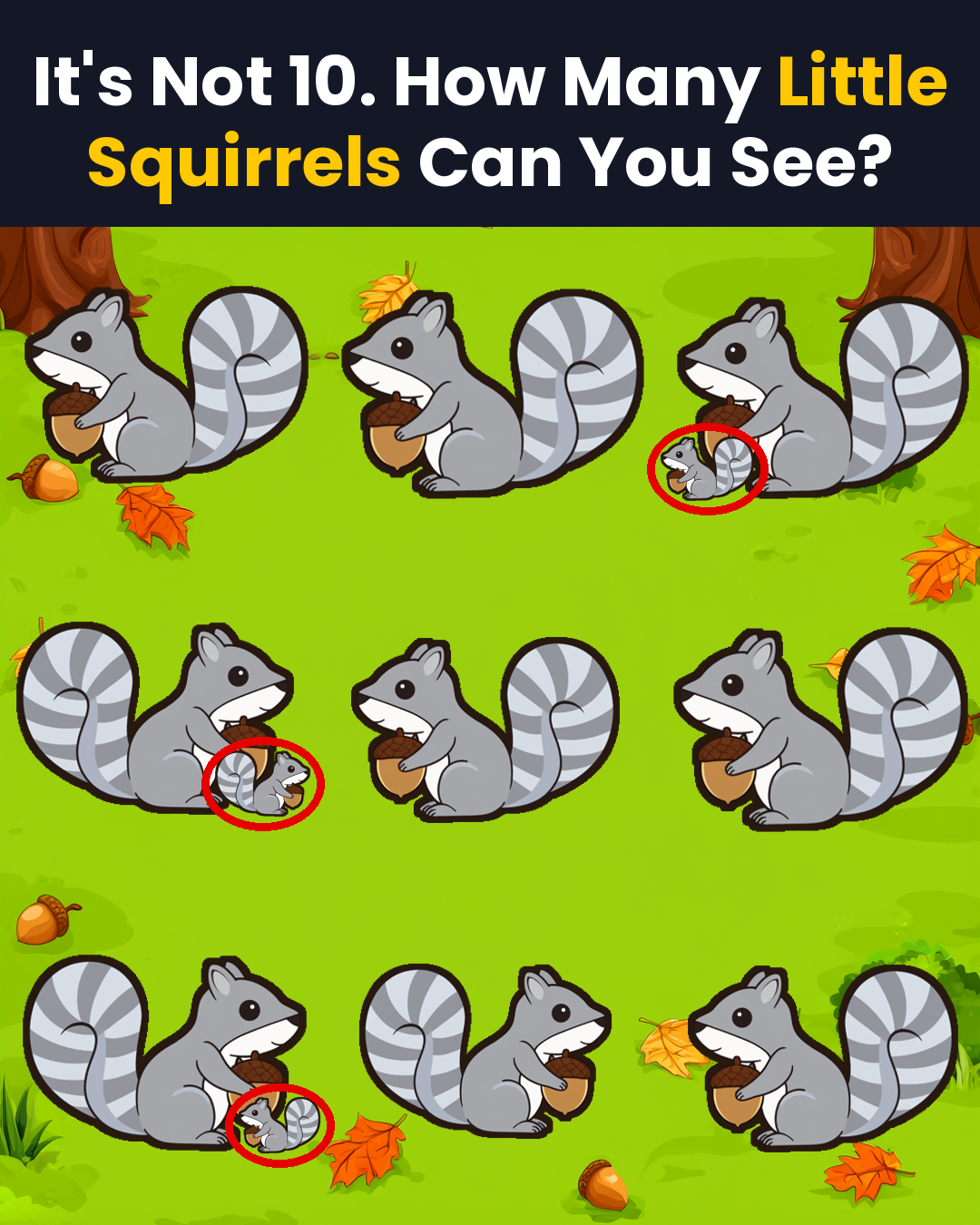
ANSWER: 12 squirrels – three tiny ones are hiding right beside the big ones
Where The Little Ones Are Hiding
There are nine big squirrels, one in each place you would expect, and three small ones hidden beside them. That makes twelve in total.
The first little squirrel is in the top row, tucked against the chest of the squirrel on the right, just below its acorn. The second is in the middle row, pressed against the front of the squirrel on the left, half covered by its bushy tail. The third is in the bottom row, sitting low beside the squirrel on the left, almost resting on the grass.
All three are the same grey as their big companions, and each one is holding its own tiny acorn.
Why Nine Feels So Right
The nine big squirrels are arranged in a tidy pattern of three rows of three. Our minds love a neat grid, and as soon as we recognise one we stop looking. The pattern answers the question before we have finished asking it.
The little ones also sit in the shadow of the larger bodies, overlapping the chest and the tail, which are the busiest parts of the shape. Overlapping outlines are famously difficult for the eye to separate.
Colour finishes the job. Same grey fur, same white belly, same striped tail, same brown acorn. There is simply no contrast to make a small one stand out.
How Did You Do?
Twelve on your first try, in under fifteen seconds: eagle eyes, and you clearly do not trust tidy patterns.
Twelve after a careful second look: excellent. That is exactly how a good counter works.
Ten or eleven: very close. You found some of the hidden ones but not all three.
Nine: you are with the great majority of readers, and now you know to look in the gaps next time.