Hello, puzzle friends!
It is a sunny Saturday and this cheerful fellow has rolled his blue car onto the driveway for a proper wash.
Sponge in one hand, hose in the other, soap bubbles everywhere, and a red front door watching from the house.
The two pictures look like twins. Same car, same tree, same bucket of soapy water.
But one small detail in the picture on the right has changed, and it is not where most people look first.
Work your way calmly from the roof of the house down to the wheels.
Good luck, and enjoy the hunt!
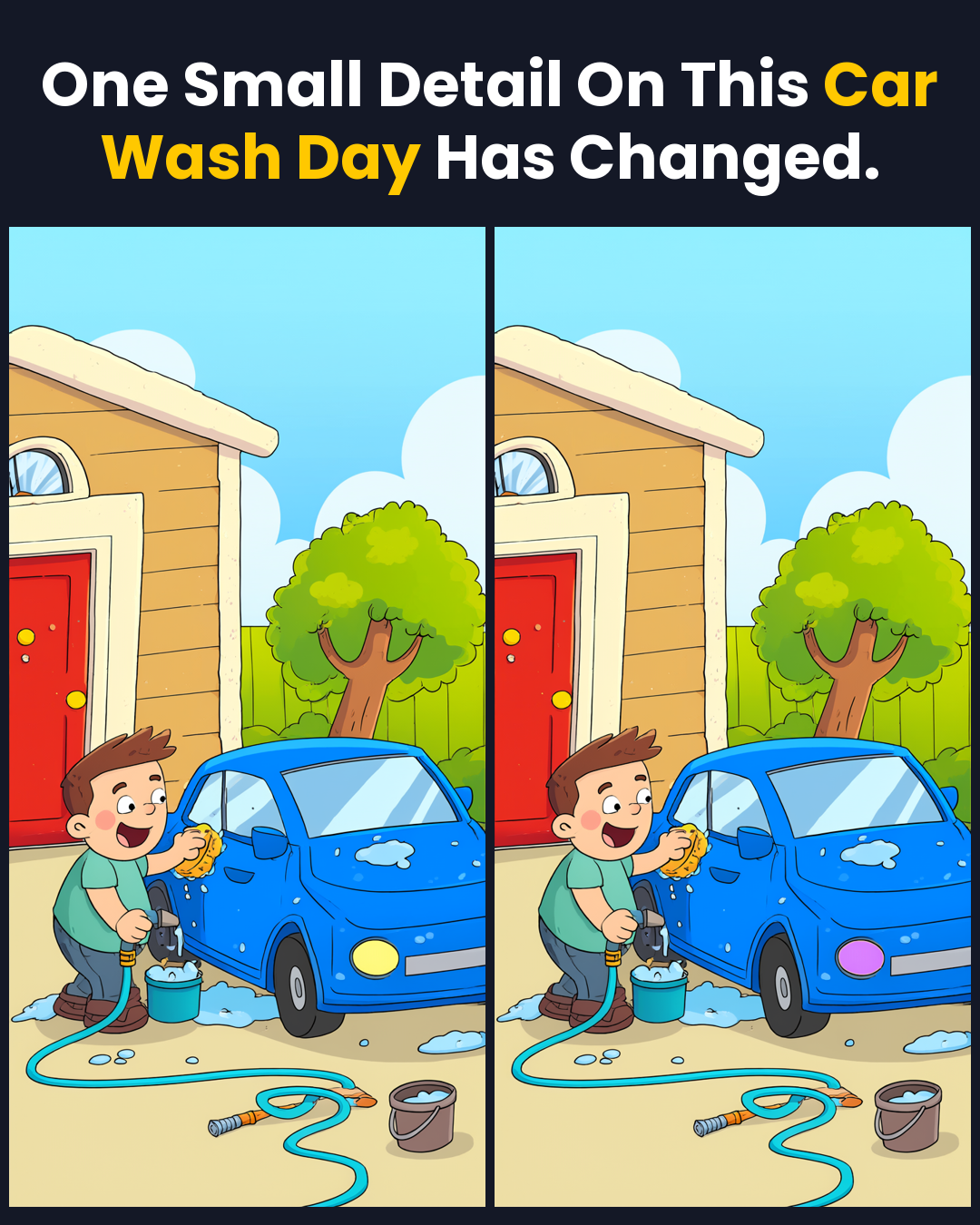
Take your time and look closely before you scroll down!
Where To Look First
When two pictures sit side by side, most of us start in the middle and then jump around at random. That feels fast, but it is the slowest way to work. The eye keeps returning to the same few spots and never covers the quiet corners.
Try this instead. Imagine a line down the middle of each picture, then across, so each one is cut into four parts. Compare the top left quarter in both pictures until you are sure, then the top right, then the two lower quarters. In this driveway scene that gives you the house and sky, the tree and fence, the man and the bucket, and finally the car itself with the hose on the ground.
One more tip that works wonders: look at edges and small round shapes. Door handles, wheels, buttons, lamps. Small round things are where puzzle makers love to hide their secret, because our eyes treat them as unimportant background detail.
The Little Trick Your Brain Plays
Your brain is not a camera. It is more like a busy editor who keeps only the parts of the scene that seem useful and writes the rest from memory. When it sees a car, it stores car, blue, parked and moves on. It does not store every lamp and every line of chrome.
So when something small on that car changes, there is no stored copy to compare it with. You are not looking at the picture any more, you are looking at your idea of the picture. This is why people can stare straight at the change and still not see it.
Colour adds another layer. Bright, warm colours grab attention first, which is why the red door and the blue car pull your eyes so strongly. Anything quiet and small near those loud areas becomes almost invisible.
A Game Older Than Television
Side-by-side picture puzzles have been a family favourite since the days when newspapers were the main entertainment of the evening. Children raced their parents, and the winner usually got the last slice of cake.
There is a reason the format has lasted. Comparing two scenes uses attention, memory and patience together, and it rewards you with a tiny burst of joy the moment you succeed. Puzzle lovers often say it is the cheapest happy moment of the day.
Today these pictures travel around the world in seconds instead of being printed on paper, but the pleasure is exactly the same as it was a hundred years ago.
Your Challenge For Today
The average person finds this one in about fifty seconds. People who already know the trick of checking small round objects often find it in under fifteen.
If you get stuck, do something that sounds strange but really helps: blink hard, look away for three seconds, then look back. A fresh look often finds in a moment what a tired stare cannot find in a minute.
And when you have it, pass the picture on to a friend. Watching someone else search is almost as much fun as solving it yourself.
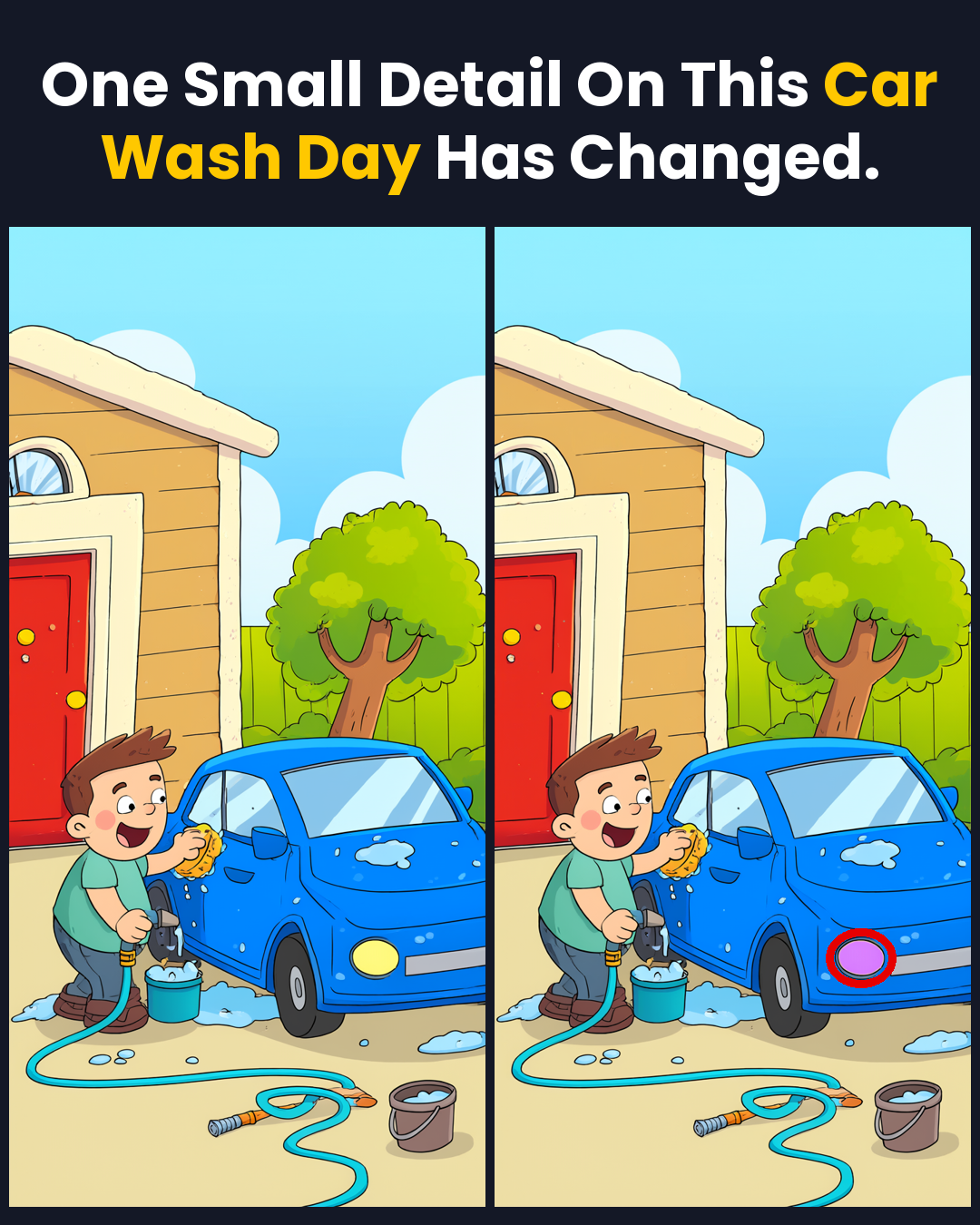
ANSWER: The headlight on the car changed colour – it is yellow in the first picture and purple in the second.
The Change Was On The Car All Along
Look at the front of the blue car, low down near the bumper. In the first picture the round headlight is a warm yellow, just as you would expect. In the second picture that same headlight has turned a soft purple.
The shape, the size and the position are all exactly the same. Only the colour is different, and it sits in the lower part of the picture, close to the ground, where our eyes spend the least time.
Once you know where to look, the difference seems obvious, and that is the strange charm of these puzzles. The eye that could not find it a minute ago now sees it instantly, every single time.
Why It Is So Easy To Miss
Three things work against you here. First, the car is large and blue, and the brain records it as one big blue object instead of a collection of parts. Second, the man, the bubbles and the red door are far more interesting to look at, so your attention keeps drifting back up to them.
Third, a headlight is a thing we almost never study. We know a car has them, so the brain ticks the box and moves on. Change the colour of something nobody examines, and it can hide in the open for a very long time.
How Did You Do?
Under 10 seconds: eagle eyes. Very few people are this quick.
10 to 30 seconds: sharp and focused, a lovely result.
30 to 60 seconds: the normal range, and a solid win.
Over a minute: you are in good company, and you still got there. Next time, start at the wheels and work upward. You will surprise yourself.
Whatever your time was, the real prize is the few quiet minutes you spent looking closely at a simple, friendly scene. That kind of calm attention is good for all of us.