Hello, puzzle friends!
Today we are standing at a little farm stand on a bright autumn morning, with hay bales, wooden crates and a red barn behind us.
The whole yard is full of round orange pumpkins with curly green stems, and every one of them wants to be counted.
That sounds like an easy job, and it is exactly the kind of job our eyes love to rush.
Some of these pumpkins are big and sit right in front of you, and a few are much smaller than the rest.
Take your time, work across the picture row by row, and look carefully in the gaps between the big ones.
Decide on your number before you scroll down, and no peeking at the bottom of the page!
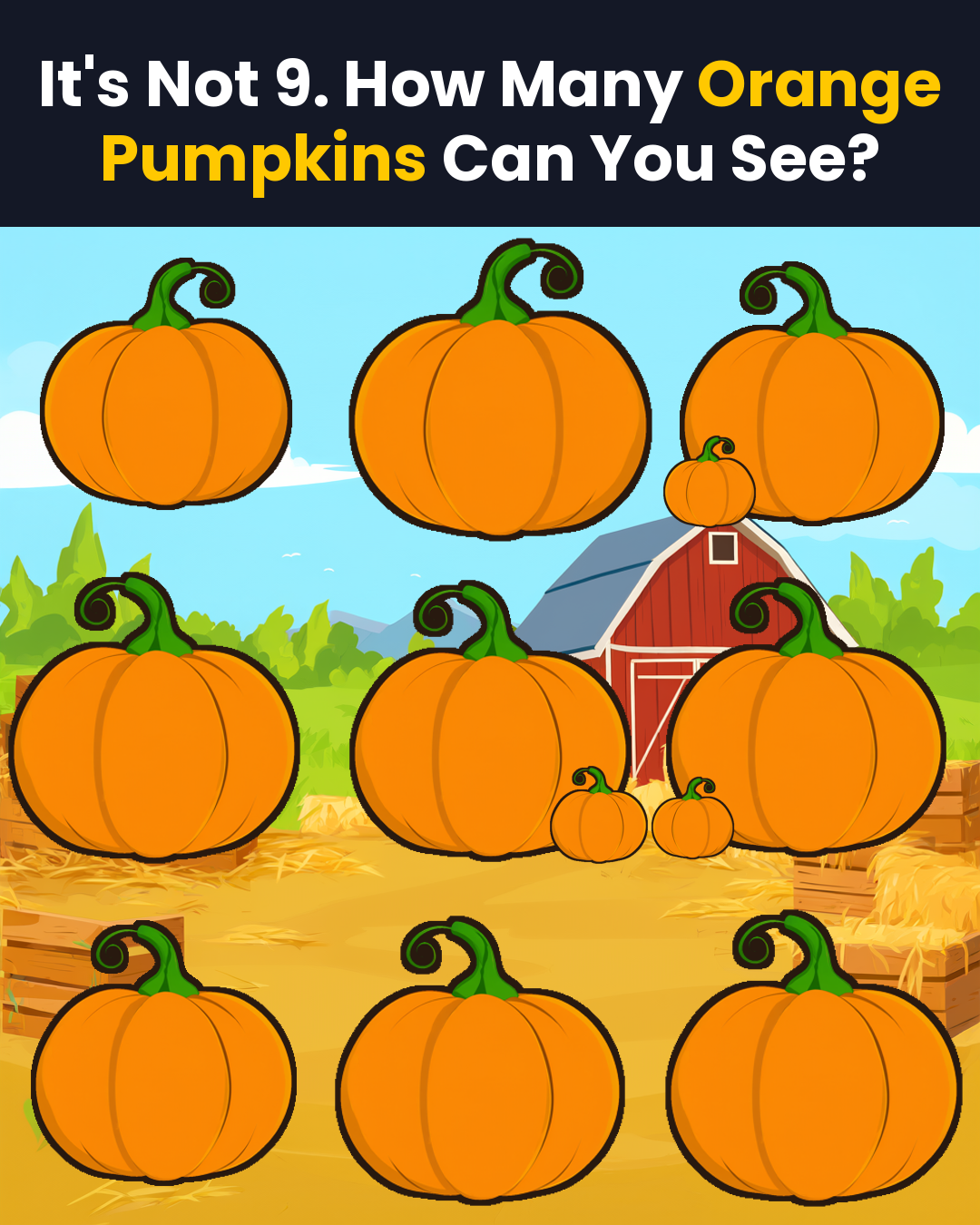
Take your time and look closely before you scroll down!
A Simple Method That Really Works
Counting seems like the easiest thing in the world, and that is exactly why so many people get it wrong. The eye takes in the whole picture at once, the mind makes a quick guess, and that guess is usually one or two short of the truth.
The cure is a little bit of order. Instead of letting your eyes jump around the farm stand, divide the picture into three bands: the top of the yard, the middle around the barn, and the ground at the front. Count one band completely, say the number out loud, and only then move to the next band. Three small numbers added together are far more reliable than one big guess.
It also helps to touch the screen, or to point with a finger, as you count. Moving your hand slows your eyes down and gives your mind a place to rest. People who count out loud and point almost always beat people who count silently and quickly.
Why Our Brain Finds Counting Hard
Our eyes are wonderful at recognising a shape, and surprisingly poor at keeping track of how many of that shape we have seen. Researchers call the quick, effortless kind of counting subitising, and it only works up to about four objects. Beyond that, the mind has to switch into slow, careful mode, and most of us do not notice the moment it should have switched.
There is a second trap here, and it has to do with size. When several large pumpkins sit in a group, they become the story of the picture, and anything smaller nearby turns into background. The little ones are not hidden at all. They are in plain sight, simply overshadowed by their big neighbours.
Colour plays its part too. Everything in this scene lives in the same warm family of orange, gold and straw, so a small pumpkin against a bale of hay has very little contrast to make it stand out. Your eye slides straight past it on the way to the next big shape.
Pumpkins Have Always Been Good Company
Counting pumpkins is a very old pleasure. Autumn markets have been piling them into pyramids for generations, and farmers have always had their own way of keeping the total: five in a row, four rows to a crate, and the sum written in chalk on a board by the gate.
Picture puzzles like this one grew out of the same simple joy. Magazines in the nineteen twenties printed counting pictures for the family to argue over on a Sunday afternoon, and the trick they used then is the trick we are using now: a few small objects placed right next to much larger ones.
The idea has survived a hundred years because it never stops working, no matter how often you have seen it before.
How Long Will You Need?
Most people give their first answer in about eight seconds, and most people are wrong. Those who take a full half minute and count in bands get it right far more often.
So be honest with yourself. Did you count, or did you guess? If you guessed, go back to the picture and try the three band method before you read on.
And when you have your number, show the picture to a friend or to someone in the family without saying a word about it. Watching another person make exactly the same mistake you made is half the fun of a puzzle like this.
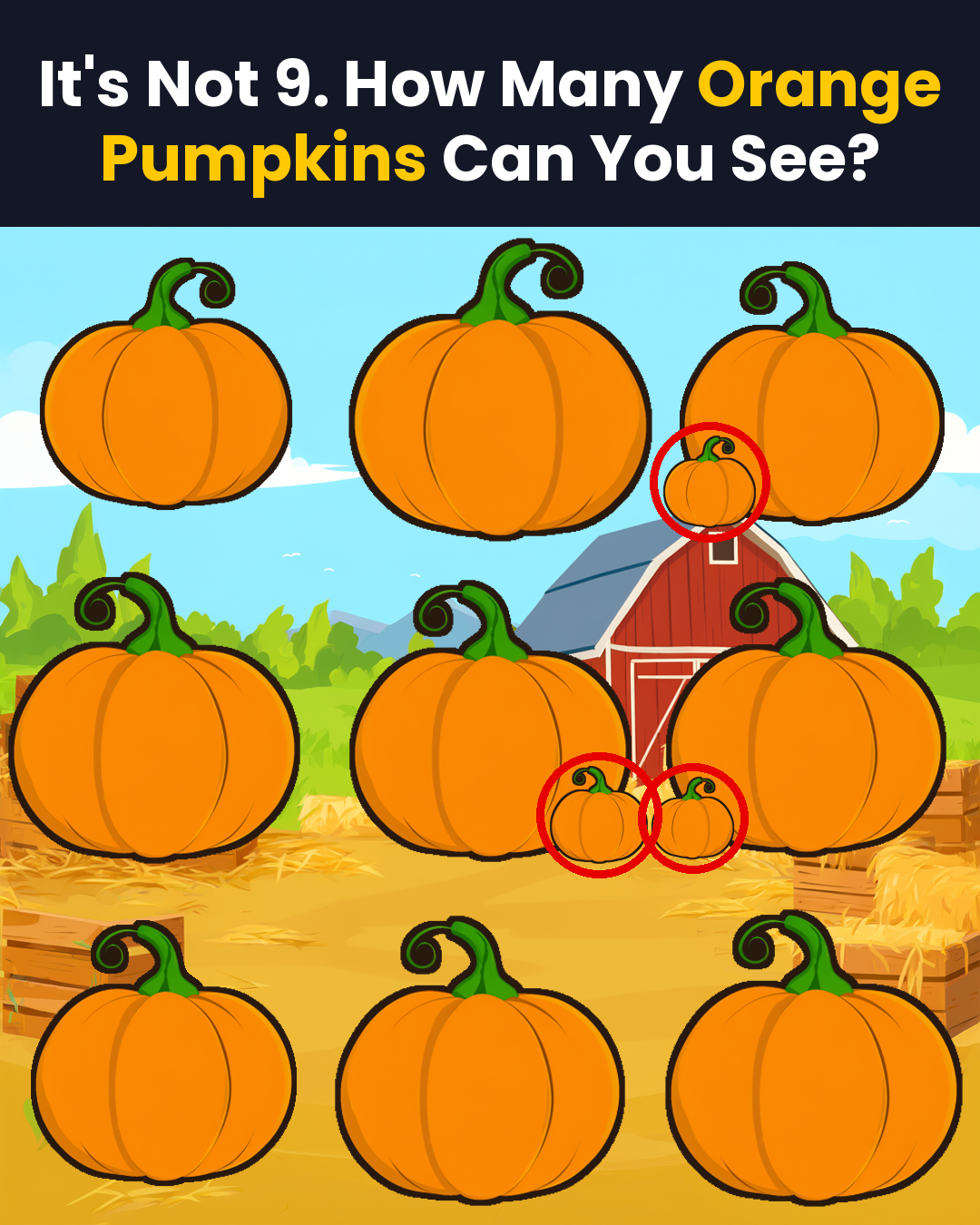
ANSWER: 12 pumpkins – three small ones are tucked in beside the big ones.
Where The Missing Pumpkins Were Hiding
The nine large pumpkins are the easy part. They are spread evenly across the yard in three loose rows, and almost everybody finds all nine of them.
The three extra pumpkins are much smaller. One sits high on the right, leaning against the big pumpkin in the top row with the red barn just behind it. The other two are down in the middle of the picture, side by side on the straw, right between the big pumpkin in the centre and the one to its right.
All three are fully visible. Nothing covers them and nothing is cut off. They are simply small, and they sit so close to their large neighbours that the eye reads the whole group as a single object.
Why Almost Everyone Says Nine
The title plants a number in your head before you even look, and nine is the number of the big, obvious pumpkins. Once your eyes have confirmed what the title suggested, the mind closes the case and stops searching.
The small pumpkins also sit in front of straw and warm sand, so their orange has very little contrast against the background. Add that to the fact that they are touching bigger shapes, and they become almost invisible to a quick glance, even though they are right in the middle of the picture.
How Did You Do?
Under ten seconds and a correct twelve: you have truly sharp eyes, and you clearly did not trust the title for a second.
Ten to thirty seconds: an excellent result. You noticed that something was odd about the easy answer and went back for a second look.
Thirty seconds to a minute: exactly where most careful people land, and nothing at all to be ashamed of.
Answered nine straight away: welcome to the club. Almost everyone does, which is precisely why this puzzle is so much fun to pass on.