Hello, puzzle friends!
Here is a garden full of the happiest visitors you could wish for: a whole family of brown puppies with red collars and wagging tails.
They are sitting on the grass by the fence, and they are waiting for you to count them.
It sounds easy, and the first count almost always comes out wrong.
Some of these puppies are big and proud, and some are very small indeed.
Count slowly, row by row, and look right next to the big ones before you decide.
Write your number down before you read on. No peeking at the bottom of the page!
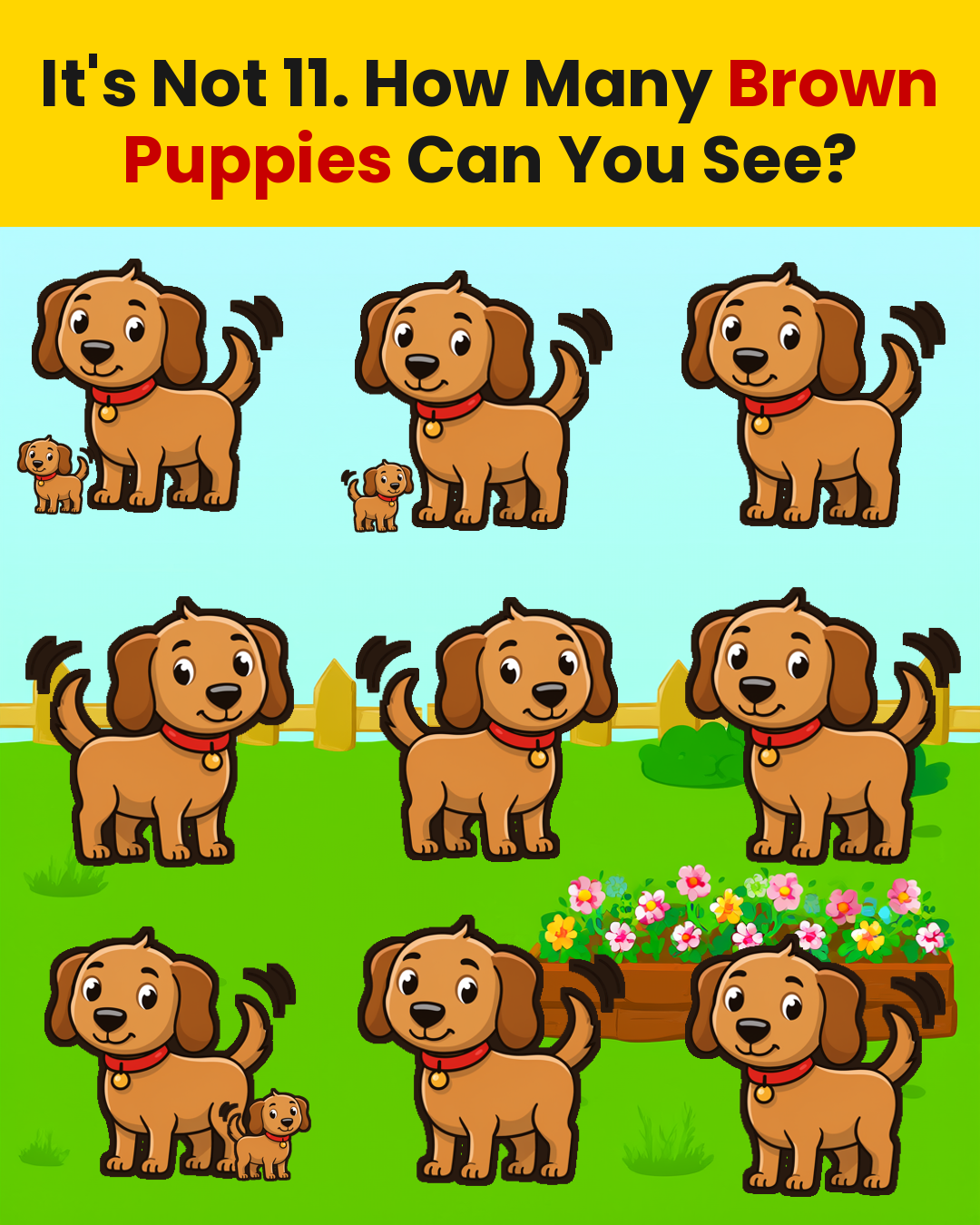
Take your time and look closely before you scroll down!
How To Count Without Losing Your Place
Counting looks like the simplest task in the world, and that is exactly why we get it wrong. The mind wants to grab the whole picture at once and give an answer straight away, and that quick guess is nearly always one or two short.
The cure is to count in rows, like reading a page. Start in the top row, go from left to right, then drop to the second row and do the same. Say each number quietly to yourself as you go, because the voice in your head keeps your place far better than your eyes do.
The second rule is just as important: look beside and behind every big shape before you move on. Small things hide next to large things, partly because they are small, and partly because the big one has already taken all your attention.
Why Our Eyes Miss The Little Ones
The brain has a quick counting system that works beautifully up to about four objects. Beyond that it has to switch to careful, one-by-one counting, and most of us do not notice when that switch is needed. We keep using the fast method and end up guessing.
There is also a habit called size bias. When objects of different sizes are mixed together, we record the large ones as the real group and treat the small ones as decoration. A tiny puppy standing beside a big puppy can be seen by your eye and still be left out of your total.
And then there is the fence, the flower bed and the grass. Every extra detail gives your eyes somewhere else to go, and every glance away is a chance to lose count.
A Little History Of Counting Puzzles
Counting puzzles are among the oldest brain teasers we know. Market traders tested each other with handfuls of beans, teachers used pebbles and seeds, and old puzzle books are full of pictures asking how many birds, boats or barrels are on the page.
They stay popular because they are completely fair. There is no trick wording and nothing is hidden outside the picture. Everything you need is right there in front of you, which makes the mistake all the more surprising when it happens.
They are also wonderfully social. Three people will often give three different numbers, and the friendly argument that follows is half the fun.
Your Challenge
Most people give their first answer in about ten seconds, and most of those first answers are wrong. The ones who get it right usually count twice: once quickly, and once slowly from the bottom row upward.
So here is the challenge. Count once the way you normally would. Then count again in the opposite direction and see whether you get the same number. If the two counts disagree, you have already found your mistake.
Then show the picture to a friend and ask for their number before you tell them yours.
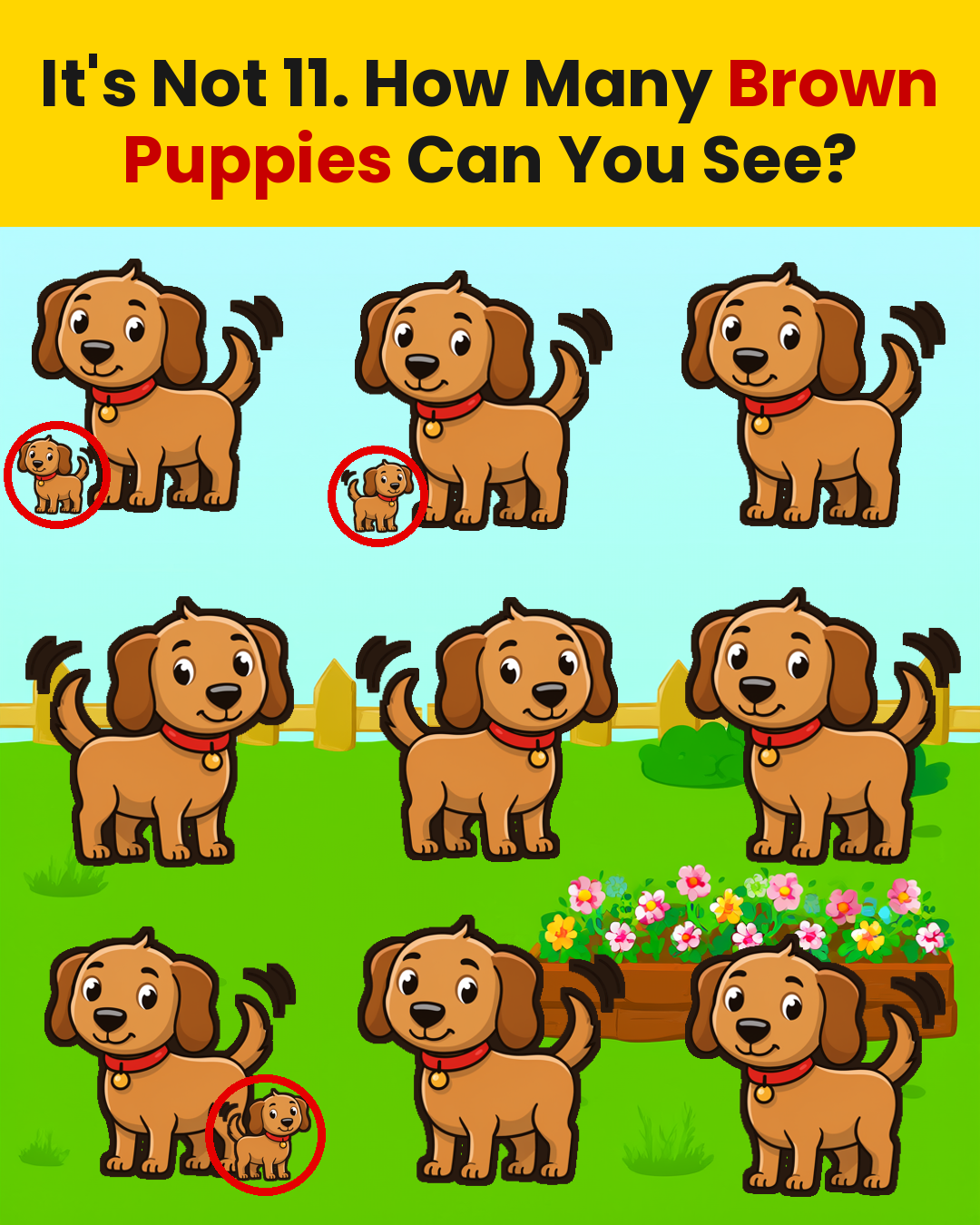
ANSWER: 12 puppies – three tiny ones are standing right beside the big ones.
The Three Little Ones
There are nine large puppies, and they are easy to see. The trouble is caused by three much smaller puppies standing right next to them.
One tiny puppy stands at the far left of the top row, tucked against the front legs of the first big puppy. A second little one sits between the first and second big puppies in that same top row. The third is in the bottom row, standing beside the big puppy on the left, half in front of its tail.
Nine big ones plus three small ones gives twelve puppies in all.
Why The Small Ones Disappear
Each little puppy is placed in the shadow of a big one, and that is no accident. When two objects touch or overlap, the brain tends to read them as a single thing. The small puppy becomes part of the big puppy, rather than a puppy of its own.
The colour helps the trick along as well. All the puppies share the same warm brown coat and the same red collar, so there is no difference in colour to make the small ones stand out. If they had been white or black, almost everyone would have counted correctly the first time.
How Did You Do?
Twelve on the first try: eagle eyes, and a very steady way of counting.
Eleven: so close. You found one of the little ones and the other two slipped past.
Nine or ten: you counted the big puppies perfectly, which most people do.
Anything else: do not worry at all. Count once more, row by row, and this time look beside every big puppy. The number will come out right, and the next counting puzzle will be much easier.