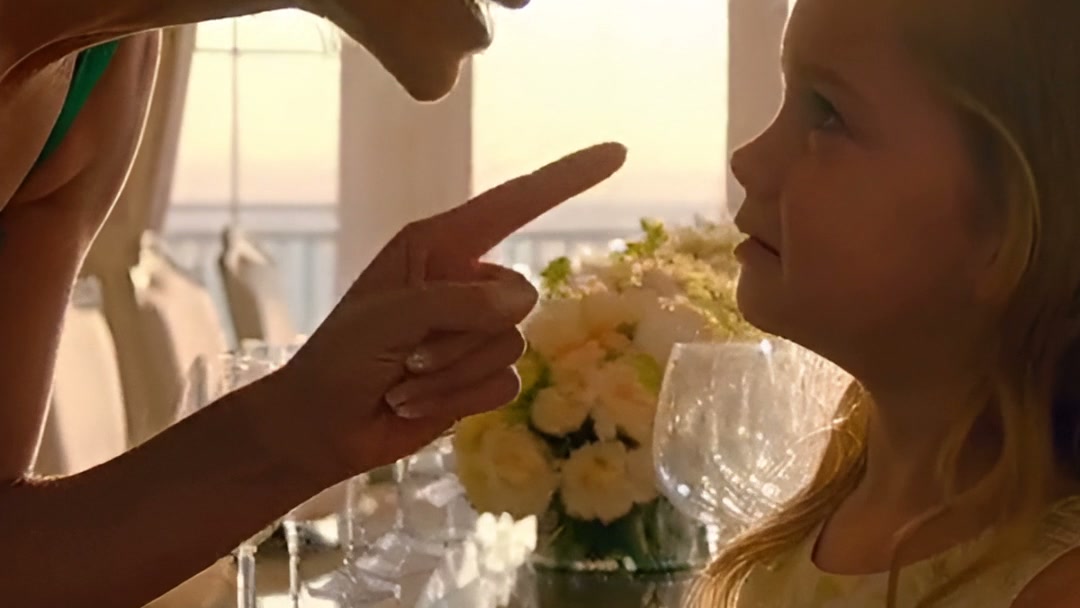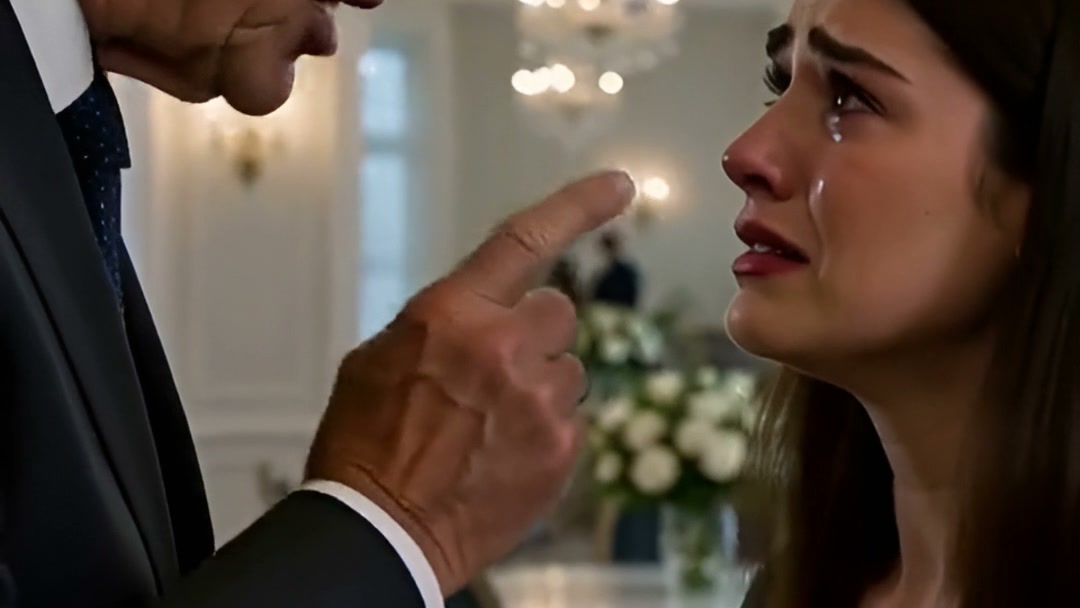
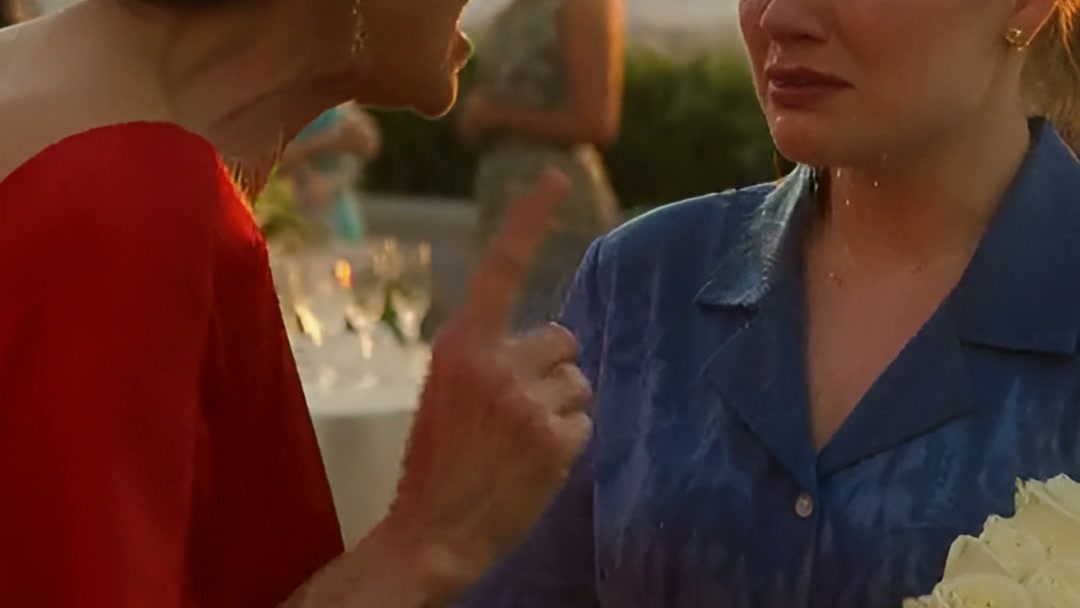
The CEO stopped the hostess mid-shove at his rooftop gala… But when the florist girl quietly said who sent her white roses every year, his champagne glass slipped from his fingers and shattered on the marble floor.
The rooftop bloomed gold.
White umbrellas caught the last of the sun, and long tables ran the length of the terrace, every vase crammed with white roses. The city skyline burned amber behind it all, and two hundred guests in silk and linen moved through the light like they owned it.
Because most of them did.
Nora Callaway was twenty years old, and she owned exactly nothing except a secondhand van, a talent for flowers, and a blue work dress that the agency said was regulation but that always made her feel like a school crossing guard at a fashion show. She tucked her dark hair behind her ear and lifted the last crystal vase into place at the far end of the head table.
“Perfect,” she whispered to herself.
She stepped back to check the angle. White roses, stems cut at forty-five degrees, the outer petals just beginning to open. She had sourced them from a grower in Oregon who dried his beds with fans so the petals never bruised. She had ordered them herself, had driven to the warehouse at five this morning, had arranged all forty-seven vases by hand.
She was still looking at the last one when Marguerite Voss found her.
Marguerite was fifty-three, the evening’s hostess, chairman of the Voss Foundation, and a woman who had never in her adult life allowed a problem to linger more than thirty seconds before she dissolved it. She was wearing pale gold Chanel and her expression suggested that Nora was a problem.
“What are you still doing up here?” Her voice carried the precise, clipped quality of someone who had trained herself never to shout, because shouting implied that the other person’s opinion mattered.
“I was just finishing—”
“You’re done. Staff do not stand at the head table during the reception. You are visible.”
“I’m sorry, I was just checking the last—”
The champagne hit Nora’s face before she finished the sentence.
It was cold. It ran down her cheek, into the collar of her blue dress, pooled at her collarbone. The guests within earshot went very still. Nora didn’t move. She stood with her hands at her sides and her eyes wide, the way a person stands when something has happened that is so far outside their expectations that their body simply doesn’t know yet what to do.
Marguerite set the empty flute down on the nearest tray with a precise click.
“Now you have a reason to leave.” She stepped forward, one arm rising, palm flat, ready to shove.
A hand closed around her wrist.
Not hard. Not violent. Just definitive.
“Marguerite.” His voice was low. Just the name, said the way a teacher says a student’s name when the student already knows exactly what they’ve done.
Nora looked up.
He was perhaps twenty-seven, maybe twenty-eight. Cream linen suit, open collar, no tie. Dark blond hair that had been combed at some point this afternoon and had since made its own decisions. He was not especially tall, but he had the particular stillness of a man who never needed to raise his voice because the room always quieted anyway.
His name was James Calloway. As in Calloway Group. As in the name on the building below them.
He was also, Nora was almost certain, the man who had hired her agency for the evening without having met her. But he was looking at her now with an expression she couldn’t fully read — something between shock and recognition, though she had never seen his face before in her life.
Marguerite’s arm dropped.
“James, the girl was—”
“You can go,” he said. Still that same quiet register. Still looking at Nora.
Marguerite went.
The guests resumed their conversations with the careful studied nonchalance of people who had witnessed something they intended to process privately. Someone topped up a glass. A quartet in the corner began playing again. The terrace exhaled.
James Calloway crouched down.
The roses were scattered across the stone floor where Nora had dropped them when the champagne hit — six or seven stems fanning out across the pale pavers, white against grey. He gathered them one by one, slowly, and held them out to her.
Nora looked at the roses and didn’t take them.
“Are you alright?” he asked.
“I’m wet,” she said, which was not quite an answer but was the most truthful thing she could think of.
“I know. I’m sorry. That shouldn’t have happened.”
“You didn’t do it.”
“It happened at my event.” He was still holding out the roses. “These are extraordinary, by the way. Where did you source them?”
She looked at him sharply. Nobody at these events ever asked that.
“Paulsen’s Farm. Outside Portland,” she said. “They dry the beds with fans. The petals don’t bruise.”
He nodded slowly, still watching her face.
“I know Paulsen’s Farm,” he said.
Something about the way he said it — very careful, very quiet — made Nora’s skin prickle.
“You order from there?” she asked.
He paused. “I’ve been familiar with it for a while.”
She took the roses. She turned one stem in her fingers, looking at the small curl of the outermost petal, the particular ivory-white that was almost cream, not quite. The variety was called Margaret, which she always thought was funny given who had just thrown champagne at her.
“These are the same ones,” she said, half to herself.
“Sorry?”
She looked up at him. “Someone sends me white roses every year. On my birthday. They’re always this variety, always from the same grower. Oregon petals, fan-dried, the stems cut at an angle.” She held up the one in her hand. “Same cut. Same angle. I always thought it was a mistake, the first time — like they were meant for someone else. But it’s happened every year for ten years.”
The city blazed behind him. Guests moved through golden light. Music lifted from the corner.
James Calloway had gone absolutely still.
“You said ten years,” he said carefully.
“Since I was ten years old, yeah.”
Something moved across his face. She watched him try to contain it and fail.
“Nora,” he said. Then stopped.
She had not told him her name.
“How do you know my name?”
He opened his mouth. Closed it. His jaw worked. He looked at her the way a person looks when they have rehearsed the wrong version of a conversation for years and suddenly realize they are in the real one.
“There’s a card,” he said slowly. “With the roses every year. Do you still have it? Any of them?”
Nora stared at him. “There’s never a card.”
He closed his eyes briefly.
“There’s always supposed to be a card,” he said. “Someone at the florist has been forgetting for ten years.” He laughed — a short, broken sound, nothing like humor. “Ten years.”
“Who are you?” Nora said. “Who are you to me?”
He opened his eyes.
“I knew your mother,” he said. “Before she died. We worked together at the very first property I ever developed — I was nineteen, she was an event coordinator. She was the best person I knew.” His voice had gone rough at the edges. “She asked me one thing. She asked me to send you white roses every birthday because she said you’d know they were from someone who understood beauty and meant it. She didn’t want you to know who sent them until you were old enough to find out yourself.” A pause. “She said you’d end up somewhere like this, with flowers.”
Nora’s mother had died when Nora was nine.
Nora stood in her wet blue dress on a rooftop full of people who had already forgotten she existed, holding a handful of white roses that somebody had been sending to her for ten years through an accidental silence, and she breathed.
“Why are you crying?” he asked.
“I don’t know,” she said, though she did know. “Why are you?”
He didn’t answer that. He reached into his jacket pocket and produced a card — a heavy cream card, slightly bent, handwritten on one side. He held it out.
“I write one every year,” he said. “I’ve been writing them every year and they never — someone was supposed to—” He stopped. Steadied. “This was supposed to go with the delivery last month. I’d like you to have it now, if that’s alright.”
She took it.
The handwriting was unhurried, careful — the kind of handwriting that belongs to a person who thinks before they write:
*Your mother said you would find beauty wherever you went. She was right. Happy birthday, Nora. The roses are Margaret variety, fan-dried, from Oregon. She chose them herself. — J.C.*
Nora read it twice. Then she looked up.
“She chose them herself,” she said.
“She did.”
“Before she died. She went to a farm in Oregon and chose roses for my birthdays.”
“She picked the variety, told me about the drying process, made me write it down. She was very thorough.” His voice cracked. He let it. “She made me promise to keep sending them even if you never knew, because she said she just wanted you to receive something beautiful every year on your birthday, from someone who meant it.”
Nora set the roses down on the edge of the table, very carefully, the way you set down something you don’t want to drop again.
“What was her name?” she asked.
“Claire,” he said. “Claire Callaway.”
The same name as Nora’s. Different spelling — different family, different woman, same warm impossible word. And the roses kept coming, year after year, a dead woman’s instructions followed faithfully by a young man who had grown up and built a skyline and still, every October, called a farm in Oregon and ordered a dozen white Margaret roses to be sent to whatever address he had on file for a girl he had never met, whose mother had trusted him with the single most tender task of her death.
Marguerite Voss did not come back to the terrace.
When James Calloway’s general counsel called the next morning to ask whether Nora intended to escalate the incident with the champagne, she said no. When he asked if there was anything the Calloway Group could do, she said yes, actually: she’d like a contract to arrange all flowers for the group’s events, and she’d like it in writing, with a clause that said she chose the variety herself.
The contract arrived by courier that afternoon.
The following October, on her birthday, she received white roses at her shop — twelve stems, Margaret variety, fan-dried, the stems cut at forty-five degrees — with a card in unhurried handwriting that said everything it meant to say.
This time, the card arrived with the flowers.