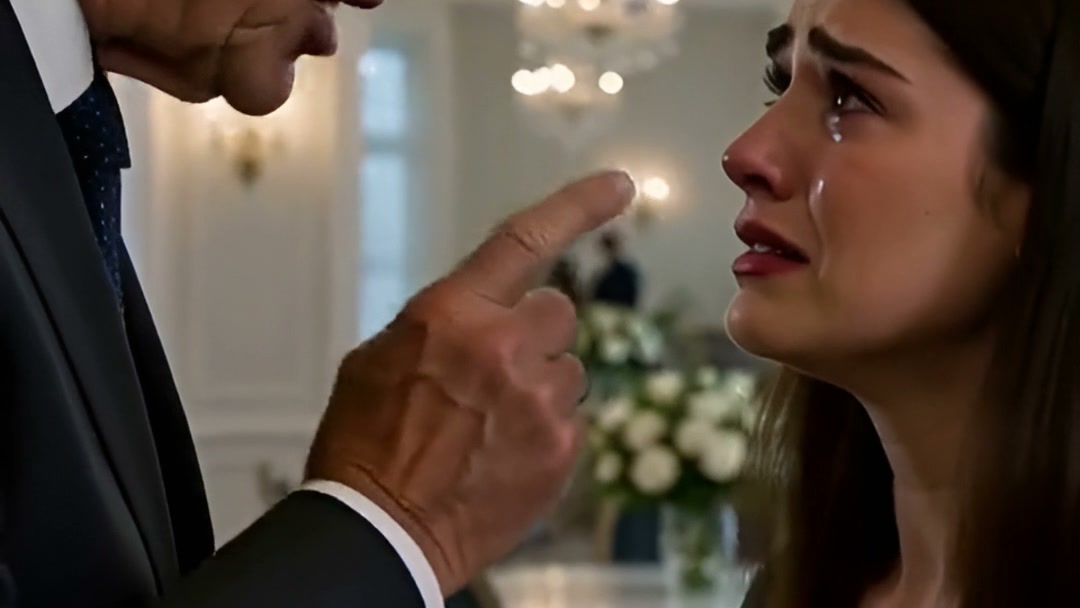
The billionaire caught an appraiser’s wrist before he could humiliate a young woman at a public auction… But when she described the man who gave her grandmother that ring, every expert in the room went pale.
The Whitmore Auction House smelled like old money and fresh cruelty.
Eliza Carr stood at the appraisal counter in a green cotton dress she’d ironed twice that morning. The velvet box in her hand was small and worn at the corners. She’d taken the bus for forty minutes to get here.
“Next,” the head appraiser said, not looking up.
His name was Gerald Phelps. Silver hair, wire glasses, the particular boredom of a man who has decided who matters before anyone opens their mouth. He finally looked at Eliza, then at the little box, and something moved behind his eyes. Not interest. Dismissal.
“What’ve you got?”
Eliza set the box on the counter and opened it. Inside sat a narrow gold band set with a single oval ruby, deep red as a held breath. The gold was old. The setting was unusual. She’d worn gloves when she’d polished it that morning.
Phelps didn’t touch it. He stared at it over the rim of his glasses.
“Where did you get this?”
“My grandmother left it to me,” Eliza said. “She passed six weeks ago. I was told it might be significant.”
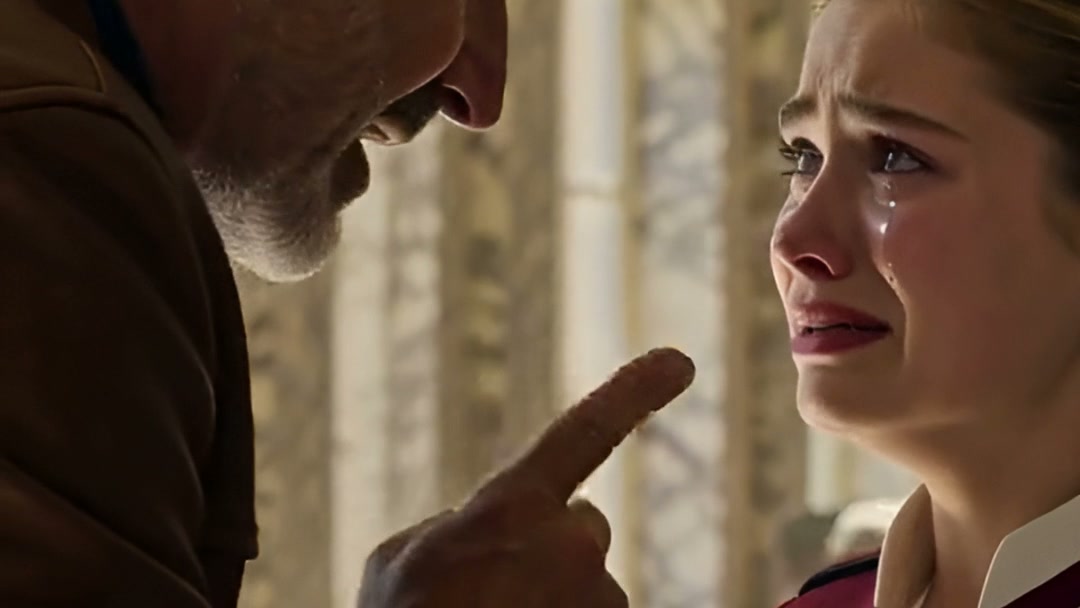
Phelps made a sound low in his throat. He picked up the box—not to examine it, she realized too late—and knocked it cleanly out of her hands. The box clattered across the marble floor. The ring skidded out. Thirty velvet chairs’ worth of auction-day audience turned to look.
“The back door,” Phelps said loudly, “is for walk-ins without appointments. People like you use the back door.”
The room went very quiet in the particular way that means everyone heard and no one intends to intervene.
Eliza’s face burned. She crouched to reach for the ring.
A hand got there first.
Not Phelps’s hand. A different one—younger, faster, in a navy sleeve with a silver cufflink. The hand caught Phelps’s wrist first, in the air, before Phelps had time to understand he’d been moving toward the ring at all. The grip was quiet and absolute.
“Let go of me,” Phelps said.
“You first,” the man said.
He was maybe thirty. Dark hair, cut clean. A navy suit that cost more than Phelps’s monthly salary but worn like he’d forgotten about it. His eyes were fixed on Phelps with the flat, polite expression of someone who has decided not to lose his temper and is succeeding only technically.
Phelps stepped back. He had no choice.
The young man picked up the ring from the marble floor, turned it once in the light, and placed it carefully back in Eliza’s palm. He folded her fingers over it.
“Take your time,” he said quietly.
“I’m sorry,” she said reflexively, then stopped herself. “I mean—thank you. I don’t know why I apologized.”
“People do that when they’ve just been made to feel small,” he said. “It’s not a character flaw.” He paused. “I’m Marcus Hale. I’m actually supposed to be buying a seventeenth-century escritoire this afternoon, but this seems more interesting.”
The name landed in the room like a stone in still water. Phelps went slightly gray. Marcus Hale was the youngest senior partner at Whitmore’s parent company. He was also, though most people didn’t know it, its largest private shareholder.
Eliza didn’t know any of that. She just saw a man who’d picked up her grandmother’s ring without being asked.
“Eliza Carr,” she said. “The ring belonged to my grandmother, Agnes Carr. She always said it was given to her by someone important, but she was very private about it. I found her letters after she died.” She paused. “The man who gave it to her was named in them. He was an artist. He said it was a commission piece—that he’d designed the setting himself—but then he became too famous for anyone to believe her, and she stopped trying to tell people.”
Marcus was watching her carefully. Around them, the salon had grown very still.
“She said his name often, toward the end,” Eliza continued. “When she was sick, she’d hold this ring and say his name like it was the answer to something. She kept a postcard he sent her. It’s dated 1959.”
She reached into her bag and produced a small clear envelope. Inside was a postcard, cream-colored, the ink faded to the color of old tea. On the back, in a cramped left-handed script, were fourteen words and a signature.
Marcus took the envelope. He read it. He read it again.
Phelps, from behind the counter, craned his neck.
“That’s not possible,” Phelps said.
“What isn’t?” Eliza asked.
Marcus looked up. His expression had changed. The flat politeness was gone.
“The artist who designed this setting,” he said carefully, “died in 1961. His estate hasn’t released any record of a commission like this. If this postcard is authentic—” He stopped.
“His entire private correspondence sold at this house,” Phelps interrupted, color returning to his face now, professional indignation reasserting itself. “Four years ago. Twelve million dollars. There was nothing about a ring. Nothing about an Agnes Carr. This is—”
“Gerald,” Marcus said.
The tone was quiet. Phelps stopped.
“Go get Renata Voss from the archives. Now. Bring her here.” Marcus handed the postcard envelope back to Eliza with both hands. “Do you have the letters?”
“At home.”
“Would you be willing to let our authentication team examine them? We’d send a courier to you—you wouldn’t have to bring them anywhere.”
“Why are you doing this?” Eliza asked. Not suspicious. Genuinely confused.
Marcus was quiet for a moment.
“Because if this is what I think it is,” he said, “your grandmother was telling the truth for sixty years and no one listened.” He looked at the ring in her hand. “And because the back door is not, in fact, for people like you. The back door is a fire exit and it’s technically supposed to be locked.”
Phelps came back with Renata Voss, the archive director—sixty, gray braids, the expression of someone permanently three days behind on sleep. She looked at the postcard through the clear envelope, looked at the ring, and looked at Marcus.
“How did we not know about this?” she said.
“We’re going to find out,” Marcus said.
Three weeks later, the authentication report came back.
The postcard was genuine. The handwriting matched the artist’s known letters—left-handed, cramped, the particular shape of his lowercase G confirmed against twelve verified samples. The ring’s setting technique matched his two known jewelry commissions from the late 1950s. The ruby was consistent with a specific lot purchased in Florence in 1958.
The estate’s lawyers called Eliza on a Tuesday morning. The ring had not been included in the official catalogue because it had been given as a private gift, outside the estate’s knowledge. Its existence was, the lawyers said carefully, “a significant discovery.”
A private collector in Connecticut offered four hundred and thirty thousand dollars before the authentication report was even published.
Eliza declined.
“I don’t want to sell it,” she told Marcus, who’d become, over the three weeks of phone calls and document scans and once a very quiet lunch in a pale-green restaurant near the auction house, something between a liaison and a friend. “My grandmother kept it for sixty years. She wasn’t keeping it because it was valuable. She was keeping it because someone she loved made it.”
“Then keep it,” Marcus said.
“The estate lawyers seem annoyed by that.”
“The estate lawyers are annoyed by everything. It’s load-bearing for them.”
She laughed. It was the first time she’d laughed in the six weeks since her grandmother had died.
The story came out anyway—a short piece in an art journal, then a longer one in a Sunday magazine, with a photograph of Agnes Carr from 1959, young and laughing, the ring on her hand. The headline was careful but clear: *A Ring, A Postcard, And Sixty Years Of A Story No One Believed.*
Phelps was quietly reassigned to a satellite office in Hartford. No announcement was made. These things rarely are.
Marcus found the postcard’s text in his head sometimes, at odd hours.
*Fourteen words. A cramped left-handed script.*
*For Agnes, who listened when I needed it most. Thank you. —R.*
Eliza had shown it to him fully, once, out of the envelope.
He thought about her grandmother holding that ring toward the end. Saying the name like it was an answer. Keeping the postcard for six decades.
Some things are not valuable because they can be sold. Some things are valuable because they are the proof that someone, once, was seen.
Eliza kept the ring. She had a small velvet box made for it—new, dove gray, the corners sharp. She kept it on her dresser where she could see it in the morning.
Her grandmother had told the truth. Now the world knew it.
That was enough. That was everything.