A Senior Boy Slapped A Little Girl — Her Sister Had Just Stepped Off The Bus
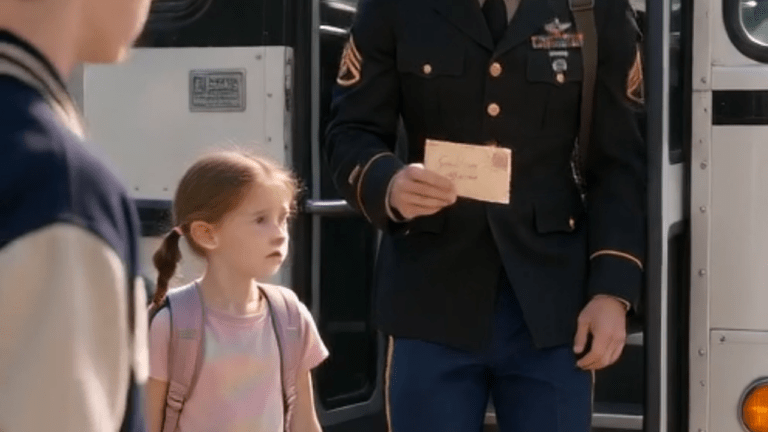
A senior boy slapped a nine-year-old girl at the school entrance in front of everyone… But her big sister had just stepped off the bus across the street — six months deployed, first day back — still holding the drawing her little sister had slipped under her door the morning she left.
The morning was ordinary until it wasn’t.
Students streamed through the main entrance of Jefferson Middle-High, backpacks swinging, sneakers squeaking on wet pavement. Maya, nine years old, stood near the railing at the top of the steps, waiting for her friend Cora, who was always exactly four minutes late.
She wasn’t bothering anyone.
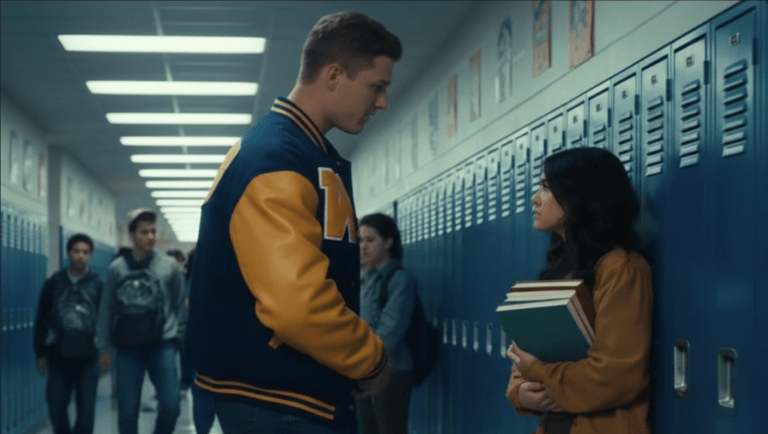
Tyler Marsh, seventeen, letterman jacket, the kind of boy who had learned early that size was a language — he came up the steps behind her and stopped. His friends were watching. That was always the reason.
“Move,” he said.
Maya stepped to the side. She’d already moved.
He slapped her anyway.
Open palm. Hard. The crack of it cut through the crowd noise like a gunshot, and for a half-second the entire entrance went silent. Maya’s hand shot to the railing. Her other hand went to her cheek. Her eyes went wide and wet but she didn’t cry — she was the kind of kid who didn’t cry in front of people, had trained herself out of it, which was its own kind of heartbreak.
Tyler’s friends laughed. Someone said, “Dude.”
Across the street, the 7:42 crosstown bus hissed to a stop.
Sergeant Rachel Dolan stepped off the bottom step of the bus and onto the sidewalk, and the first thing she did — the first thing she always did when she thought about home — was reach into her breast pocket.
The drawing was there. Still folded. Still soft at the creases from six months of handling.
She’d meant to give it back the moment she landed. Had pictured it the whole flight. Maya’s face when she saw it — *I kept this. The whole time. Every single day.*
She pulled it out. Looked at it once, the way you look at something you’ve memorized but still need to see.
Then she looked up.
She saw the railing first. Then Maya’s hand on it. Then Maya’s other hand on her face.
Then the boy in the letterman jacket turning back to his friends like it was already over.
Rachel put the drawing back in her pocket.
She crossed the street.
She didn’t run. That was the thing students would talk about later — she didn’t run. She walked, and somehow that was worse, because it meant she wasn’t panicking. It meant she had time.
The crowd at the entrance parted without being asked.
Tyler was mid-sentence to his friend when he heard the shift in the crowd and turned. He saw a woman in uniform coming up the steps, and his first instinct was to stand straighter, which told you everything about his instincts.
“Hey,” he said. “I don’t know what you think you—”
“Don’t.” Her voice was quiet. Not loud. Quiet in the way that makes a crowd go still. “Don’t finish that sentence.”
She walked past him.
She crouched down in front of Maya.
Maya’s cheek was red. Her eyes were doing the thing they did when she was fighting — jaw tight, chin up, refusing to let it out.
“Hey,” Rachel said.
“Hey,” Maya said. Her voice cracked on the single syllable.
“You okay?”
Maya looked at her for a long moment. Then she shook her head once, small and honest.
“Okay,” Rachel said. “Okay.”
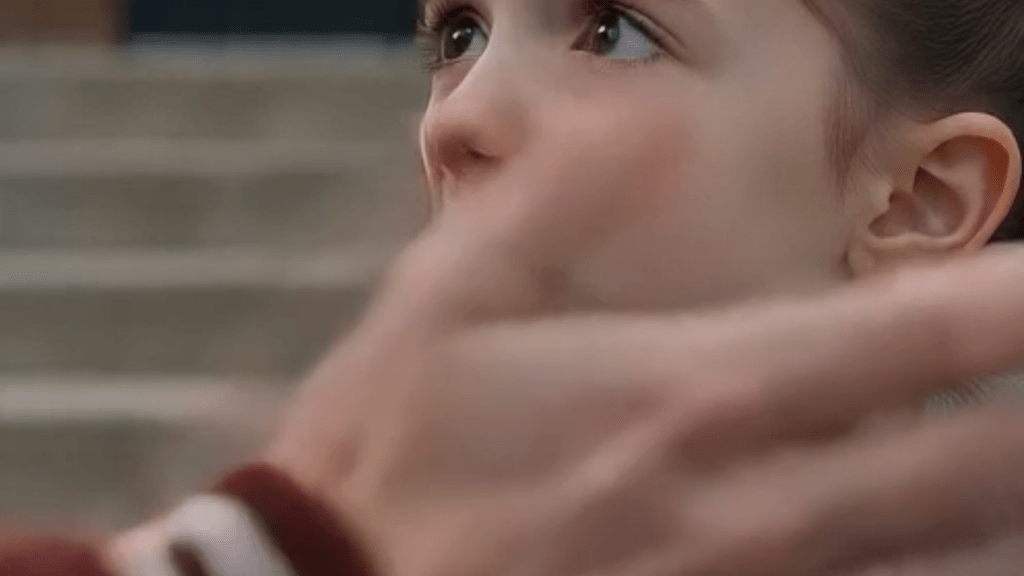
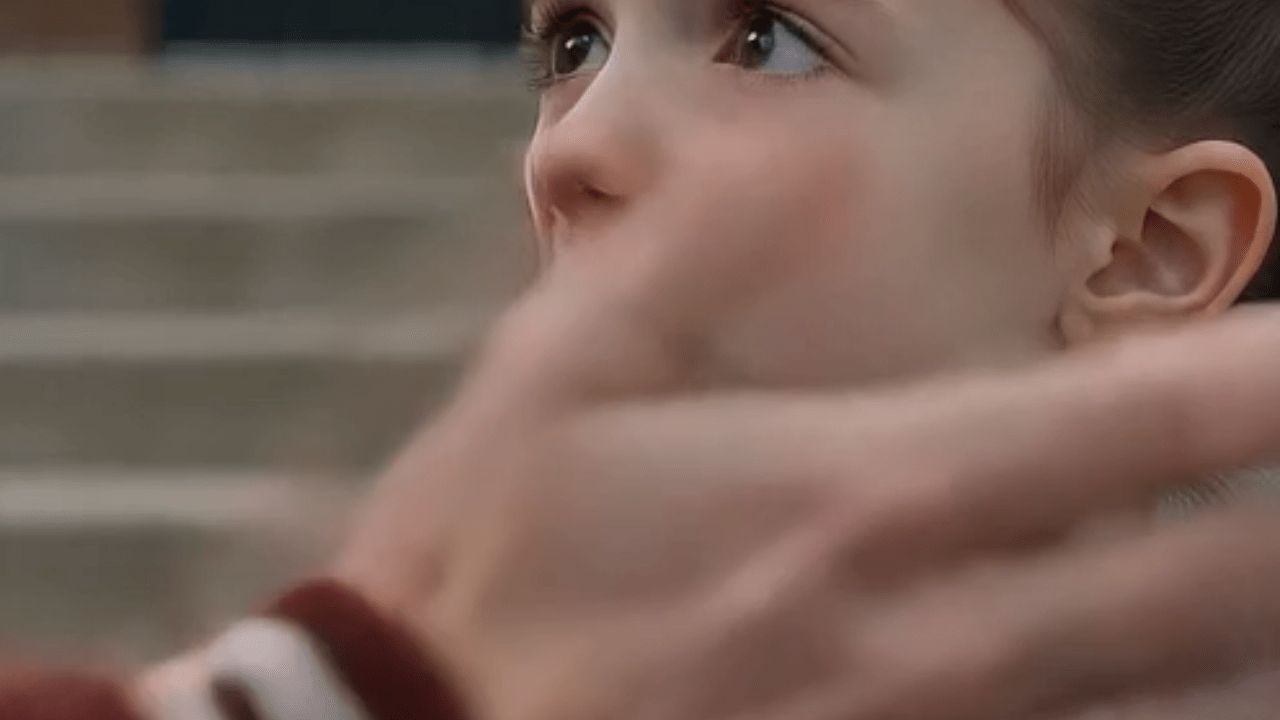
She put both hands on Maya’s face — gently, just cupping it, looking at the cheek, looking at her eyes. Then she stood up.
She turned around.
Tyler had not left. His friends had, quietly, in the way friends do when they calculate odds and find them unfavorable. But Tyler had stayed, which was either courage or stupidity, and from where Rachel was standing it looked like the second one.
“She’s nine,” Rachel said.
“It was a joke,” Tyler said. “She was in the way.”
“She’s nine years old and she was standing at a railing.”
“Look, I don’t know who you are—”
“I’m her sister.” She said it the way you state a fact. “And I’ve been gone for six months, and the first thing I saw when I stepped off that bus was your hand on her face.”
Tyler opened his mouth.
“Don’t,” she said again. “I need you to think very carefully about what you say next.”
He closed his mouth.
Principal Diane Howell had been alerted by three different students before she reached the entrance. She pushed through the crowd, already composing the liability language in her head, and stopped when she saw the uniform.
“What’s happening here?” she said.
“This student struck my sister,” Rachel said. She didn’t turn around. “Open palm. In front of approximately forty witnesses.”
Howell looked at Maya. Looked at Tyler. Looked at the red mark on Maya’s face that was already deepening to a bruise.
“Tyler,” she said. Her voice had changed.
“It was—”
“Don’t say joke,” Howell said. “I’m asking you not to say joke.”
He said nothing.
“My office,” she said. “Now.”
Tyler walked. Howell followed. The crowd began to breathe again.
Rachel turned back to Maya, who had let go of the railing and was now standing with her arms slightly out, the way kids stand when they want to be held but aren’t sure they’re allowed to ask.
Rachel pulled her in.
Maya grabbed the back of her uniform jacket with both fists and held on.
“You’re back,” Maya said into her shoulder.
“I’m back.”
“I didn’t know you were coming today.”
“I wanted to surprise you.”
Maya laughed, small and wet. “This is a weird surprise.”
“Yeah,” Rachel said. “It really is.”
They sat on the front steps while the crowd filtered inside. A teacher hovered nearby, unsure what her role was. Rachel ignored her.
“Does it hurt?” Rachel asked.
“Kind of.”
“On a scale.”
“Like a four,” Maya said. “Maybe a five.”
“Okay.” Rachel nodded. “We’re going to get it looked at. And then we’re going to talk to Mom. And Tyler Marsh is going to have a very bad week.”
“How do you know his name?”
“I heard someone say it.”
Maya looked up at her. “What are you going to do?”
“Nothing dramatic,” Rachel said. “I’m going to let the school handle it, and then I’m going to make sure they actually do.”
“And if they don’t?”
Rachel looked at her. “Then I’ll make some phone calls.”
Inside Howell’s office, Tyler sat across from the principal with his parents on speakerphone. His father’s voice had gone flat and careful, the tone of a man doing math.
Howell laid it out plainly. Witnessed assault. Documented injury. Military servicemember present at scene. Forty student witnesses.
“He’s never—” his mother started.
“Mrs. Marsh,” Howell said. “I have a nine-year-old with a bruised cheek and a camera on that entrance that caught all of it. I need you to understand where we are.”
The line went quiet.
“Suspension is mandatory,” Howell said. “We’ll discuss the rest when you’re here in person. This afternoon.”
Tyler stared at the desk.
“Tyler,” his father said, voice stripped of everything. “Not a word. Not one word.”
Rachel sat with Maya in the nurse’s office while the nurse documented the injury with photographs and a written report.
“This goes on record,” the nurse said to Rachel. “And I’m recommending a police report as well, given her age and the nature of the contact.”
“Good,” Rachel said.
Maya was eating a small bag of crackers the nurse had produced from somewhere, with the focused energy of a child who had decided the crisis was over and it was time to eat.
“Can I go to class after this?” Maya asked.
“Do you want to?” Rachel said.
Maya thought about it. “Yeah. I don’t want to miss the science thing.”
“Then yeah. After.”
The police report was filed that afternoon. Tyler Marsh received a ten-day suspension and was removed from two leadership positions — student council vice president, and captain of the junior varsity lacrosse team — pending a disciplinary review. His parents met with Howell for two hours. His father did not speak to him on the drive home.
The school sent a letter to all families that evening. It used the words *unacceptable* and *zero tolerance* and *community standards.* Three parents called to say it wasn’t enough. One called to say it was too much. Howell stopped answering her personal phone at seven PM.
That night, Rachel sat on the edge of Maya’s bed while their mother made dinner downstairs — something with garlic, something that smelled like every homecoming Rachel had ever imagined.
Maya was cross-legged on the bed, still in her school clothes, watching Rachel with the focused attention of someone who has been waiting a long time and is now making up for it.
“I have something for you,” Rachel said.
She reached into her breast pocket.
The drawing came out soft and worn at the folds, the crayon colors still bright — two figures, one tall, one small, both with yellow hair and enormous hands, standing in front of a house with a lopsided sun in the corner. Maya had written their names in careful, five-AM handwriting. *Rachel. Maya.*
She held it out.
Maya stared at it.
“You kept it,” she said.
“Every day.”
“I drew that at like five in the morning. I didn’t even know if you’d want it.”
“I wanted it,” Rachel said. “I carried it the whole time.”
Maya took it carefully, both hands, the way you hold something that has been somewhere and come back.
“I was going to give it back to you the second I stepped off the bus,” Rachel said. “I had it out and everything. And then I looked up.”
Maya looked at her. “You put it away.”
“I needed both hands.”
Maya laughed — a real one this time, full and unguarded. Then she leaned forward and put her arms around her sister’s neck and held on, and Rachel held her back, and downstairs the garlic smell got stronger and their mother called up that dinner was ready and neither of them moved for a long moment.
“I’m glad you’re home,” Maya said.
“I’m glad I’m home too.”
“Even with the weird surprise?”
“Especially with the weird surprise.”
Maya pulled back and looked at the drawing in her hands. Then she looked up.
“You can have it back,” she said. “If you want.”
Rachel shook her head. “It’s yours. I just wanted you to know I kept it.”
Maya nodded slowly. She smoothed the paper against her knee, pressed the folds flat, and set it carefully on her nightstand — propped against her lamp where she could see it.
“Okay,” she said. “But I’m keeping it right here so you can see it too.”
Rachel looked at it there — the lopsided sun, the enormous hands, the two names in careful crayon.
“Deal,” she said.