Senior Boy Slapped a 9-Year-Old — Then Her Brother Walked Around the Corner
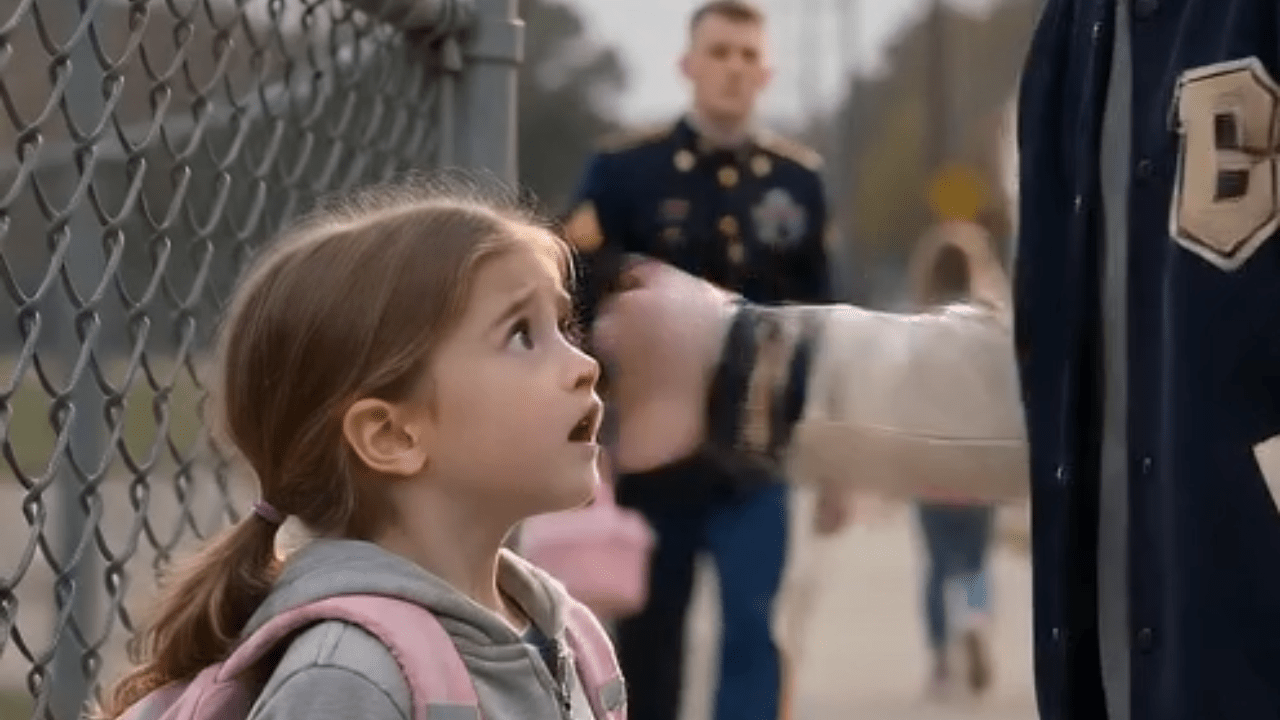
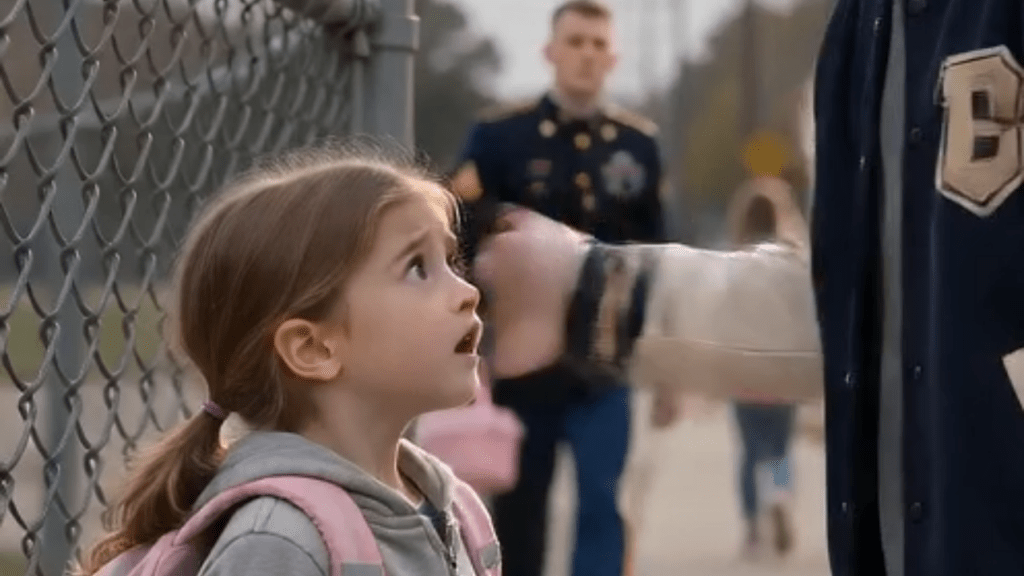
A senior boy slapped a nine-year-old girl hard across the face at the school gate… But her big brother had just rounded the corner in his Army dress uniform — first day home — still carrying her forgotten lunch box.
The morning was ordinary until it wasn’t.
Emma stood at the school gate the way she always did — backpack straps pulled tight, sneakers scuffing the concrete, waiting for the crossing guard to wave the kids through. She was nine. She was small. She was alone for exactly ninety seconds.
That was enough.
Tyler Marsh was seventeen, broad-shouldered, wearing his letterman jacket like it was armor. He’d been at Jefferson High long enough to know nobody stopped him. Teachers looked away. Kids moved aside. He walked through the world like it owed him passage.
He stopped beside Emma.
Nobody knows what she said, if she said anything at all. Maybe she was just standing in the wrong spot. Maybe that was the whole reason.
His open hand connected hard across her cheek.
The sound cut through the morning noise — through the idling cars and the crossing guard’s whistle and the low chatter of a hundred kids. Sharp. Flat. Unmistakable.
Emma stumbled sideways into the chain-link fence, her hand flying to her face, her backpack swinging with the momentum. She didn’t fall. She caught the fence with her free hand and held on.
Tyler laughed — a short, dismissive sound — and walked through the gate.
A few kids nearby froze. One girl covered her mouth. A boy in a red jacket took a step forward, then stopped. Nobody moved. Nobody said anything.
Emma stood at the fence with her hand pressed to her cheek and her eyes wide and bright with tears she was fighting too hard to shed.
Around the corner of Birchwood Street, twenty-two-year-old Caleb Harris was walking.
He’d come off the bus at 5:47 AM, duffel on his shoulder, dress uniform pressed the way the Army had taught him to press it — sharp creases, brass buttons, the kind of appearance that meant something. Fourteen months overseas. Two tours. A handful of things he’d carry quietly for the rest of his life.
He’d walked in through the front door of the house at six AM and his mother had been asleep and the kitchen had been quiet and Emma had already left for school.
He’d stood in the kitchen for a moment, just standing, the way you do when you’ve been somewhere loud for a very long time and suddenly there’s nothing but the hum of a refrigerator and the smell of coffee his mother had set on a timer.
Then he’d seen the lunch box on the counter.
Pink. Plastic handle. A small sticker of a horse on the front that Emma had put there in second grade and refused to remove. He’d picked it up without thinking about it, because the school was four blocks and he hadn’t seen his sister in fourteen months and he thought he’d surprise her.
Four blocks on foot. First day back. Pink lunch box.
He rounded the corner of Birchwood and Jefferson and the school gate came into view and he saw her immediately — because she was his sister and he’d spent fourteen months learning to find the thing that mattered in a landscape fast.
He saw her hand on her face.
He saw the fence she was leaning against.
He saw the boy in the letterman jacket walking away through the gate, still laughing at something, hands loose at his sides.
Caleb stopped walking.
He looked down at the lunch box in his right hand.
He looked back up at his sister.
He crossed the distance between them in twelve steps.
Emma heard the footsteps and turned, and for a half second she didn’t understand what she was seeing — the uniform, the brass, the pressed creases — and then she understood all of it at once.
“Cal—” Her voice broke on the single syllable.
He crouched down to her level, right there on the sidewalk in his dress uniform, and he looked at her face — the redness blooming across her cheek, the brightness in her eyes — and something in his expression went very quiet and very still.
“Hey,” he said. Soft. “Hey, I’ve got you.”
She grabbed the front of his uniform jacket with both fists and buried her face against his shoulder and the tears she’d been holding back came out all at once, hard and fast, the way nine-year-olds cry when they’ve been trying very hard not to.
He held her. One arm around her back, the pink lunch box still in his other hand.
The crossing guard had seen it. Two mothers near the curb had seen it. A cluster of kids at the gate had gone completely silent.
Caleb stood up slowly, Emma still holding his jacket. He looked through the chain-link fence at the school yard. Tyler Marsh was twenty feet inside the gate, standing with two other boys, saying something, gesturing, the letterman jacket catching the morning light.
Caleb looked at the crossing guard — a heavyset man named Dennis who’d been at this gate for eleven years.
“Did you see that?” Caleb asked. Quiet. Direct.
Dennis looked at him. Looked at Emma. Looked at the redness on her cheek. “I saw it.”
“What’s his name?”
Dennis hesitated for exactly one second. “Tyler Marsh. Junior. He’s done it before.” He said the last part like a confession. “I’ve reported it. Nothing—”
“I need the principal,” Caleb said. “Right now.”
He walked through the gate with Emma’s hand in his left hand and the lunch box in his right and every single kid in the school yard went quiet as he passed.
Tyler Marsh saw him coming from fifteen feet away and the laughter stopped.
Caleb didn’t stop walking toward the main entrance. He didn’t look at Tyler. He didn’t need to yet.
But Tyler looked at him — at the uniform, at the brass, at the measured, unhurried way this man walked — and something shifted in his face that hadn’t been there thirty seconds ago.
Principal Karen Aldridge was in her office when her assistant knocked and said there was a soldier at the front desk asking to see her immediately about an assault on school property.
She was in the lobby in forty-five seconds.
She saw Caleb. She saw Emma. She saw the mark on Emma’s face.
“My sister was struck by a student named Tyler Marsh at the front gate approximately eight minutes ago,” Caleb said. “In front of multiple witnesses including your crossing guard. I need to know what happens next.”
Aldridge looked at Emma. “Sweetheart, are you okay?”
Emma looked up at her brother, then back at the principal. “It hurt,” she said simply.
“I’m calling his parents right now,” Aldridge said. “And I’m pulling the gate footage. We have cameras on the entrance.”
“I know you do,” Caleb said. “I’d like to be present for that conversation.”
Tyler Marsh was pulled from first period at 8:22 AM.
He walked into the principal’s office expecting the usual — a talking-to, maybe a day’s suspension, his parents making the right noises and then taking him for breakfast after. It had worked before. It had worked twice before, according to the file Aldridge had pulled and was now holding open on her desk.
He walked in and found Caleb Harris sitting in the chair across from the principal’s desk, still in dress uniform, Emma beside him, and his own parents already there — his father in a work shirt, his mother with her arms crossed, neither of them looking at Tyler the way they usually did.
They’d been shown the footage before Tyler arrived.
The camera above the gate had caught all of it. Twelve seconds. Clear angle. No ambiguity.
Tyler looked at the screen, at the frozen frame of his own hand mid-swing.
“That’s—” he started.
“Don’t,” his father said. One word. Flat.
Aldridge laid out the consequences in a measured voice: ten-day suspension, mandatory behavioral assessment, a formal police report filed — because Emma was nine, and what the footage showed was a minor striking another minor, and the school was required by district policy to report it.
“Police report?” Tyler’s mother said, her voice climbing.
“Your son struck a nine-year-old child hard enough to knock her into a fence,” Caleb said. He wasn’t loud. He didn’t need to be. “On camera. In front of witnesses. She’s nine years old.”
The room was quiet.
“I’m not here to ruin anyone’s life,” Caleb said, and he meant it. “I’m here because my sister deserves to walk to school without someone putting their hands on her. And because if nothing happens today, he does it again next week to someone else.”
Tyler’s father looked at his son for a long moment. “You’re going to stand up and apologize to this little girl right now.”
“Dad—”
“Right now, Tyler.”
Tyler Marsh stood up. He looked at Emma. He looked at the floor. He looked at Emma again.
“I’m sorry,” he said. It wasn’t much. It was real.
Emma looked at him for a moment with the clear, unblinking assessment of a nine-year-old who has decided to take something seriously. Then she nodded once, the way someone nods when they’re accepting something without necessarily forgiving it yet — which was honest, and which was enough.
The police report was filed at 9:15 AM.
The suspension started that day.
The behavioral assessment was scheduled for the following week, and Tyler’s parents drove home in silence, and Tyler sat in the back seat looking out the window at nothing.
Caleb walked Emma to her classroom at 9:30, thirty minutes late, lunch box in hand.
Her teacher, Ms. Brennan, opened the door and looked at the two of them — the small girl with the fading mark on her cheek and the young man in the Army uniform holding a pink lunch box — and understood most of it without being told.
“We had a situation this morning,” Caleb said. “She’s okay. She’s ready.”
Ms. Brennan nodded and held the door open. “We’re glad to have you back, Emma.”
Emma stepped through the door, then turned back and looked at her brother.
“You were supposed to surprise me,” she said.
“I did surprise you,” he said.
She almost smiled. Then she did smile — full, real, the kind that reached her eyes. “You brought my lunch.”
“You forgot it.”
“You walked four blocks.”
“It’s four blocks.”
She looked at him — at the uniform, at the brass, at the brother she hadn’t seen in fourteen months — and she said, “I’m really glad you came home.”
“Me too, kid,” he said. “Me too.”
He handed her the lunch box.
She took it and walked into her classroom, and the door closed behind her.
Caleb stood in the hallway for a moment, alone, the way you stand when something has been resolved and the adrenaline is leaving and what’s underneath it is just relief.
He straightened his jacket. Checked his watch. His mother would be awake by now.
He walked back down the hallway toward the front entrance, dress shoes quiet on the linoleum, and pushed through the main doors into the morning light.
Four blocks home.
He started walking.