He Threw Her Apron On The Floor — She Was America’s Best Chef

A restaurant manager screamed at his waitress in front of a packed dining room and threw her apron on the floor… But the food critic at table seven had been eating her cooking for three years and recognized her knife roll on the way out.
The dining room at Carver’s was full on a Friday night — every table, every booth, every stool at the bar. The kind of crowd that made a manager feel powerful.
Marcus Holt felt very powerful.
“You dropped it,” he said, his voice carrying across the room. “Table nine waited twenty-two minutes for a soup that came out cold. You want to tell me why?”
Dani Reyes stood at the service station, order pad in hand, jaw tight. “The kitchen was backed up. I told Chef Ramos—”
“I don’t want excuses.” Marcus stepped closer. “I want competence. Which you clearly don’t have.”
The room had gone quiet. Not the polite quiet of people pretending not to listen. The real quiet — forks resting on plates, wine glasses held mid-air.
Dani kept her voice low. “Marcus, can we do this in the back?”
“No.” He pulled the apron strings from around her neck in one sharp tug. “We can do this right here.”
He dropped the apron on the floor between them.
“You’re done. Tonight. Don’t clock out — you’re not getting paid for this shift. Consider the docked wages your apology to table nine.”
Someone at the bar actually gasped.
Dani looked at the apron on the floor. She did not pick it up.
“Okay,” she said.
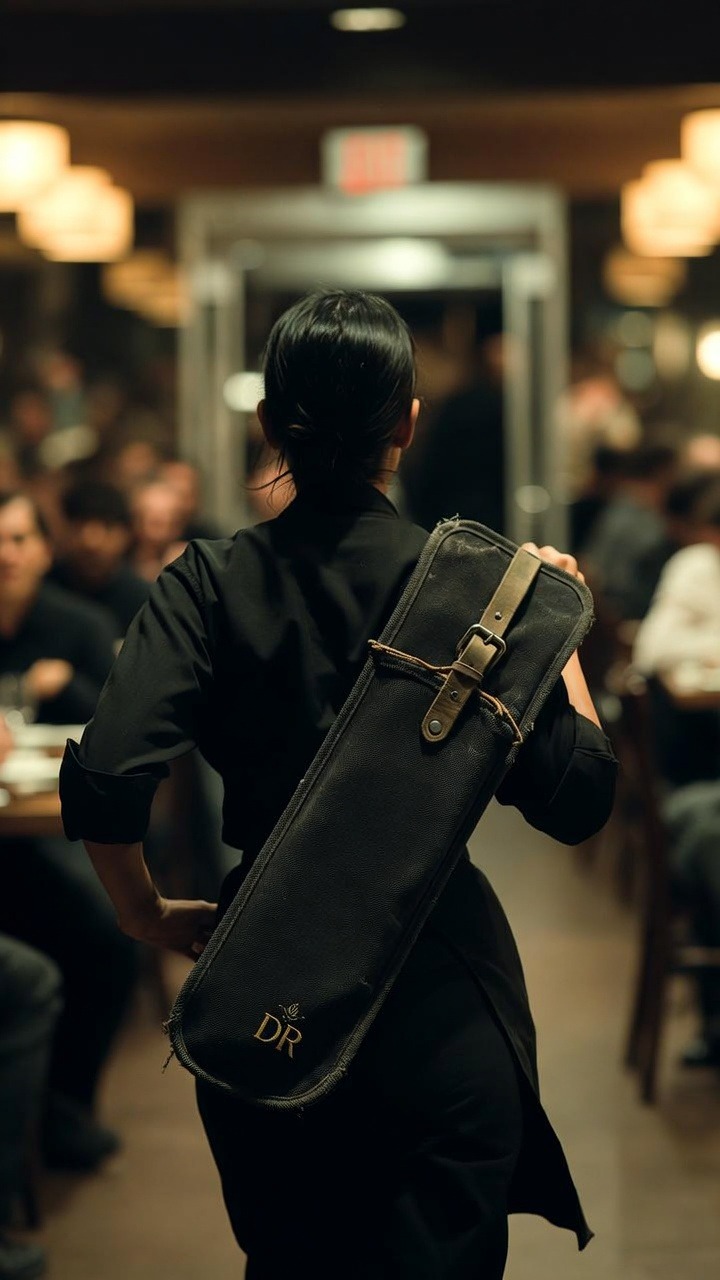
She walked to the service station, reached underneath the counter, and pulled out a black canvas roll, tied with leather cord, worn smooth at the edges. She set it on the counter without ceremony. Then she picked up her jacket from the hook by the kitchen door and walked toward the exit.
She didn’t rush. She didn’t cry.
At table seven, a man in his early fifties with reading glasses pushed down his nose looked up from his notebook. He had a glass of the Burgundy, a half-eaten plate of duck confit, and an expression that had shifted from relaxed to very, very alert.
His name was Gerald Fitch. He wrote the “Table for One” column in *The American Palate* — the most-read restaurant criticism column in the country. He had a Beard Award. He had ended careers.
He had also, for three years running, eaten at Maison Corbet in San Francisco — the number one rated restaurant in the country — and written about its Executive Chef with phrases like *”surgical precision”* and *”the most confident hand in American fine dining.”*
That chef’s name had been Danielle Reyes.
He recognized the knife roll the moment she set it on the counter. Wüsthof handles, custom leather, the small embroidered *DR* near the buckle. He had seen it in a profile photo. He had seen it in the kitchen at Maison Corbet when he’d been given a rare back-of-house tour.
He put down his fork.
“Excuse me,” he said to the server passing by. “That woman who just left — was she a waitress here?”
“Yes, sir. Dani. She just got fired.”
Gerald Fitch folded his napkin. He picked up his phone and typed one name into the search bar. The first result was a *Food & Wine* profile from eighteen months ago. The photo showed a woman in chef’s whites, dark hair pulled back, holding a knife roll with a small embroidered *DR* near the buckle.
He looked at the door she’d walked out of.
Then he looked at Marcus Holt, who was already straightening his tie and saying something to the hostess about “keeping standards.”
Gerald left three hundred dollars on the table — cash, no card — and walked out.
Dani was sitting on the curb half a block down, knife roll across her knees, texting her sister. She heard footsteps and looked up.
“Ms. Reyes,” Gerald Fitch said.
She squinted. “I’m sorry — do I know you?”
“Gerald Fitch. *The American Palate.*”
A beat.
“I reviewed Maison Corbet four times,” he said. “Twice while you were Executive Chef. I called your duck press the finest thing I’d eaten in a decade.”
Dani stared at him. “You’re Gerald Fitch.”
“I am.”
“And you were at table seven.”
“I was.”
She looked down at her knife roll. Then she laughed — a short, disbelieving sound. “Of course you were.”
“May I ask,” he said carefully, “what you’re doing waiting tables at Carver’s?”
She was quiet for a moment. “I left Corbet eight months ago. Family stuff. My mom got sick, I moved back here to be close to her. I needed something flexible while I figured out next steps. Carver’s was hiring.” She shrugged. “It was supposed to be temporary.”
“I see.” Gerald sat down on the curb beside her, which surprised her enough that she moved her knife roll to make room. “I’m going to ask you something, and I want you to think about it seriously.”
“Okay.”
“Are you ready for next steps?”
The piece ran twelve days later.

Gerald Fitch’s column in *The American Palate* was titled: *”The Best Chef in America Was Waiting Your Table — Until Her Manager Threw Her Apron on the Floor.”*
He didn’t name Carver’s in the first paragraph. He built to it. He described the dining room, the Friday night crowd, the manager’s performance. He described the knife roll. He described watching Danielle Reyes — James Beard Award nominee, former Executive Chef of the number one rated restaurant in the country — walk out of a restaurant that didn’t deserve her.
Then he named the restaurant.
Then he named Marcus Holt.
By the time the piece went live, it had been shared forty thousand times before noon. By evening it was on the front page of three food publications and two general news sites. By the following morning, Carver’s had lost eleven corporate reservations, two private event bookings, and its standing reservation with the city’s restaurant week committee.
Marcus Holt was called into a meeting with the ownership group at nine a.m. He did not come out with his job.
Dani’s phone started ringing the morning the piece dropped. She let most of them go to voicemail.
The one she answered was from a number she didn’t recognize — a San Francisco area code.
“Dani.” It was James Corbet himself. Owner of Maison Corbet. She hadn’t spoken to him since she’d left. “I read the piece.”
“Everyone read the piece.”
“I want you to come back. Your position. Your kitchen. Same title, better contract, and we’ll work around whatever you need for your mother.”
She sat with that for a moment. Through the window of her apartment she could see the street, ordinary and morning-quiet.
“I’ll need to think about it,” she said.
“Of course.” A pause. “Dani. I’m sorry we didn’t make that offer when you left.”
“Yeah,” she said. “You should have.”
She hung up. She looked at her knife roll on the kitchen table.
Then she called him back and said yes.
Three weeks later, Dani Reyes returned to the kitchen at Maison Corbet. Her first night back, she plated a duck press that made her sous chef tear up.
Gerald Fitch was at table four. He had not told her he was coming.
When the plate arrived, he cut into it, tasted it, and wrote one word in his notebook.
*Perfect.*
Marcus Holt, meanwhile, applied to four restaurant management positions over the following month. Each one ran a standard background check, which included a basic Google search.
Every one of them passed.