He Was Reading Her Letter When It Happened Three Feet In Front Of Him
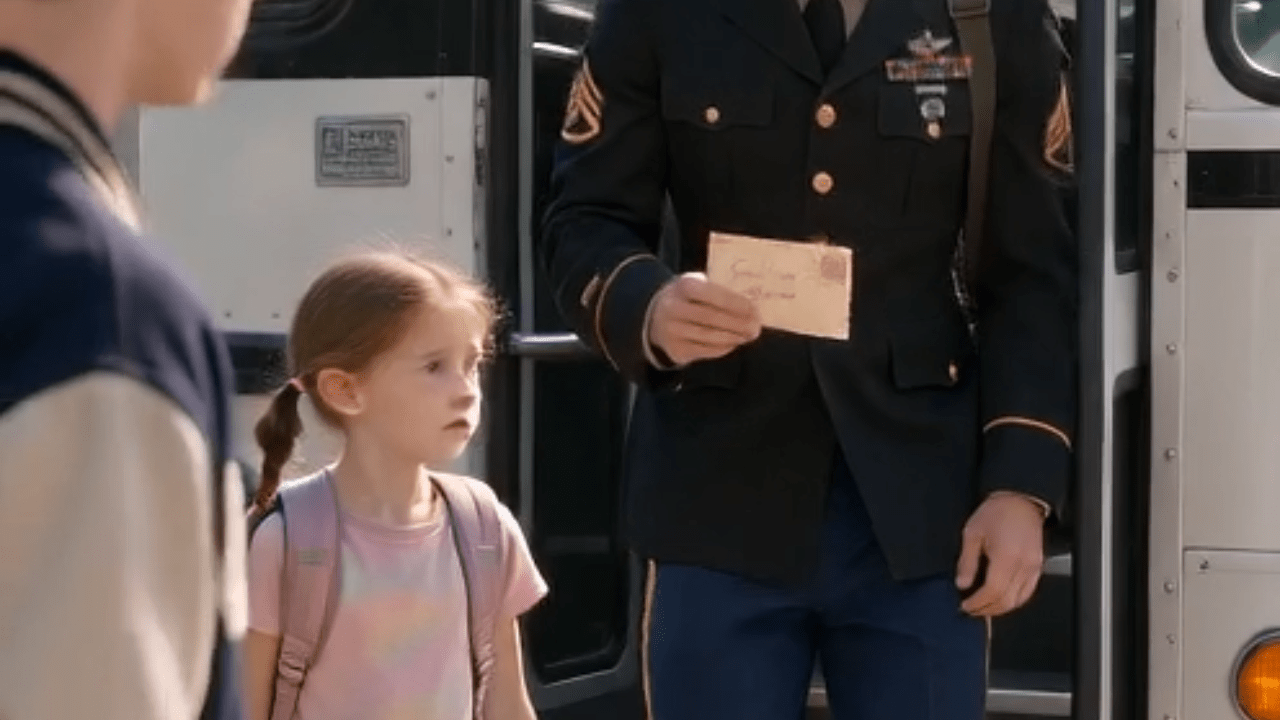
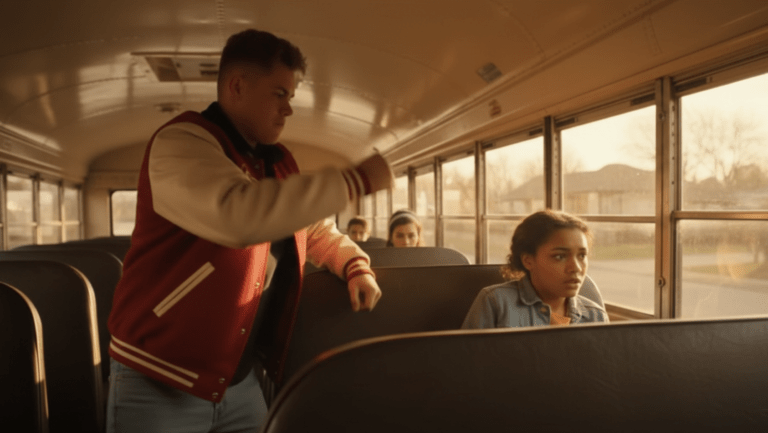
A senior boy slapped a nine-year-old girl the moment she stepped off the bus — but her big brother had been sitting three feet behind her, reading her letter, when it happened.
The letter had arrived at the base eight days ago.
He’d saved it for the ride home. That was the thing about Mia’s letters — they weren’t something you rushed. She drew small pictures in the margins. Suns with faces. Dogs that looked like clouds. She pressed hard with the pencil like every word mattered, because to her, every word did.
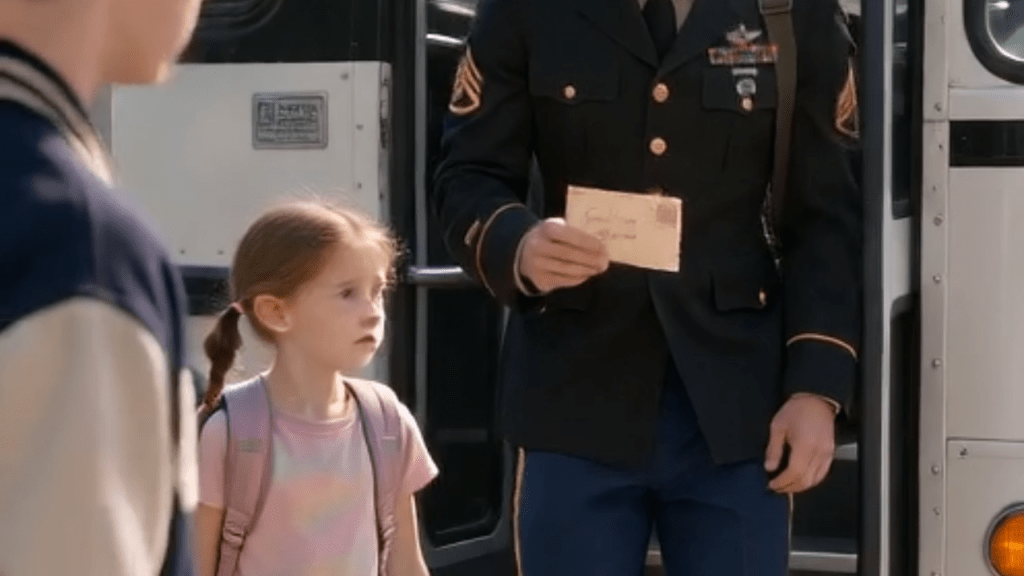
Corporal Daniel Reeves, twenty-two, sat in the back of the city bus with his duffel between his feet and his sister’s envelope in his hands. Eight months. Forty-one letters. He’d kept every one.
He was reading the last paragraph when the bus slowed to the stop on Carver Street.
*”I saved you the window seat at Thanksgiving even though you weren’t here. Mom said that was silly. I said it wasn’t. I hope you come home soon. I miss you every single day. Love, Mia. P.S. I got an A on my science project. P.P.S. I told everyone at school my brother is a soldier.”*
He folded the letter carefully. Slid it back into the envelope.
The bus doors opened.
Mia stepped off first.
Daniel was still reaching for his duffel when he heard it.
The sound was flat and sharp and wrong. The kind of sound that doesn’t belong near a school bus stop at seven-forty in the morning.
He looked up through the open door.
Mia’s head had snapped sideways. Her small hand shot out and grabbed the door frame. Her backpack swung hard off her shoulder. Her other hand flew to her cheek.
A boy in a letterman jacket stood two feet in front of her. Seventeen, easy. Big. The kind of big that knew it was big. He was already pulling his hand back, already half-smiling, already turning to say something to the two guys behind him.
Daniel looked down at the envelope in his hand.
Her handwriting. His name. The little sun she’d drawn in the corner of the return address.
He put the letter in his jacket pocket.
Stepped off the bus.
The boy in the letterman jacket was saying something. Something about the sidewalk. Something about watching where she was going. His friends were laughing, and a cluster of middle schoolers at the stop had gone completely still, the way kids go still when they know something is about to happen and they don’t know what kind.
Mia hadn’t moved. Her hand was still pressed to her face. She hadn’t cried yet. She was doing that thing little kids do when they’re trying to decide if it’s safe to cry — looking around first, checking the landscape.
She turned.
She saw Daniel.
Her face broke open completely.
“Danny—”
He was already moving.
He didn’t run. He didn’t raise his voice. He crossed the sidewalk in four steps and he stopped directly in front of the boy in the letterman jacket, close enough that the boy had to tilt his head back to hold eye contact.
The boy’s smile flickered.
“Whoa — hey, man, I didn’t—”
“You hit my sister.” Daniel’s voice was level. Completely level. That was the thing that made the middle schoolers take a step back. Not volume. Not anger. Just the flatness of a man stating a fact he already knows the answer to.
“She walked into me, I barely—”
“You hit a nine-year-old girl.” Same tone. Same volume. “At a school bus stop. In front of witnesses.”
The boy looked at his friends. They had stopped laughing.
“Look, it was an accident, I didn’t even—”
“What’s your name.”
The boy blinked. “What?”
“Your name.” Daniel didn’t move. “And what school.”
“I’m not telling you my—”
“Okay.” Daniel took out his phone. Turned slightly. There were six kids within ten feet, all of them with phones, all of them already recording — had been since before he stepped off the bus, probably. He looked at the nearest one, a girl in a yellow jacket, maybe thirteen. “Did you get that on video?”
She nodded fast. “The whole thing. From when she stepped off.”
“Thank you.” He turned back to the boy. “So we have video. We have witnesses. And my sister is nine years old with a red mark on her face.” He paused. “You want to tell me your name now, or do you want me to walk into every school within four blocks until I find the one with your picture on the wall?”
The boy’s name was Tyler Marsh. He went to Westfield High, three blocks north. He was a junior, not a senior, though he carried himself like he’d already decided otherwise.
He gave the name. He gave the school. He gave it quickly, with his friends watching, with six phones still raised, with Mia standing five feet away pressing her face against Daniel’s arm.
“Here’s what’s going to happen,” Daniel said. “You’re going to walk to school. You’re going to go to the principal’s office before first period and you’re going to tell them what you did. Exactly what you did. Not an accident. Not she walked into you. What you did.”
Tyler said nothing.
“If you don’t,” Daniel said, “I have six videos, a witness list, and eight months of free time to make sure every administrator, school board member, and parent in this district knows your name and your face. Are we clear?”
Tyler nodded. Once. Small.
“Go.”
He went. His friends went with him, not laughing anymore, not looking back.
Daniel crouched down in front of Mia.
She had her backpack strap in both hands, twisting it. Her cheek was still red. Her eyes were wet but she hadn’t let them spill yet, still holding on, still being brave in that exhausting way small kids are brave.
“Hey,” he said. “Let me see.”
She turned her face. He looked at her cheek. He pressed his lips together once, then let it go.
“Does it hurt?”
“A little,” she said. Then: “You were on the bus.”
“I was on the bus.”
“I didn’t see you.”
“I was in the back. I was reading your letter.”
Her chin wobbled. “Which one?”
“The last one.” He reached into his jacket pocket and held up the envelope. She could see her own handwriting on it. Her little sun in the corner. “I saved it for the ride.”
She stared at it for a second. Then she wrapped both arms around his neck and held on.
He held on back. One hand on her backpack. One hand on the back of her head.
“I told everyone you were a soldier,” she said into his shoulder.
“I know. I read it.”
“Are you mad I told?”
“I’m real proud you told.”
She pulled back and looked at him. Her eyes were dry now. She’d decided.
“Is he going to get in trouble?”
“Yes.”
“For real trouble? Not just a talking-to?”
“For real trouble.”
She seemed to weigh this. Then she nodded, satisfied, the way nine-year-olds are satisfied when justice has been confirmed by a reliable source.
“Okay,” she said. “Can you walk me to school?”
“That’s why I’m here.”
Tyler Marsh did go to the principal’s office. He did it before first period, the way Daniel said. Whether it was the six videos, the witness list, or something that happened in the four blocks between the bus stop and Westfield High’s front door — something in the silence, something in the way his friends had stopped laughing — no one knew for certain.
He was suspended for five days. His parents were called. The school sent a formal letter to Mia’s family.
The girl in the yellow jacket posted the video that afternoon. By evening it had been shared four hundred times. By the next morning, twice that. Not because of the confrontation. Because of the letter in his pocket. Because someone had been close enough to read the return address and mentioned it in the comments, and then the comments had done what comments do.
*He was on the same bus. Three feet behind her. Reading her letter when it happened.*
*Her handwriting on the envelope. His name. He’d been reading it on the ride.*
*Put the letter in his pocket. Stepped off the bus. Both hands free.*
Daniel didn’t see any of it. He’d walked Mia to school, dropped her at the front door, watched her go through. She’d turned back once to wave. He’d waved back.
Then he’d gone home, sat at the kitchen table, and finished reading the letter.
*”I hope you come home soon. I miss you every single day.”*
He was home.
Three weeks later, Mia slid a new envelope across the breakfast table.
He looked at it. His name. Her handwriting. A small sun in the corner.
“You can save it,” she said, “for when you need it.”
He picked it up. Held it.
“I’ll save it for the ride,” he said.
She smiled so wide it took up her whole face.
He put it in his jacket pocket.