He Slapped an Old Man at the School Door — Then Saw the Security Badge
A teenager slapped an old man at the school entrance for walking too slowly… But the security guard who stepped outside had been watching that door for twenty years — and the old man was holding his coffee.
Every Friday morning, Walter Briggs made the same walk.
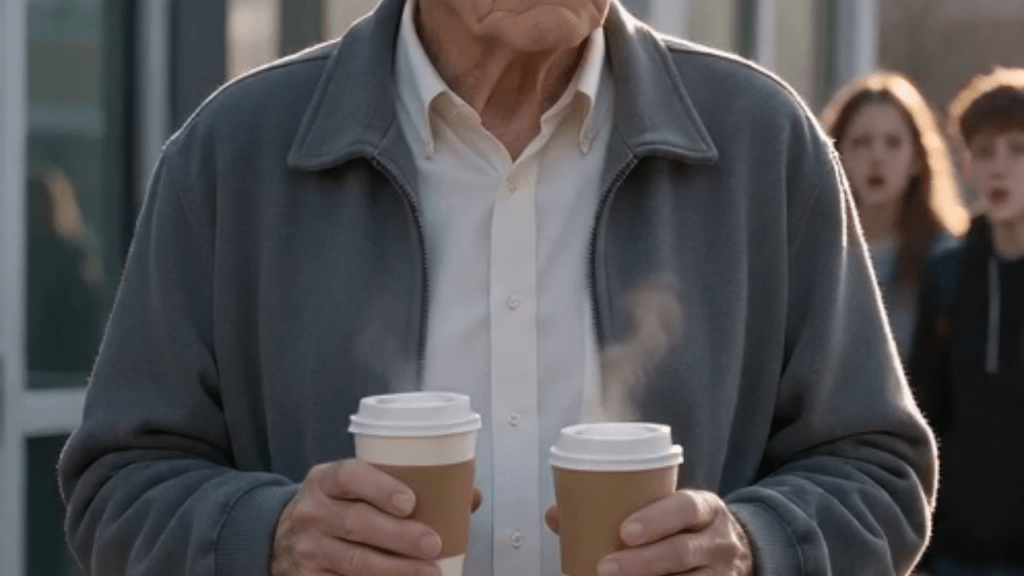
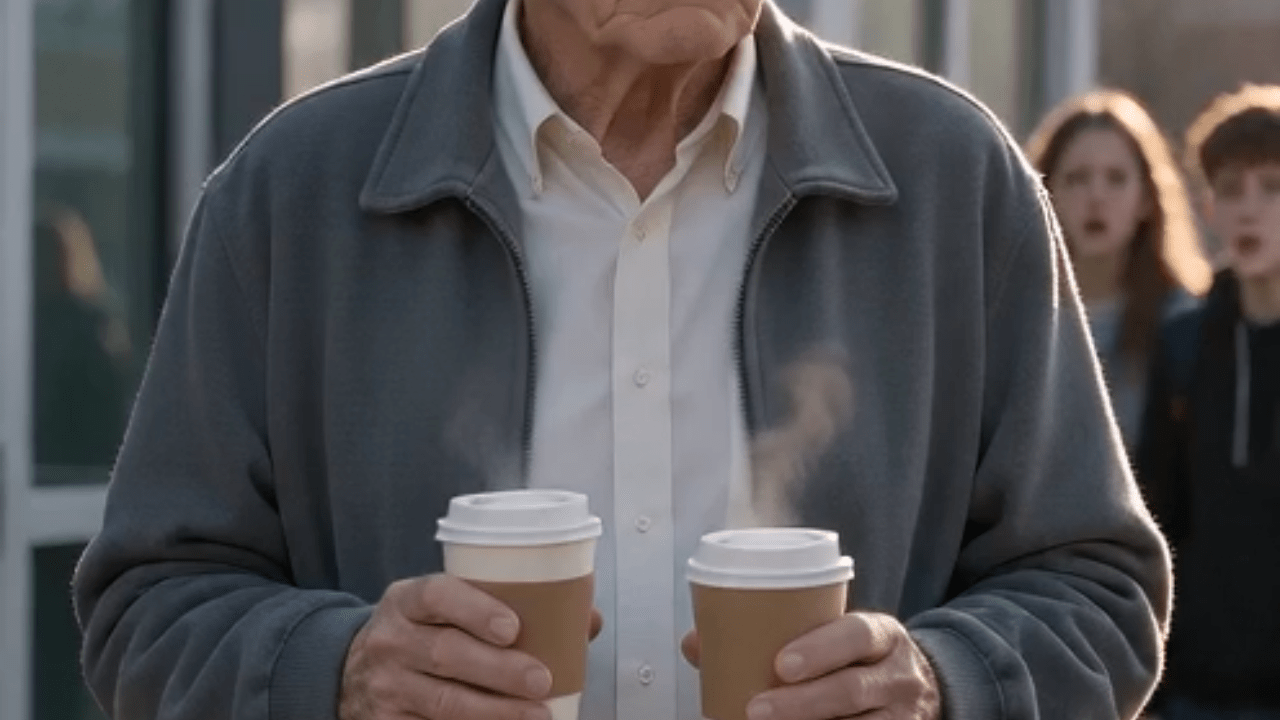
Four blocks from his apartment to the front entrance of Jefferson High. Two paper cups of coffee from the diner on Elm. One for himself. One for his son, Dennis, who had worked the security booth at that entrance for twenty-two years.
It was the only standing appointment either of them kept.
Walter was seventy-three. He walked slowly now. His knees had opinions. His back had louder ones. But he never missed a Friday, and he never showed up with just one cup.
It was 7:40 in the morning when he reached the top of the front steps.
The entrance was busy — students pushing through in clusters, backpacks swinging, earbuds in, eyes down on phones. Walter stepped to the side of the door to let a group pass. He was careful about that. He knew he moved slowly. He didn’t want to be in anyone’s way.
He was holding both cups out slightly from his body, the way you do when your hands are full and the world is moving fast around you.
He didn’t see the boy coming.
Ryan Mercer was seventeen, broad-shouldered, and running four minutes late to first period. He’d been late twice already this week. A third time meant detention, and detention meant missing practice, and missing practice meant Coach Harlan would make his life miserable.
He saw the old man near the door.
He didn’t slow down.
“Move,” Ryan said, not really to Walter, more at him — the way you say it to furniture that’s in your path.
Walter started to step aside. Not fast enough.
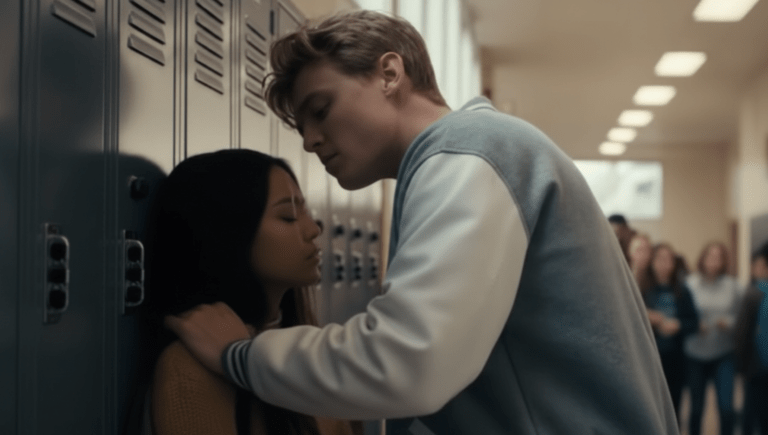
Ryan’s hand came up — open palm, sharp — and connected across the side of Walter’s face. Not a full swing. Casual. Dismissive. The kind of hit that said *you’re not worth the effort of a real one.*
One cup tilted. Coffee ran across Walter’s knuckles, soaked into his sleeve, dripped onto the concrete step.
He steadied both cups.
He didn’t drop either one.
Ryan was already through the door, already laughing at something on his phone, already gone.
Inside the security booth, Dennis Briggs had been watching the entrance monitor when the motion caught his eye through the booth window.
He stepped outside.
He saw his father first — the familiar gray jacket, the slight hunch in the shoulders, the two paper cups. Same as every Friday. Same as always.
Then he saw the coffee on his father’s hand. The dark stain spreading up the sleeve of the gray jacket. His father’s cheek, reddened.
Dennis stood very still for a moment.
Walter turned, found his son’s face, and did what he always did.
He held out the second cup.
Dennis looked at his father. At the cup. At the coffee soaking into the old man’s sleeve.
He took the cup.
He took one sip. Slow. The way his father had always told him — *don’t rush coffee, Dennis, it’s the only part of the morning that’s actually yours.*
Then he set the cup carefully on the edge of the booth counter.
And he walked toward the door.
Ryan was at his locker on the second floor when the PA system clicked on.
*”Ryan Mercer to the main office. Ryan Mercer, main office, please.”*
His friend Marcus elbowed him. “Dude. What’d you do now?”
“Nothing,” Ryan said. But something in his stomach shifted.
Dennis didn’t go to the office. He went to the hallway outside it and waited.
When Ryan came around the corner and saw the security uniform, he slowed. When he saw Dennis’s face, he stopped.
Dennis was not a large man. He was average height, average build, twenty-two years of standing at a door and watching kids walk through it. He had a calm face. People who didn’t know him thought that meant he was easygoing.
People who knew him knew better.
“You know why you’re here?” Dennis said.
Ryan shifted his backpack. “I don’t know what—”
“The man at the front entrance this morning.” Dennis’s voice was level. Completely level. “You want to try that answer again?”
Ryan looked at the floor. “I was late. He was blocking the—”
“He was standing to the side of the door,” Dennis said. “I watched the footage twice. He was not blocking anything.”
Silence.
“That man,” Dennis said, “comes to this school every Friday morning. Has for twenty-two years. Brings two cups of coffee. Walks four blocks to do it. He’s seventy-three years old and his knees hurt and he still doesn’t miss a Friday.”
Ryan said nothing.
“That’s my father,” Dennis said.
The words landed like something physical.
Ryan looked up. His face had changed — the easy arrogance gone, replaced by something younger, something caught.
“I didn’t know—” he started.
“That’s the point,” Dennis said. “You didn’t look. You didn’t see him as a person who mattered. You saw something in your way and you hit it.”
He let that sit.
“He didn’t drop the cups,” Dennis continued. “You hit him hard enough to spill coffee on his hand and he stood there and steadied both cups. You want to know why?”
Ryan didn’t answer.
“Because one of them was for me,” Dennis said. “That was the only reason he was there. To bring me coffee. And when you hit him, the first thing he did — before he even looked to see if you were still there — was make sure he didn’t drop my cup.”
Something crossed Ryan’s face. It might have been shame. It looked like it was working hard to become shame.
Principal Hargrove called Ryan’s parents that afternoon.
His mother arrived first. His father twenty minutes later. They sat across from Dennis and Principal Hargrove and watched the entrance footage on a laptop — the casual swing of Ryan’s hand, the coffee spilling, Walter steadying both cups without flinching.
Ryan’s mother put her hand over her mouth.
His father didn’t say anything for a long moment. Then: “Ryan. Look at that.”
Ryan looked.
“That man didn’t even react to you,” his father said quietly. “He just — held the cups. Like you weren’t worth reacting to.” He paused. “That should embarrass you more than anything else in this room.”
It did. It clearly did.
The school’s disciplinary outcome was formal: three days suspension, mandatory conflict resolution sessions, a written apology.
But that wasn’t the part that stayed with Ryan.
The following Friday morning, 7:35 a.m.
Walter Briggs made his four-block walk. Two cups. Same diner. Same route. His hand still had a faint mark where the coffee had burned, but it was fading.
He reached the top of the front steps.
Ryan Mercer was standing there. Not blocking the door. Standing off to the side, backpack on, hands in his jacket pockets. He looked like he hadn’t slept well.
Walter slowed.
Ryan looked at the ground, then back up. “Sir,” he said. “I’m — I wanted to say I’m sorry. In person. Not just on paper.”
Walter studied him for a moment. The boy looked younger than he had that morning. They usually did, once the posturing was gone.
“You burned my hand a little,” Walter said.
“I know. I’m sorry.”
“My son was very upset.”
“I know that too.”
Walter nodded slowly. “You know what he did when he came outside and saw me?”
Ryan shook his head.
“He took the coffee first,” Walter said. “Before he did anything else. I gave it to him and he took it.” A small pause. “That’s my boy. Twenty-two years at this door and he still takes the coffee first.”
Ryan didn’t say anything. His jaw was tight.
“Apology accepted,” Walter said simply. “Don’t do it again. To anyone.”
“I won’t,” Ryan said. And something in the way he said it — no performance, no audience, just a kid standing on a school step at 7:35 in the morning — made it sound true.
Dennis stepped out of the booth a minute later.
He saw his father. He saw Ryan walking through the entrance, head down, quiet.
Walter held out the second cup.
Dennis took it. Looked at his father’s hand — the faint mark, nearly gone.
“He apologized?” Dennis asked.
“He did,” Walter said.
“Good.” Dennis sipped the coffee. “How are your knees?”
“Terrible,” Walter said. “Same as last week.”
“You could take the bus.”
“I could,” Walter agreed. “But then I’d only need one cup.”
Dennis looked at him.
Walter looked back, completely straight-faced.
Dennis shook his head slowly. But he was smiling — the kind of smile that takes over before you can stop it.
“Four blocks,” Dennis said. “Every Friday. Terrible knees.”
“Twenty-two years,” Walter said. “I’m not stopping now.”
He raised his cup.
Dennis raised his.
They stood at the entrance together in the morning light, the way they had every Friday for twenty-two years, while the school filled up around them — and this Friday, like every Friday, neither cup was dropped.