AGT 2026’s Top 10 Auditions: Robots with Rhythm, Daring Parkour, Power Voices

Some seasons of America’s Got Talent move in slow waves. This one snaps to attention. The show’s biggest early auditions don’t just ask for applause; they demand it—through scale, surprise, and a stubborn kind of heart. Across one fast-moving hour, a robot wrangler from China makes machines groove like people, a world-class magician returns with a bigger idea, a 14-year-old from Texas earns a thundering moment with Simon, a French comic plays with language and wins, a Spanish parkour athlete pushes past what a body is supposed to do, and a Sydney singer steps out alone, chasing her own dream. The judges—Simon, Sofia, Howie, and Mel—don’t hold back. Neither do the acts.
Robots with rhythm, and a dancer who won’t blink
He walks on like a patient tactician. He tells the panel he goes by Flying Bug, he’s 26, and he’s from Sichuan, China. When Simon asks the oldest question in show business—are you going to win?—the young man takes a breath and answers with a shrug and a promise.
“Are you going to win?”
“Of course. I think no one come here that will create victory.”
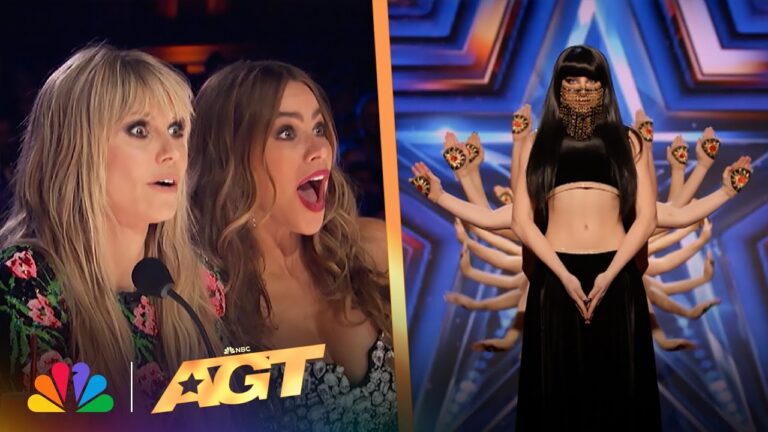
Then the curtain of expectation rips a little. “Oh, no. It’s robots,” someone blurts, and the stage tilts into the uncanny. Rows of machines snap to life. Hands lift. Bodies lock in precise angles. What could have been a cold gimmick becomes something else when the dancer takes control. He shapes the air, and the robots seem to feel it. It’s not the usual clatter. The judges catch the difference first.
“They don’t look human, but they’re they’re all staring at me right now.”
“I’ve never seen anything like this… These ones have rhythm. Yeah. It was like watching people dance, and you are amazing. The way you dance is spectacular.”
What follows is a chorus of questions and a perfectly oddball detail from the performer: yes, the metal friends have names.
“Do your metal friends have names?”
“Yes. His name is Jackie… because he really love kung fu.”
Sofia tries to adopt one on the spot—“Can I have Jackie?”—and gets a fast “No.” Then the votes fall in order: Howie, Mel, Sofia, Simon—four yeses. The theater fills with the easy grin of a surprise well played.
The return of Yoo Ho Jin, and a larger promise
Some artists don’t let go. Yoo Ho Jin comes back looking calm, measured, and fixed on the future. “I was here season 17,” he says, and then adds the only sentence that matters: “Simon told me that I needed something bigger.”
“So I bought something bigger.”
What unfolds is precise, poised, and clean. The judges watch like they’ve been caught in a well-laid trap. When it’s over, the room sounds like thunder in a box, the kind that keeps vibrating even when the noise stops. Howie leans forward, words spilling out fast.
“I have never seen a better magic act in my life. You guys deserve your own… your own hotel in Vegas.”
The act exits before the echo dies, leaving the panel reaching for superlatives that can do the work justice. The message, though, is uncomplicated. Bigger wasn’t just a promise; it was a delivery.
Lei of Texas, 14, and the hush after a note
Sometimes a talent show looks like a care station. A teenager steps out, polite, shaky, and ready. “I’m 14,” she says when asked her age. She tells the panel she waited for the year she felt most prepared. “I believe I was more ready this year,” she explains. “I definitely got better in my performances and being more confident in myself.” The kindness comes fast from the desk. “If you’re nervous, that means you’re alive,” a judge says, and then: “We have the best audience in the world.” Before the first note, there’s a brief, tender beat where she accepts a sip of water and settles in.
Then sound. Strong and sure. The room changes at once. When she’s done, Simon does not waste syllables.
“Shall I tell you honestly what I think? Words aren’t necessary.”
Mel says, “Spectacular.” Someone else, still catching up to their own goosebumps, half-jokes, “That wasn’t her singing. Right?” The desk erupts. There is a scramble near the middle of the panel, a tussle of impulse and pride. “I told him, no. I’m gonna beat her the golden buzzer, and he got up and did it,” Sofia teases. “Don’t tell him. He took her from me.” It all ends the way it should, with joy skating right past decorum. The singer disappears into the wings and then returns for the important part.
“Do you know how special you are? Well, now I hope you do because now you’re Simon’s golden buzzer. How does that make you feel?”
“Really good.”
There are moments on this stage when the show stops being a contest and becomes a proof. This was one of them.
Kev from Paris, and the punchline of a new language
Stand-up on AGT always looks scary. It is a person. A mic. And silence large enough to drown in. Kev Adams doesn’t pretend otherwise. He announces himself with humility and a wink. “I come from Paris,” he says. “I’ve been doing stand-up comedy in France for, like, fifteen years, but it’s like, I just learned English, and this is one of my first time in a big stage.” Simon laughs, “You sound pretty good to me, but what do I know?” The setup is elegant. The payoff is cleaner.
Kev’s act is really a tour through distances—geography, vocabulary, and the fine line between flirting and confusion. He opens with his name, then drives straight at the thing that could go wrong: translation. The “hang out” routine lands with the agility of a well-practiced leap between cultures, carrying him from a club in L.A. to a punchline he makes tastefully risky. He plays with travel math—“You take your car, you go to Vegas. It’s right there… I looked up on Internet. It’s a five hour drive”—and redraws the map for laughs. The taxes bit builds into a rhythmic drumbeat about suspense at the register. Then there’s the tip, and, of course, the inevitable callback:
“If you give 40%, it’s gonna be like, oh. Do you wanna hang out?”
Some jokes only work if the room trusts the person telling them. This one works. After he wraps—“That’s my time, guys. Thank you very much.”—the panel does something rarer than a belly laugh. It explains the craft.
“What you just did, people don’t know how hard it is to just stand there and talk… You’re in a whole different culture, a whole different language, and you pick up the subtleties. You are absolutely brilliant.”
Then the tag, as perfect as a bow on a setup: Kev shoots his shot—“Do you wanna hang out?”—and gets a smiling “No.” The yeses to advance are loud, and, more importantly, they’re certain.
Ruben of Málaga, and the ground remade
Parkour is a manifesto against straight lines, and Ruben Roldan writes it in motion. He steps into view with a gentle hello. He is 23, from Málaga, Spain, and he says he is nervous. A voice close to him, full of pride, frames a mission that already sounds hard-won: the limits are in our minds; he wants to travel the world and inspire people doing the thing he loves.
When the action begins, the room braces. What happens looks impossible because it is very close to that. Then the story widens. The judges, still buzzing, ask the question that’s been waiting in the wings. What happened to you? The answer is simple and heavy.
“I have an accident… I live in a countryside, so I have an accident with a tractor.”
It’s the kind of sentence that tries to undersell its own weight. The panel doesn’t let it sit there alone. Simon speaks like he’s delivering a verdict that includes the past and the future at once.
“That was bloody fantastic. I have so much respect for your talent and your courage, and I’m gonna do…”
The rest dissolves into celebration. The other judges layer on affirmations until they turn into music.
“Congratulations. Sensational. Wowza. Seriously, incredible.”
However you name it—breakthrough, coronation, or simply the loudest yes—the message to Ruben is unmistakable. He didn’t just clear obstacles on stage. He reset the course for what comes next.
Laura Dee from Sydney, and a three-minute gamble
America’s Got Talent loves to fold a family act or a duo into its brand of variety. This time, a singer from Sydney stands up on her own. “I started working with my parents,” she explains, “but I decided to come here because I wanted to kind of pursue my dream, and I feel like this is the stage where all dreams come true.” Simon gives her the line that could terrify or transform.
“Three minutes literally could change your life. Good luck.”
She uses them well. The judges praise the tone, the control, the feeling. More than that, they praise the thing that can’t be taught: the surprise. Simon spells it out as if he’s been looking for it all night.
“This is the kind of thing that I’ve been looking for. I’ve been looking for a surprise… I’ve been looking for something unexpected. You are a star, and I wanna do something special. Let me tell you something. You deserve… you deserve this.”
Whatever “this” means in the moment—applause, momentum, an open door—the singer from Sydney walks through it. One risk. One room. A different future.
Ten stories, one season: what these auditions tell us
Compilation hours make a promise. They say, here’s what this season values. The early picture from AGT 2026 is clear. It values scale—the dancer commanding an army of machines. It values craft—an elite magician returning not to redeem himself but to build on a note. It values earnest nerve—a teenager who steadies shaking hands, takes a sip of water, and then knocks the air out of the room. It values wit that travels—comedy that can cross oceans and still land with a thump of recognition. It values resilience that doubles as art—a parkour artist changing the way a crowd reads gravity. And it values singular voices stepping out of a chorus and onto their own path—the Sydney singer who came alone because the dream was always hers to test.
Threaded through everything is the judges’ posture. Simon’s mantra is public: he is “looking for a surprise.” He says it. He means it. And the panel enforces it with praise that sounds specific because it is. When Sofia tells the robot act, “These ones have rhythm,” she is arguing that novelty isn’t enough; you need soul. When Howie tries to explain why Kev’s set worked, he lands on the hard part: “what you just did… in another language… you pick up the subtleties.” When Mel says “Spectacular” to a 14-year-old who just re-ordered the emotions in the room, she is cashing in all the careful talk about nerves and turning it into belief. And when someone on the desk looks at a parkour runner and says “bloody fantastic,” the praise isn’t only about risk; it’s about form, choice, control—the quiet mechanics behind the big gasp.
These auditions also say something about where AGT sits in the culture right now. For years, the show’s best moments have come from surprise plus competence. This crop takes a step further. It adds intention. The acts don’t just show up to demonstrate; they arrive with a clear plan for what kind of moment they want to make. The robot dancer isn’t interested in a toy parade; he wants to make a crowd argue with itself about what counts as “alive” on a stage. Yoo Ho Jin isn’t just adding a bigger prop; he’s scaling his storytelling. The teenage singer doesn’t muscle a big song; she controls the air until the panel loses its need for words. Kev doesn’t hammer his accent into a punchline; he builds a joke about how languages carry culture and how cultures carry jokes. Ruben doesn’t rely on danger; he builds a vocabulary of motion and then uses it to talk back to a childhood accident.
The little things that made the big things possible
Watch closely and the show’s small gears come into focus. Before singing, Lei accepts a glass of water. It’s nothing. It’s everything. It means the adults in the room are paying attention, and it gives the teenager a second to collect herself. Kev’s set looks casual, but it is built like a bridge. He plants “hang out” early, develops it through culture and travel, then loops back at the end so the audience can feel the snap of recognition, not just the surprise of a new laugh. In parkour, Ruben’s calm between bursts becomes its own narrative. The silence after a landing is as important as the landing. Even in magic, the beat where a performer says, “I bought something bigger,” is less about the object and more about the promise of escalation. The judges hear that and tune themselves to expect the next level; the act then meets them there.
Judges’ lines also become scaffolding for the stories the acts are trying to tell. “We have the best audience in the world,” someone says early, and it’s more than a pat on the back. It’s a reminder that the crowd is a partner in what’s about to happen. “If anyone was out of sync, it was you because they were all perfect,” Sofia teases the robot choreographer, playfully reframing the rules of a dance audition. “Words aren’t necessary,” Simon says to a 14-year-old who just left the room tangled in its own feelings. In a show built on commentary, those are the moments when commentary gets out of the way.
What comes next
AGT’s early montage of excellence never tries to settle a season. It tries to set it on tilt. By the time the Sydney singer takes her bow, the outlines of what’s to come are clear enough to get excited about and blurry enough to stay interesting. There are hints of more voices stepping out with giant, lived-in songs. There are signs the show will keep rooting for the odd and the precise as much as the huge and the loud. And there’s the sense, stronger than in recent years, that the judges are not just looking for winners but for moments that can only happen once.
What you’ll find in this video is not a tidy countdown. It’s a map of a season starting to realize what it’s good at: marrying spectacle to sincerity. If you want to feel that learning happen in real time—to hear a judge run out of adjectives, to watch a comic play hopscotch across accents, to see a dancer wave his hand and make a theater believe—press play and let the night do what it does. The next great audition might still be waiting in the wings, but the bar has been set—high enough to make even a panel of veterans lean in and say it together: sensational, incredible, really wowza.