Hello, puzzle friends!
Come and sit down at a garden tea party under a big shady tree.
The table is laid with a sunny yellow cloth, a flowered teapot, pretty cups and saucers, a cake on a stand and a bowl of fresh strawberries.
Both pictures show the same happy table, but one small detail is not the same in both.
Nothing has been added and nothing has been taken away. Something has simply turned around.
Pour yourself a cup of tea, look slowly from one side of the table to the other, and see if you can catch it.
Most people need about thirty seconds for this one.
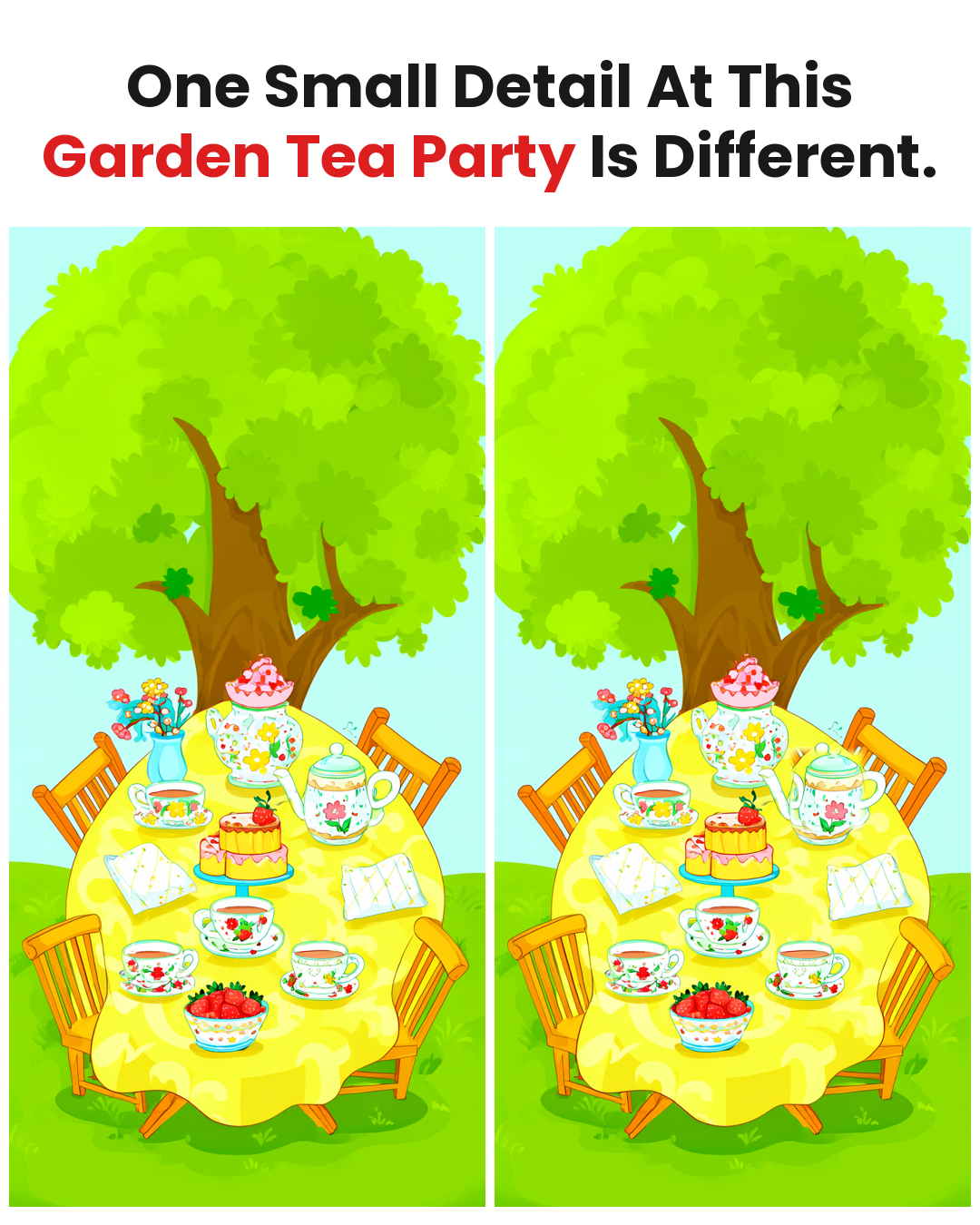
Take your time and look closely before you scroll down!
Compare Object By Object, Not Picture By Picture
The natural thing to do is to look at the whole left picture, then the whole right picture, and wait for something to feel odd. That almost never works. By the time your eyes reach the second picture, the first one has already faded into a general impression.
Instead, pick one item and compare only that item in both pictures. The flower vase. Then the big teapot. Then the cake. Then each cup in turn. Your short-term memory only has to hold one small thing at a time, and that is a job it does very well.
It sounds slow, but it is usually faster in the end, because you never have to go back and start again.
Why A Turned Object Is So Hard To See
When something changes colour, there is at least a chance that the new colour catches your eye. When something is simply turned around, nothing new appears at all. Every shape and every shade is still exactly where it was.
Our minds are also surprisingly forgiving about direction. Young children often write letters back to front, and most adults cannot say from memory which way the handle of their own kettle points. We store what a thing is far more firmly than which way it faces.
On a tea table full of round, symmetrical objects, that weakness is multiplied. Cups, saucers, bowls and plates look the same from either side, so your brain stops checking direction altogether.
A Little History Of The Tea Table
Afternoon tea became a fashionable habit in England in the eighteen hundreds, and the garden version, with a cloth on the table and cakes under a tree, followed soon after. It was a meal invented purely for company and conversation.
Puzzle pictures of tea parties have been popular for just as long. Victorian magazines loved them, because a table full of small matching china gave the artist dozens of lovely places to hide a change.
There is a pleasant irony in all this. A tea table is meant to be a place where you slow down and notice things, and that is exactly the skill this puzzle asks of you.
Your Friendly Challenge
The average time for this puzzle is around thirty seconds. Under twenty is very good, and under ten seconds is remarkable.
If the change is hiding from you, try this: look only at the objects that have a handle. Handles point somewhere, and anything that points is worth a second look.
Found it? Then share the picture with a friend over a real cup of tea and see how long they take. Say nothing, smile, and let them hunt.
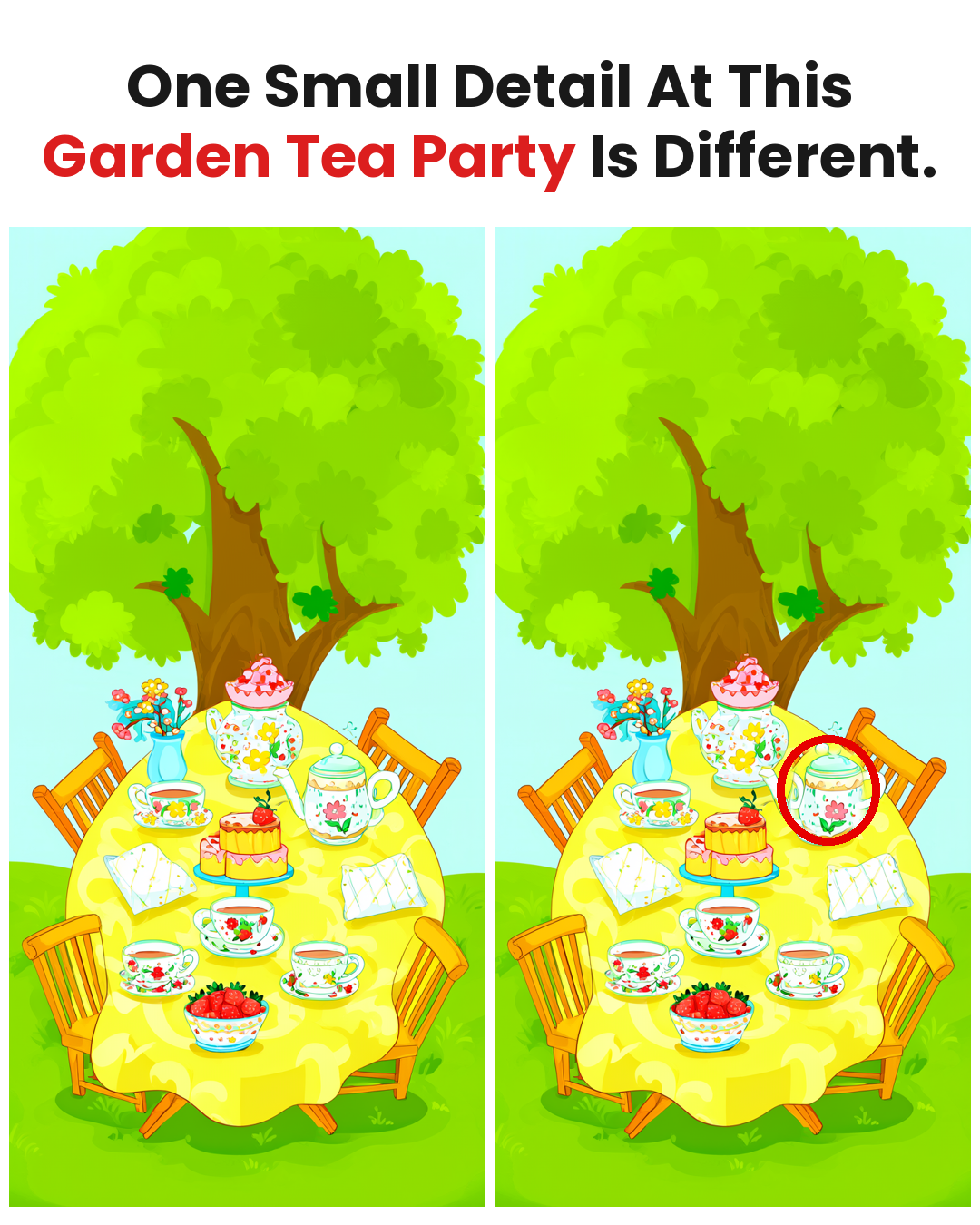
ANSWER: The small lidded teapot on the right of the table is turned the other way round – its handle and spout have swapped sides
Where The Change Is Hiding
Look at the right-hand side of the table, at the smaller teapot with the little round lid and the pink flowers painted on it.
In the first picture its handle is on the right and its spout points to the left, towards the middle of the table. In the second picture the whole pot has been turned around: the handle is now on the left and the spout points out to the right.
Everything else on the table is untouched. Same cakes, same cups, same strawberries, same flowers in the blue vase. Only that one little pot has swung around to face the other way.
Why Most People Miss It
The small pot sits right at the edge of the busiest part of the table, with a chair behind it and a cup beside it. It is also a quiet, pale object in a picture full of bright pinks, reds and yellows. The strawberries and the cake on its stand pull the eye straight to the centre.
Most importantly, the pot is still completely believable. Nobody looks at a teapot and thinks it is facing the wrong way. A pot may face any direction on a real table, so there is nothing for your sense of logic to catch hold of.
That is the secret of a good turned-around difference: it never looks like a mistake, so your eye has no reason to stop.
How Did You Do?
Under ten seconds: eagle eyes, and an unusually good memory for direction.
Ten to thirty seconds: a fine result, right at the top of the normal range.
Thirty to sixty seconds: perfectly typical. Turned objects are among the hardest changes to notice.
Over a minute: you are in good company. Try the handle trick on the next puzzle and your time will drop sharply.