Hello, puzzle friends, and welcome to the farm!
A little brown pony is standing in the field, enjoying the sunshine in front of the old red barn.
Someone has tied him up, but the rope has turned into a real tangle across the whole yard.
Four wooden posts are waiting in a row at the bottom of the picture, numbered one to four.
Only one of them is holding our pony, and the other ropes are there to lead you astray.
Follow the rope that starts on the pony and see where it finally ends.
No pens, no fingers on the screen, just your eyes – that is the whole challenge.
Choose your post, then read on to find out whether you were right.
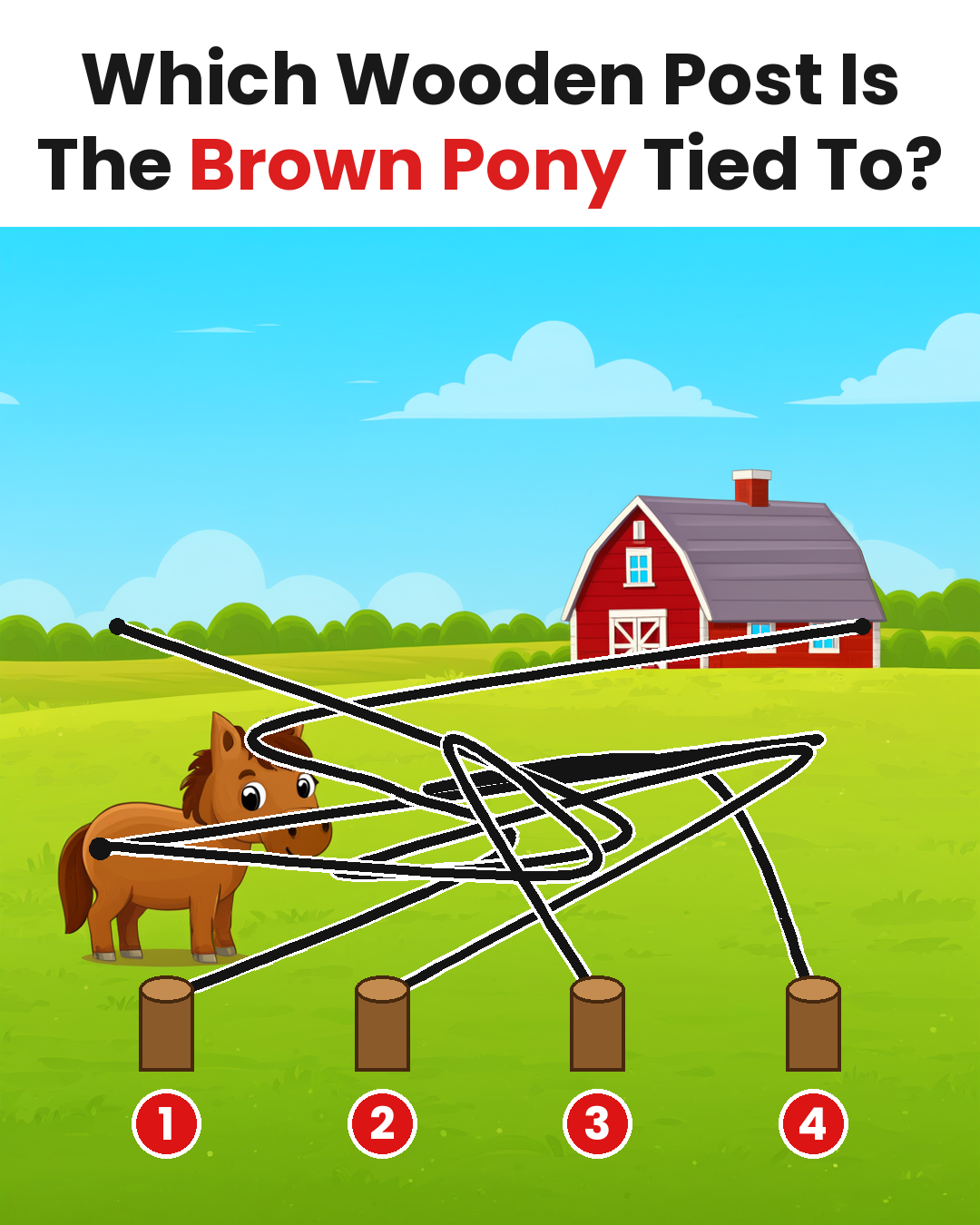
Take your time and look closely before you scroll down!
Start At The Pony, Never At The Posts
Almost everyone makes the same first mistake with a rope puzzle. They start at one of the numbered posts and try to follow that rope upwards, hoping it ends at the animal. With four posts, that approach gives you a one in four chance of picking the right starting point, and most of the time you simply waste your effort.
There is only one pony, so start there. Find the point where the rope touches the animal and follow it from that single, certain beginning.
That one change in method turns a confusing tangle into an ordinary line to follow, and it usually cuts the time you need in half.
How To Follow A Line That Crosses Itself
When two ropes cross, the eye has a strong habit of jumping onto the wrong one. The trick is to move in short steps instead of trying to take in the whole line at once.
Pick a point on the rope a little way ahead, confirm it is still the same line, and only then look further ahead. At every crossing, pause for a moment and check the direction the rope was already travelling in. A rope does not suddenly change its angle at a crossing point, so the line that continues smoothly is the one you want.
If you get lost, do not start over from the posts. Go back to the last place you were sure about and pick up the line again from there.
Why Our Eyes Get Tricked
Our vision is built for the real world, where one object usually sits in front of another. A flat drawing of crossing ropes gives the brain no depth to work with, so it falls back on guessing, and the guess is often the line that looks straightest.
There is also a limit to how much the eye can hold at one time. Follow a long winding line and the first half slips out of your short term memory before you reach the end, which is exactly why a long loop across the whole picture feels so much harder than a short one.
Tangled line puzzles like this one have been printed in children’s annuals and family magazines for well over a century, and they have never stopped working on grown ups.
The Friendly Challenge
Most people need between twenty and forty seconds to trace this rope correctly, and quite a few give the wrong answer on their very first try.
Try it as a race. Show the picture to a friend, give yourselves ten seconds each, and write down your post number before you compare. You will be amazed how often two sensible people land on two different posts.
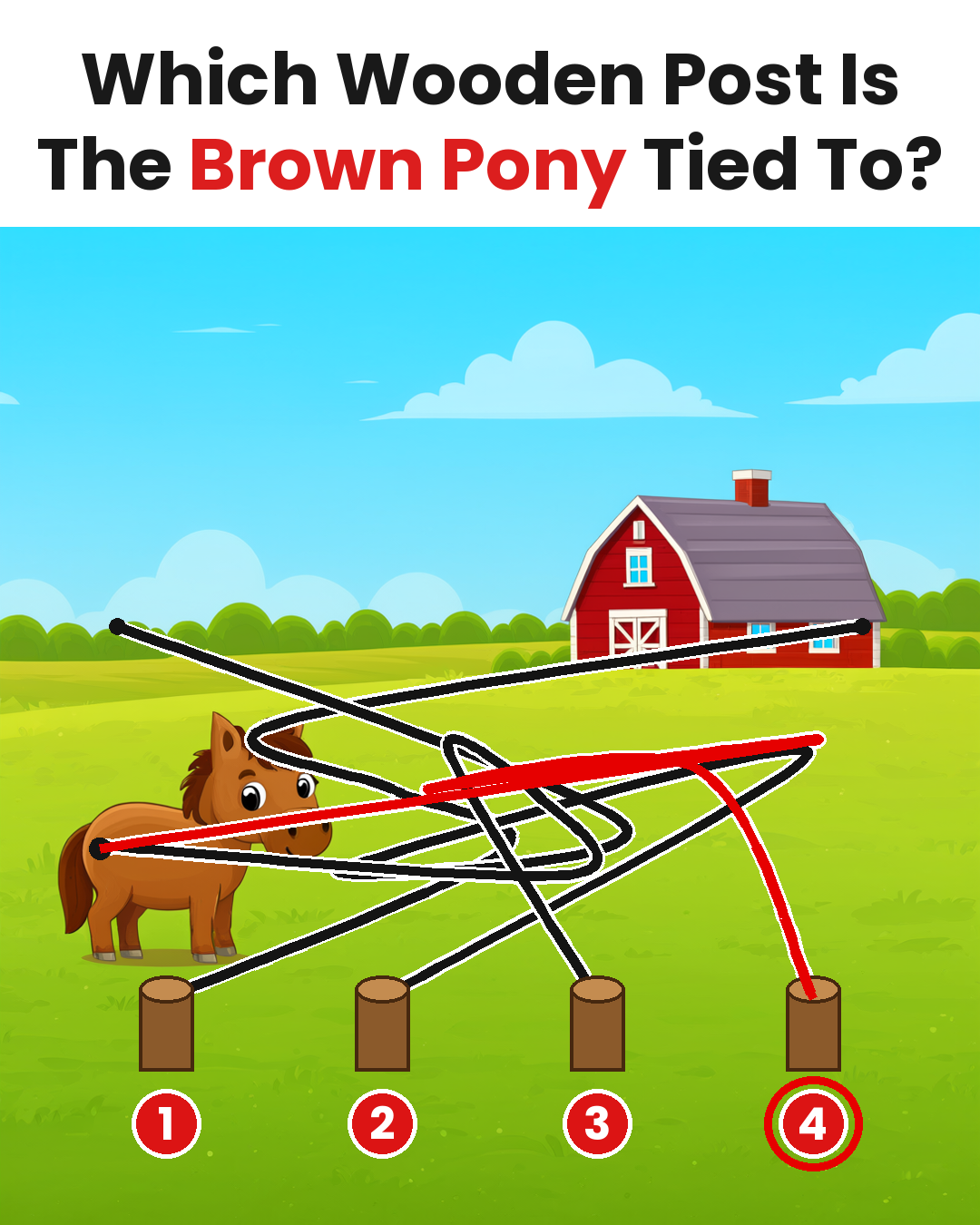
ANSWER: Post number 4 – the rope from the pony loops up to the right and comes down on the last post.
Following The Rope Step By Step
The rope that matters begins on the pony’s back, on the left hand side of the field. From there it runs almost flat towards the middle of the picture, passing under two other ropes on the way.
About halfway across it rises gently and makes a long sweep to the right, climbing up towards the barn. That rising curve is where most people lose their place, because two other ropes cross it at almost the same spot.
After the sweep it turns and comes down steadily towards the bottom right of the picture, landing neatly on the last post in the row. That is post number four.
The other three ropes never touch the pony at all. Each one starts at a loose end floating in the field or the sky, which is a useful thing to notice once you know to look for it.
Why Post One Fools So Many People
Post one is the most popular wrong answer, and the reason is simple. The pony is standing on the left of the picture, so the nearest post feels like the natural one to belong to him.
A rope really does run from near the pony down to post one, but if you look carefully it passes behind the animal rather than starting on him. Our brains are very quick to connect two things that happen to be close together, which is exactly the habit this puzzle is built to catch.
Distance in a picture tells you nothing. Only the line itself tells you the truth.
How Did You Do?
If you traced it correctly in under ten seconds, you have excellent visual tracking and you would be very hard to beat at this kind of puzzle.
Ten to thirty seconds is a strong, steady result and shows you followed a method instead of guessing.
Thirty to sixty seconds is perfectly normal, especially on a first attempt with four ropes crossing this often.
And if you chose post one, do not feel bad for a second. It is the trap that catches the greatest number of people, and now you know exactly how to avoid it next time.