Hello, puzzle friends, and welcome into the living room!
The sofa is green, the bookshelf is full, and the houseplants are doing very nicely indeed.
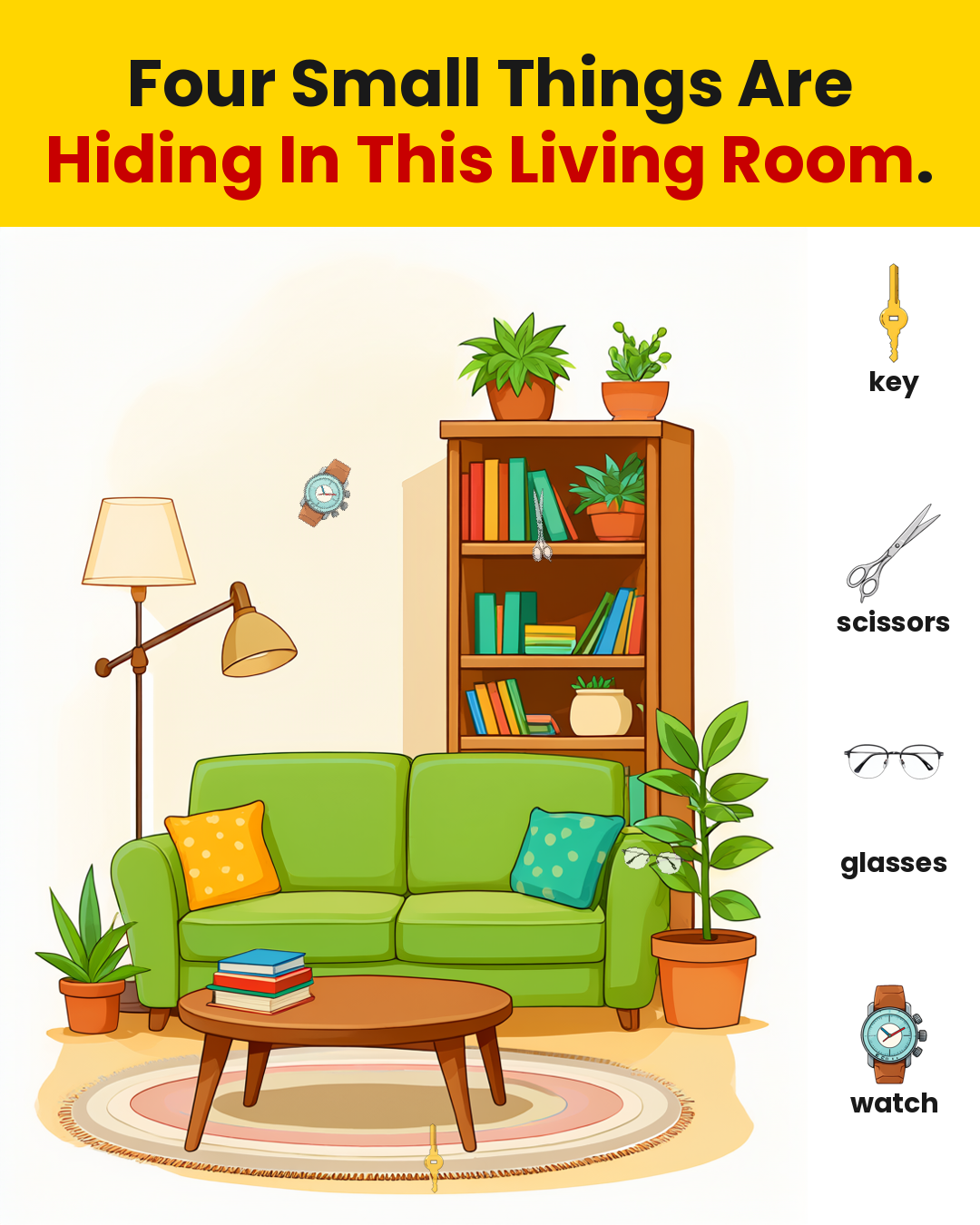
Four everyday things have gone missing in this cosy room: a key, a pair of scissors, a pair of glasses, and a wrist watch.
They are all shown down the side of the picture so you know exactly what you are looking for.
Every single one of them really is somewhere in the room, in plain sight.
Three of them turn up quite quickly, and the fourth is the one that will test you.
Find all four, then read on to see exactly where they were.
Take your time and look closely before you scroll down!
Search The Room Like A Visitor, Not Like A Camera
When we look at a picture of a room, our eyes go straight to the biggest and brightest things: the sofa, the lamp, the plants. Small objects sitting quietly in a corner never get a turn.
A better method is to divide the picture into a simple grid in your mind. Top left, top middle, top right, then the same across the middle, then the same along the bottom. Give each square a proper second or two of attention before you move on.
It feels slow, but it is far faster than drifting around the room hoping something will catch your eye, because drifting means you look at the same comfortable spots again and again.
Look For Shapes, Not For Objects
The real secret of hidden object puzzles is to search for an outline rather than a thing. Do not look for scissors. Look for two long thin blades meeting in a point, and two rounded handles.
Give each object a shape word before you start. A key is a short stem with a round loop at one end. Glasses are two circles joined by a bridge. A watch is a circle with a strap above and below it.
Once the shape is in your mind, your eyes begin to sort the picture for you, and objects that were invisible a moment ago seem to step forward on their own.
Why Clutter Hides Things So Well
Everything in this room is drawn in the same friendly cartoon style with the same kind of outline, so a small object placed among books or plants shares its edges with everything around it. Camouflage in nature works in exactly the same way.
There is also the matter of expectation. We expect a key on a hook or in a bowl, not lying on a rug. We expect glasses on a table, not pressed against the arm of a sofa. When an object turns up somewhere unexpected, the brain reads it as part of the furniture and moves on.
Hidden picture puzzles have been delighting families since the magazine and annual days of the early twentieth century, and the reason they still work is that human attention has not changed at all.
The Friendly Challenge
Most people find three of the four objects within about half a minute, and then spend just as long again hunting for the last one.
Try it with a friend or with your grandchildren. Give everyone one minute, then count up how many each person found. It is a lovely game at a kitchen table, and the last object always causes the most cheerful arguing.
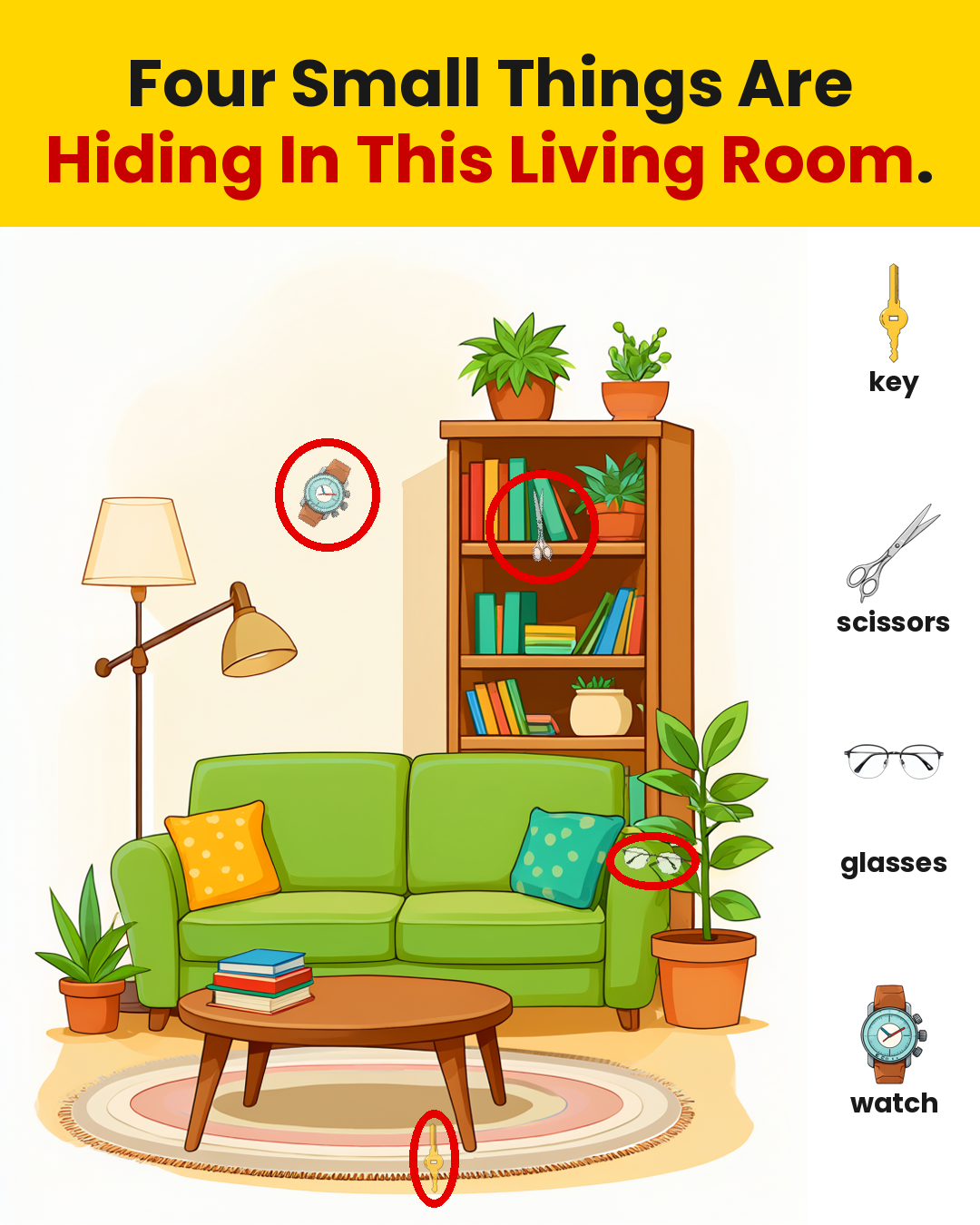
ANSWER: The watch is on the wall above the sofa, the scissors are on the bookshelf among the books, the glasses are tucked beside the sofa arm, and the key is lying on the round rug under the table.
Where Each Object Was Hiding
The wrist watch is the easiest one. It is up on the wall to the left of the bookshelf, above the back of the sofa, where the plain wall gives it nowhere to hide.
The scissors are on the bookshelf, standing among the colourful books on the upper shelf, just to the left of the little potted plant. Their silver blades line up with the edges of the books, which is why they take a moment to appear.
The glasses are tucked at the right hand end of the sofa, against the arm and partly covered by the leaves of the tall plant in the pot.
The key is the one that catches people out. It is lying flat on the round rug at the bottom of the picture, just behind the leg of the coffee table.
Why The Key Is So Easy To Miss
The key is golden, the rug is a warm cream colour, and the lamp light on the floor is warm too. Similar colours sitting together are the oldest camouflage trick there is.
It is also right at the bottom of the picture. We read images from the top down, and by the time our eyes reach the floor we are already fairly sure we have seen everything worth seeing.
And finally there is the table leg. A small object partly overlapped by a larger one almost disappears, because the brain treats the two shapes as a single piece of furniture.
How Did You Do?
All four in under fifteen seconds means genuinely remarkable eyes, and you should be rather proud of that.
Fifteen to forty seconds is a very good result and shows you searched the room in an orderly way.
Forty seconds to a minute and a half is the normal range for most people, and almost everyone spends the last stretch hunting for that key on the rug.
If you found three and had to be told the fourth, you are in the biggest group of all, and your attention was working exactly as it should.