Hello, puzzle friends, and welcome to the garden meadow!
The sun is out, the cabbages are growing nicely, and the snails have decided that today is a perfect day for a slow walk.
Your task is easy to say and much harder to do: count every single snail in this picture.
Count the big ones, count the little ones, and count the ones that are almost tucked out of sight.
Most people glance at the picture, call out a number in three seconds, and get it wrong.
A friendly hint: the large snails are only part of the family today.
Take your time, decide on your number, and then read on to see how you did.
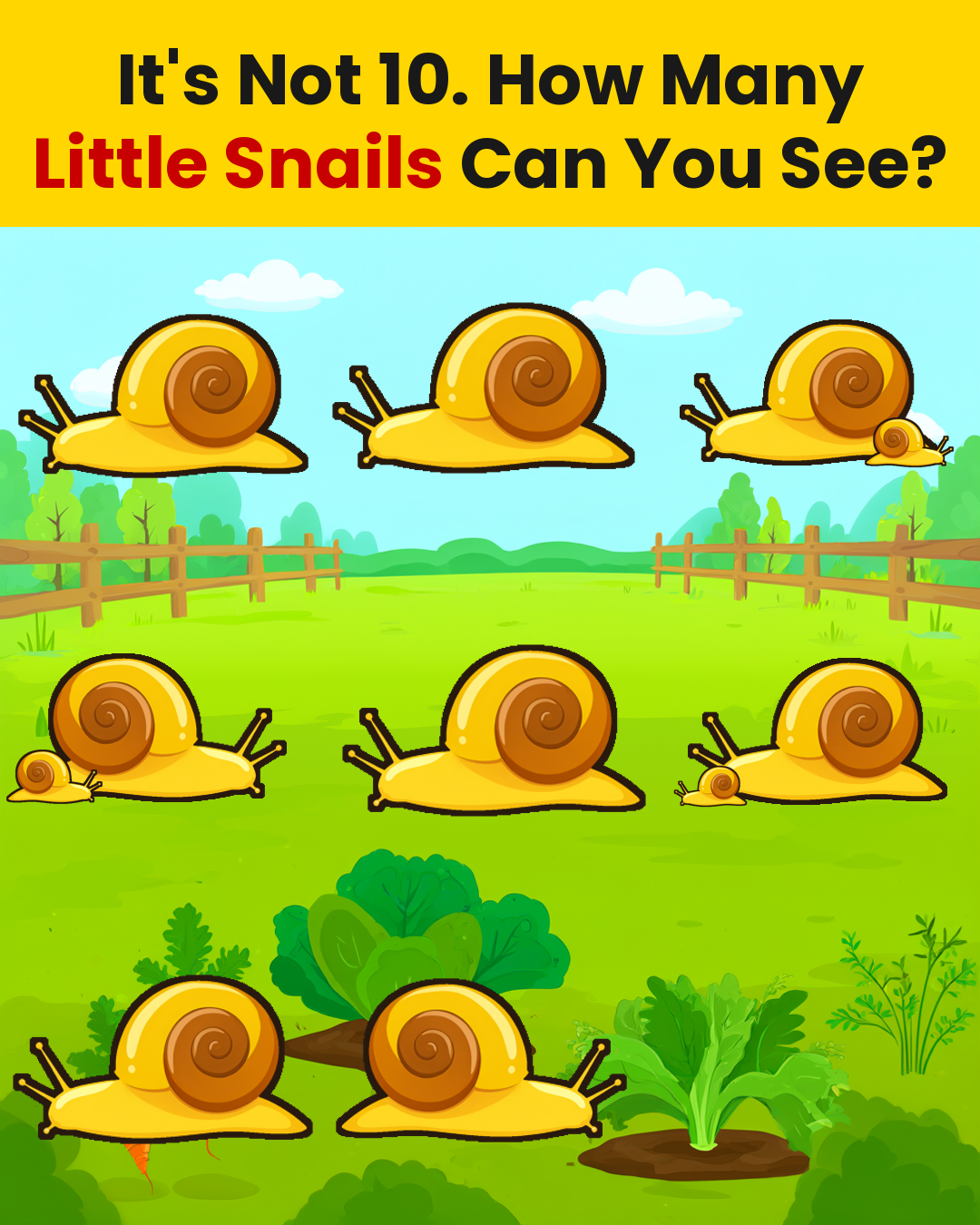
Take your time and look closely before you scroll down!
Count In Rows, Not At Random
The most common reason people get a counting puzzle wrong has nothing to do with eyesight. It is the order of counting. The eye hops about the picture, counts the same snail twice, skips another one completely, and the final number comes out wrong even though nothing was truly hidden.
The fix is simple. Give yourself a route and follow it like a road. Read the picture the way you read a page of a book: left to right along the top, then left to right across the middle, then left to right along the bottom row.
Pointing at each snail with your finger as you count sounds old fashioned, but it works beautifully. It slows the eye down just enough for the brain to keep an honest tally.
Why Our Brain Loves To Round Down
Our eyes are wonderful at spotting a pattern and terrible at checking it. Once the brain sees a tidy arrangement of large yellow shells, it decides it already understands the picture and stops looking closely. Scientists call this satisfaction of search: the moment we find what we expected, we quietly give up the hunt.
Size makes it worse. A big shape shouts for attention, so the small shapes beside it almost disappear. A tiny snail sitting right next to a large one is in the hardest place of all, because the big shell acts like a friendly umbrella hiding it.
Colour plays a part too. Warm yellow against bright green grass stands out, but a small yellow shape on a patch of light grass blends in far more than you would expect.
A Little History Of Counting Puzzles
Counting pictures are much older than the internet. Victorian newspapers printed engravings with hidden animals for families to argue over at the breakfast table, and puzzle books for soldiers and travellers used the same idea a hundred years ago.
The reason the format has lasted so long is that it is perfectly fair. There is no trick wording and no hidden rule. Everything you need is right there in the picture, which is why getting it wrong feels so funny rather than annoying.
Today these same pictures travel around the world in minutes, and millions of people cheerfully disagree about a handful of snails. Some things really do not change.
The Friendly Challenge
Most people need about thirty seconds to reach their first answer, and most of those first answers are too low. If you found them all in under twenty seconds, your eyes are sharper than average.
Here is the fun part. Show this picture to a friend or to someone in your family, let them call out their number first, and then compare. You will almost always get two different totals, and the discussion that follows is half the enjoyment.
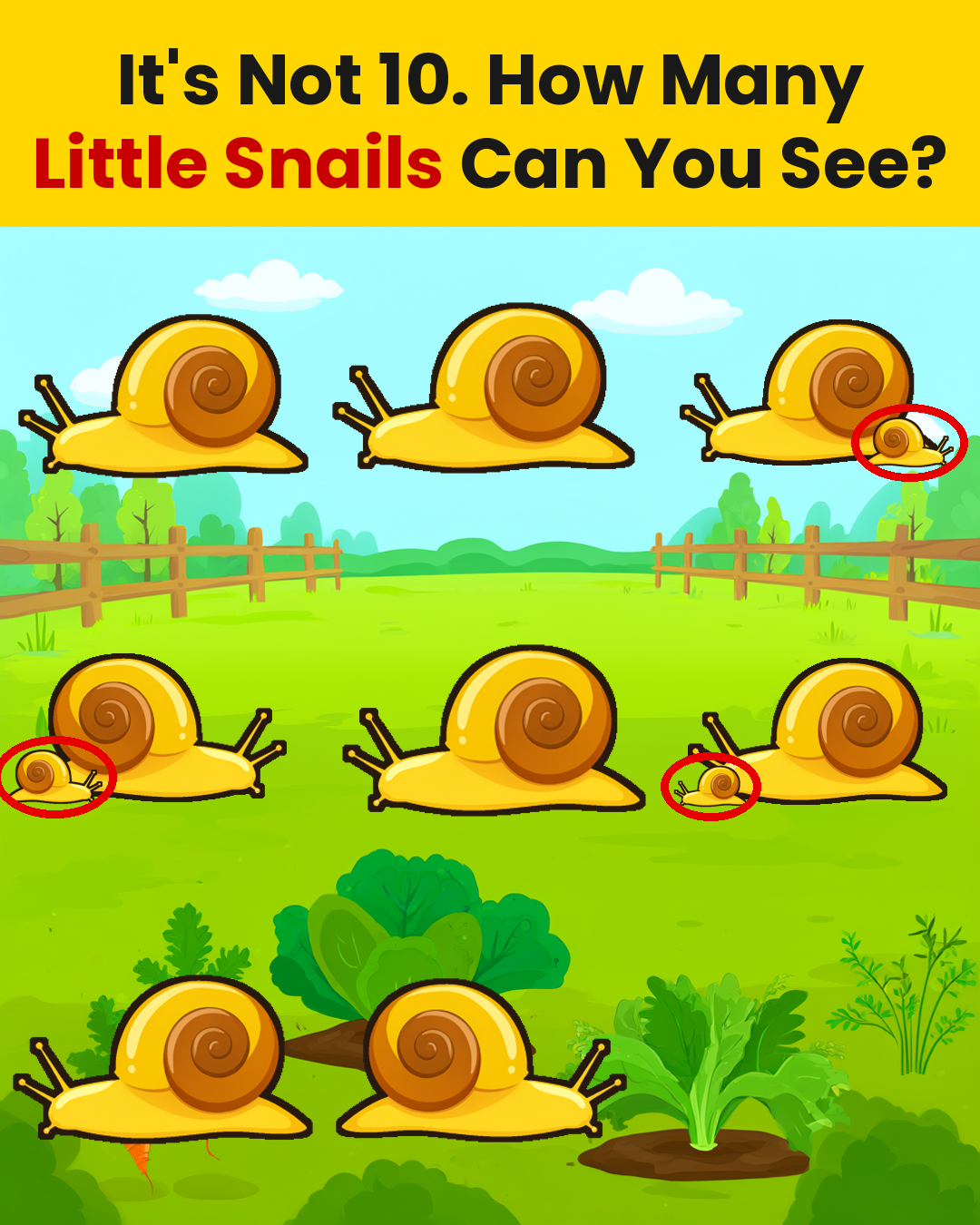
ANSWER: 11 snails – eight big ones and three tiny ones creeping along beside them.
Where The Little Ones Were Hiding
The eight large snails are the easy part. Three of them are up near the fence line, three more are crossing the open grass in the middle, and two are down at the bottom beside the cabbage and the carrot tops.
The three small snails are the ones that decide your score. One is tucked just behind the shell of the large snail on the right of the top row. One is far out on the left of the middle row, almost at the edge of the picture. The third is sitting in the middle row as well, right beside a big shell on the right.
Every one of those little snails is touching or overlapping a big one, and that is deliberate. When two shapes sit together, the brain reads them as a single object and the small one simply never gets counted.
Why Most People Say Eight
If you answered eight, you are in very good company. Eight is the number of large snails, and the large snails are what the eye notices first.
The title also played a small part. When a puzzle tells you that the answer is not ten, you start looking for a number near ten, and your brain quietly stops searching once it lands close to that range. That is why it pays to finish your count before you trust your first feeling.
The honest way to check is to count twice: once for the big shells, then a second, slower pass looking only for small shapes next to big ones.
How Did You Do?
Under ten seconds with all eleven snails found means you have genuine eagle eyes, and very few people manage it.
Ten to thirty seconds is an excellent result and shows you counted in an orderly way rather than guessing.
Thirty to sixty seconds is the normal range for most of us, so you are right in the middle of the pack.
And if you said eight or ten at first and then found the rest, that is not a failure at all. It simply means your eyes work exactly the way human eyes are built to work.