Hello, puzzle friends, and welcome to the meadow!
A family of white rabbits has come out to enjoy the sunshine, and they are scattered all across the grass.
Your job today is simple to describe and surprisingly hard to do: count every single rabbit in the picture.
Most people answer far too quickly, call out a number, and then go back and find they were wrong.
Not every rabbit is sitting out in the open, and not every rabbit is the same size.
So take your time, look behind the big ones as well as beside them, and count slowly.
When you have your number, hold on to it and scroll down to see whether you were right.
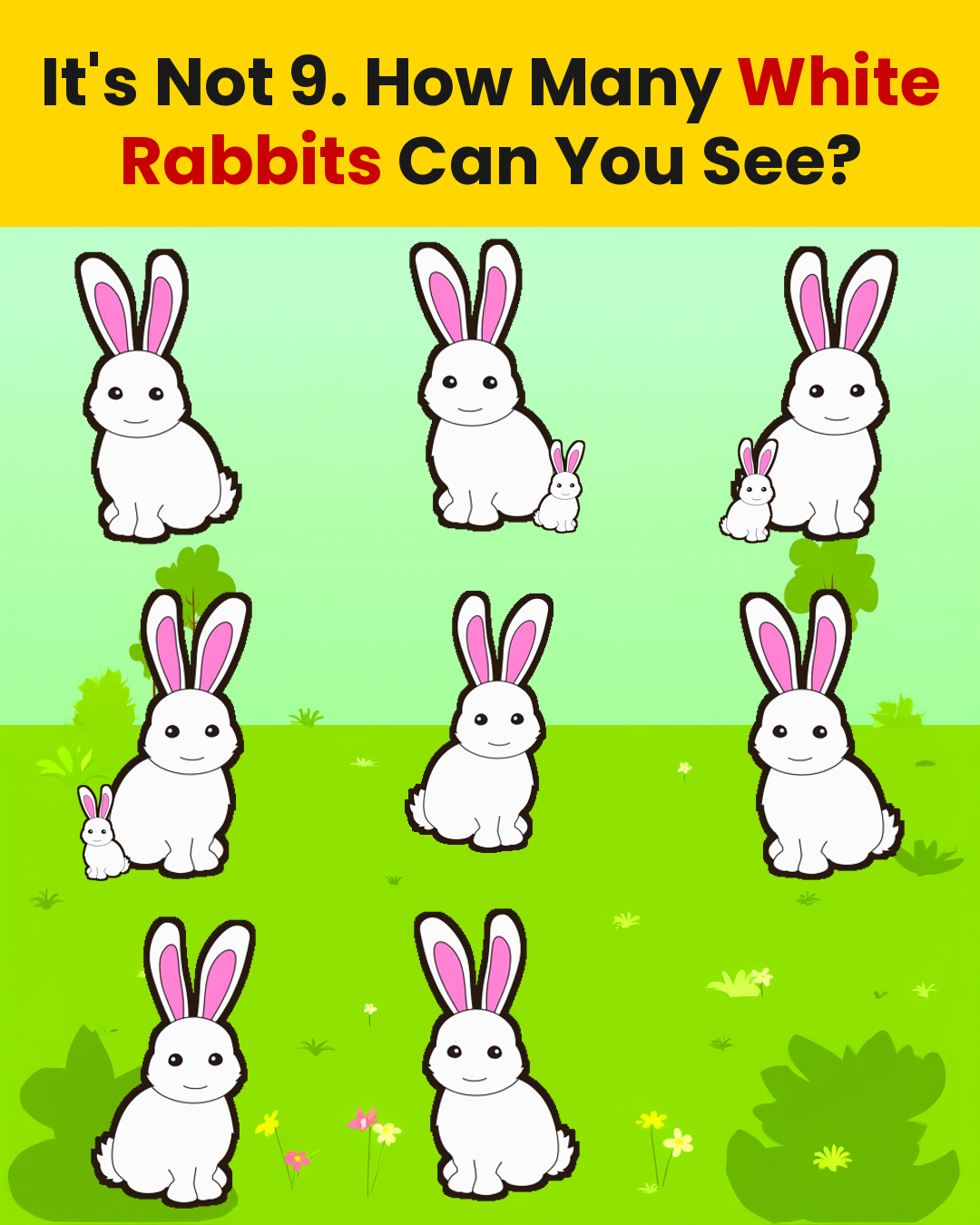
Take your time and look closely before you scroll down!
The Right Way To Count
The quickest way to get a counting puzzle wrong is to count the way we normally do, hopping from one shape to the next wherever our eye happens to land. Halfway through we lose track, start again, and finish with a different number.
The method that works is to divide the picture into rows and take them strictly one at a time. In this meadow there are three clear rows of rabbits: a top row against the pale sky, a middle row where the grass begins, and a bottom row among the flowers. Count the top row, say the number out loud, then move down. Three small numbers added together are far more reliable than one big sweep.
Then do a second pass with a different question in mind. Instead of asking how many rabbits do I see, ask is anything touching or overlapping another rabbit. That second question is where the real points are won.
Why Our Brain Loses Count
Human beings can see small numbers instantly. Up to about four objects we simply know how many there are without counting at all, a trick researchers call subitizing. Above four we have to count one by one, and that is where mistakes creep in.
It gets harder when the objects look identical. Each rabbit here is white, round and friendly, and our memory has no way to tag the ones already counted. The eye slides back over the same animal, or skips another, and the total quietly changes.
Size plays a part too. Our attention is drawn to the biggest, boldest shapes first. Something small beside something large tends to be read as a part of the large thing rather than as a separate object, which is exactly the trap waiting in this picture.
A Puzzle As Old As The Newspaper
Counting pictures have been a staple of puzzle pages for well over a century. How many faces, how many triangles, how many animals, printed beside the crossword for readers to argue about over breakfast.
They have lasted because they are wonderfully fair. There is no vocabulary to know and no formula to remember, only patience and a careful eye. Teachers still use them to show how differently two people can see the very same picture, and families still use them to start a friendly argument at the kitchen table.
Your Challenge
Here is the test. Most people land on a number within fifteen seconds and are confident about it, and most of those people are wrong.
If you took a second look before you answered, you are already ahead of the crowd. Count once more now, then share the picture with a friend and see whether the two of you agree. If your numbers differ by exactly three, you will both know why in a moment.
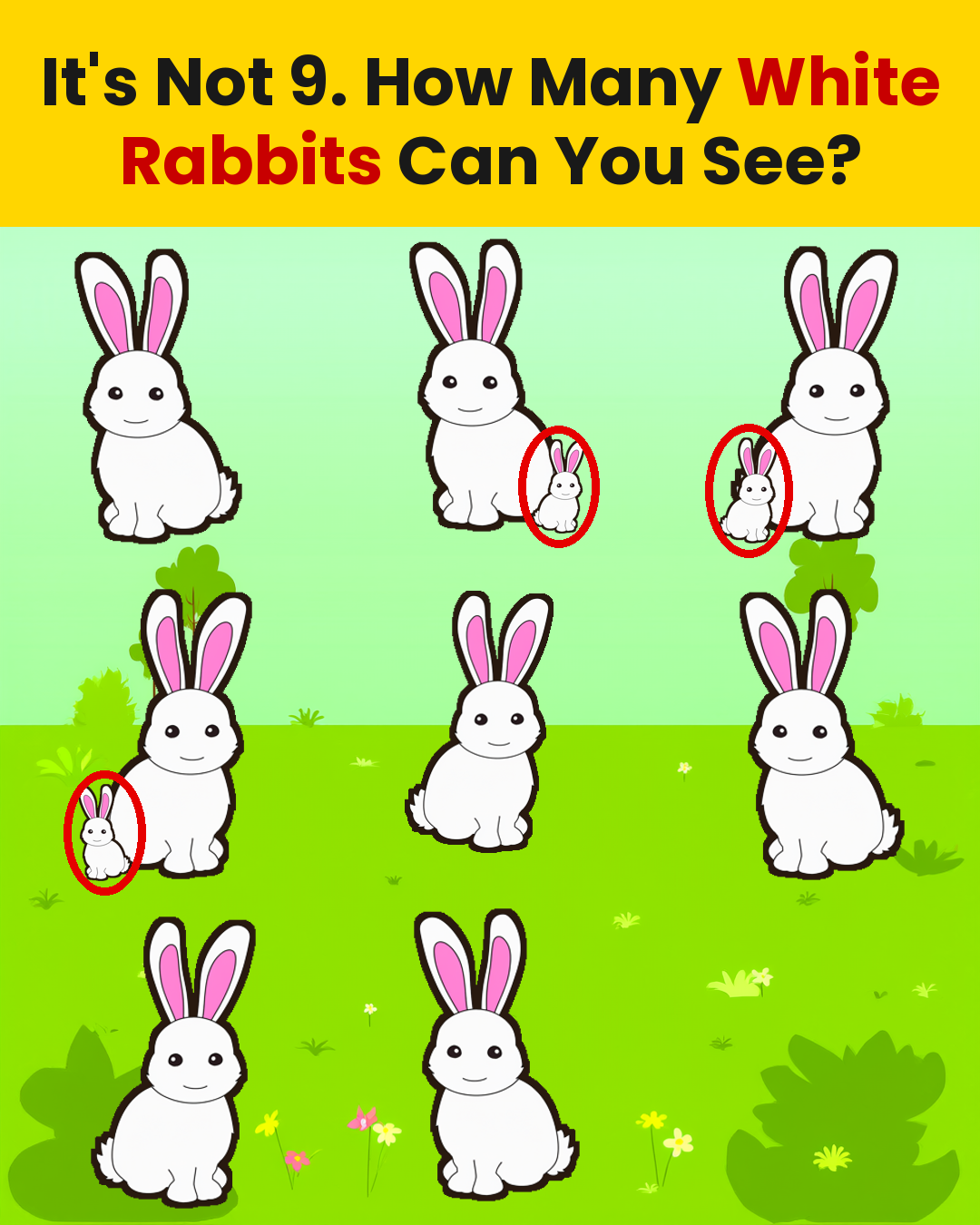
ANSWER: 11 rabbits – three tiny ones are tucked in beside the bigger rabbits
Where The Extra Rabbits Are
There are eleven rabbits in the meadow. Eight of them are the big ones you counted straight away, sitting in three tidy rows across the grass.
The other three are babies, and each one is tucked in close beside a bigger rabbit. One is in the top row, on the right side of the rabbit in the middle. Another is in the top row on the right, pressed against the left side of that rabbit. The third sits in the middle row on the left, right next to the big rabbit’s front paws.
All three are the same white colour with the same pink ears, which is precisely why they blend in so well.
Why The Little Ones Disappear
When a small shape touches a larger shape of the same colour, our brain tends to join them together and read them as one object. The tiny rabbits look like a paw, a tail or a tuft of fur belonging to the grown up next to them.
There is also the pull of the pattern. The big rabbits sit in neat rows, and once we notice a pattern we start counting the pattern instead of the picture. Anything that does not fit the rows is treated as decoration.
The cure is simple. Look at every large object and ask what is touching it. Edges are where hidden things live.
How Did You Do?
You said 11 straight away: eagle eyes, and a very patient counter. That is a rare result.
You said 9 or 10: very good. You spotted at least one of the babies, which most people never do.
You said 8: welcome to the biggest group of all. You counted the obvious rabbits perfectly and the little ones simply vanished into the big ones.
Any other number: no matter at all. Now that you know the trick, the next counting puzzle will not catch you the same way.