Hello, puzzle friends, and welcome back to the farm!
Our spotted goat has enjoyed the sunshine in the meadow all morning.
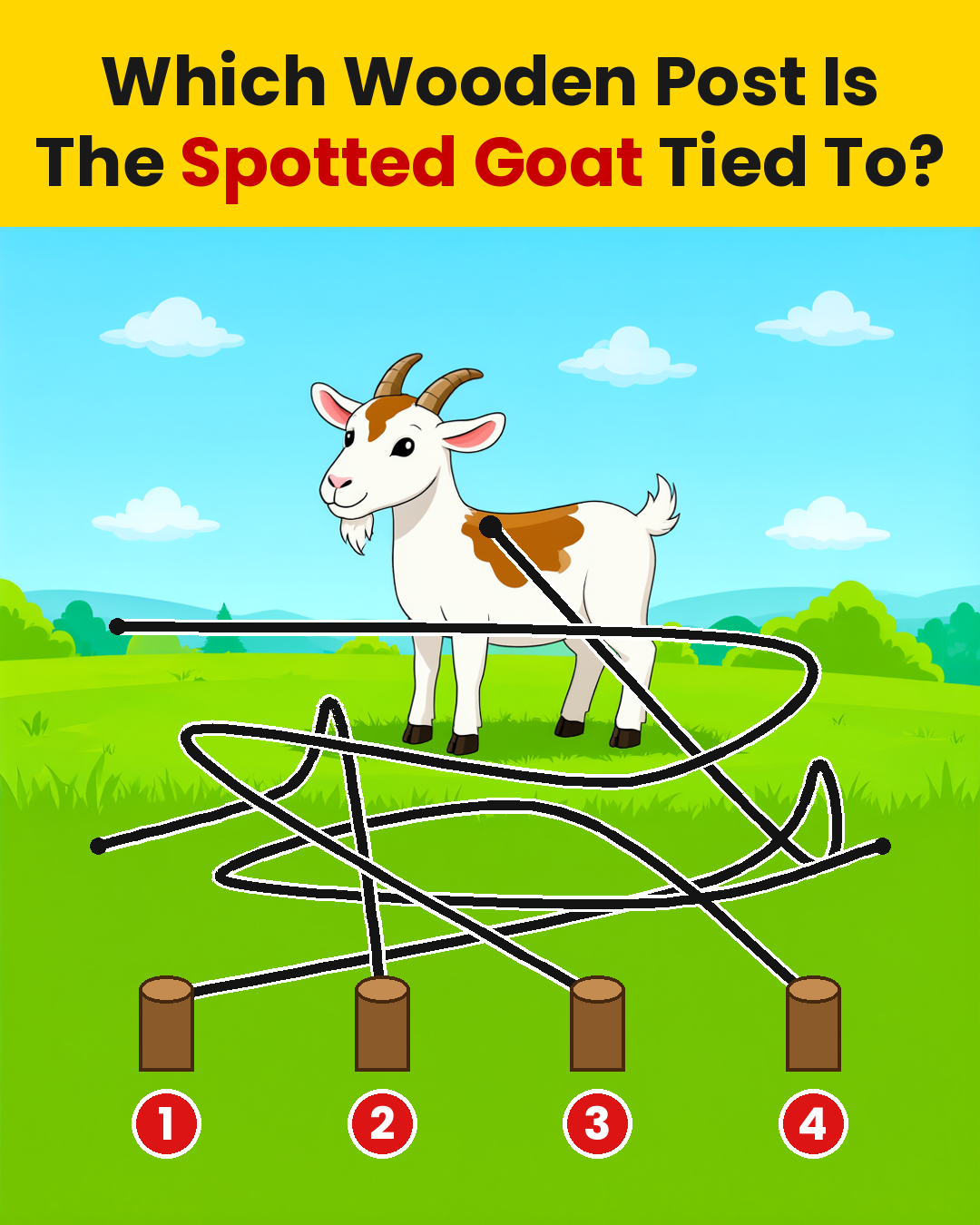
The farmer tied her rope to one of the four wooden posts below.
The trouble is that three other ropes lie in the grass as well, and they all curl and cross over each other.
Your task is to follow the goat’s rope with your eyes alone, from her shoulder down to the post.
No pen, no finger on the screen, no shortcuts.
Is it post 1, post 2, post 3 or post 4?
Look twice, because the rope does not go where most people think.
Take your time and look closely before you scroll down!
Start At The Goat, Never At The Post
Almost everybody makes the same first move: they look at post number one, start tracing upward and hope the line leads to the goat. It feels sensible, but it is the slow way round. At every crossing you have to guess which line continues, and a single wrong guess at the bottom sends you off on a long journey to nowhere.
Start at the knot on the goat’s shoulder instead. There is only one rope leaving that knot, so there is nothing to guess at the beginning. Follow it a short distance, stop, and note where you are before moving on.
The other three ropes have loose ends in the grass, marked with a small dark knot. Those are decoys. Once you know the goat’s rope, the decoys stop mattering completely.
Why Crossing Lines Confuse Us
Our eyes do not glide smoothly along a line. They move in little jumps, and between the jumps the brain fills in what it expects to see. When two ropes cross at a shallow angle, the brain quietly picks the straighter continuation, because straight is what it expects. That is where most people change ropes without ever noticing.
Vision scientists call this the problem of curve tracing, and it is one of the few visual jobs where we have to work step by step rather than take everything in at a glance. It is slow, deliberate work, which is exactly why it feels like such an effort.
The curls in this picture make it harder still. A rope that doubles back on itself breaks the sense of direction we have been building, and suddenly we are not sure whether we are going forwards or back.
A Classic From The Puzzle Books
Tangled-rope pictures have been a favourite for well over a century. They appeared as tangled fishing lines, tangled kite strings, and tangled dog leads in children’s annuals and puzzle books long before anyone had a computer.
The idea is always the same, and so is the pleasure. There is one correct answer, no knowledge is required, and anyone from eight to eighty can take part on completely equal terms. It is a rare kind of fairness.
These puzzles are also quietly good for us. Following one line among many trains sustained attention, the kind we use for reading a long letter or keeping our place in a recipe.
Can You Do It In Twenty Seconds?
Most people need about thirty seconds to follow the rope properly, and a good number give up and simply guess. With four posts, a guess gives you only a one in four chance, so it is worth the extra effort.
Here is a small trick that helps: use the edge of the screen as a ruler. Hold your eyes just above the rope and move slowly, keeping the curve on the same side of your gaze the whole way down.
When you have your answer, show the picture to a friend before you tell them what you got. Half the fun is watching a confident person point at the wrong post.
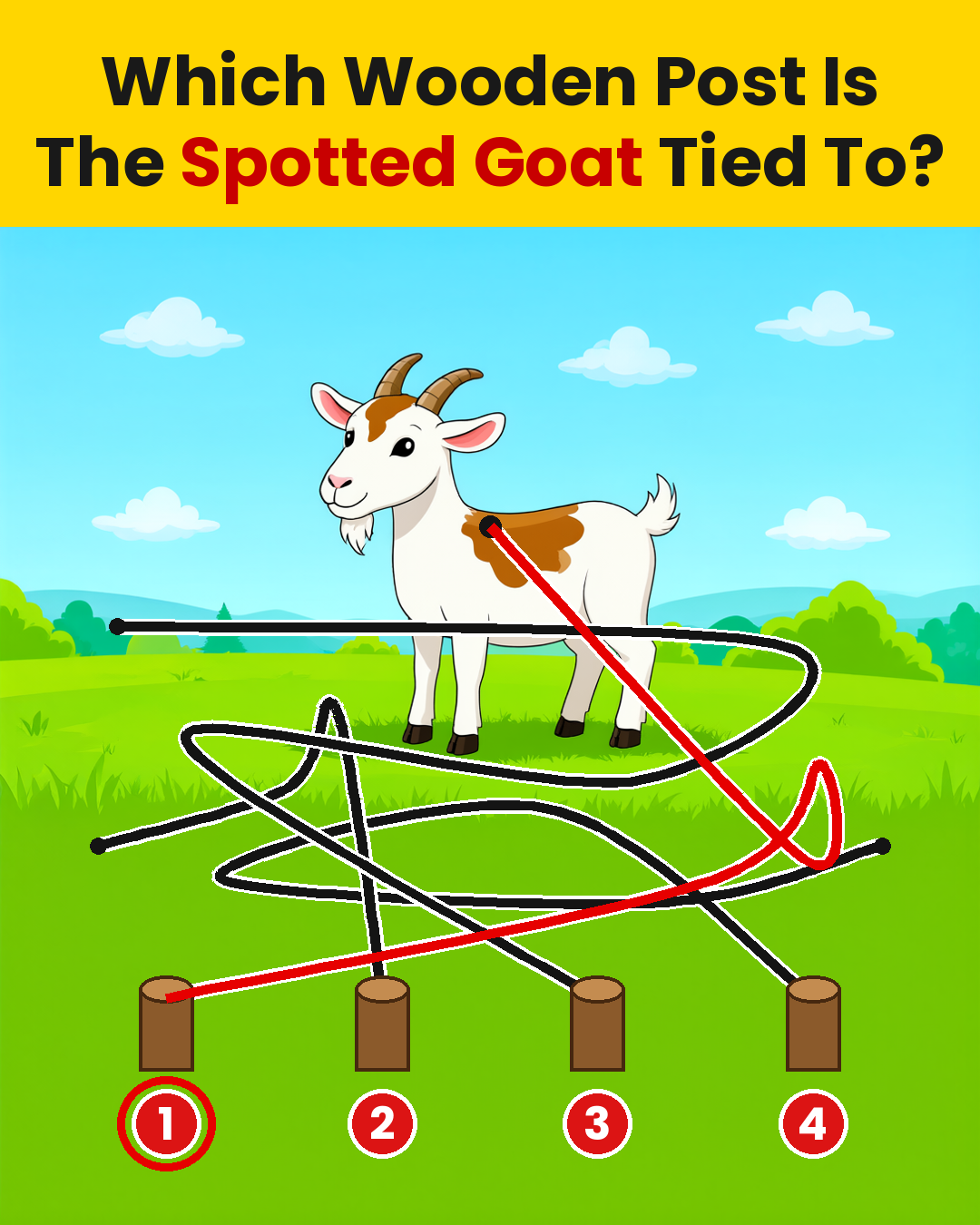
ANSWER: Post 1 – the rope from the goat loops to the right, drops down across the middle and ends at the first post on the left
The Rope’s Real Journey
The goat’s rope leaves the knot on her shoulder and runs down to the right at a steady angle, heading towards the right-hand side of the meadow. That opening direction is the first trap, because it makes post 3 or post 4 feel like the natural destination.
Instead, the rope makes a tight hook near the right edge, turns back on itself and begins a long, almost straight run down and across to the left. It passes under two of the black decoy ropes on the way, which is where most people lose it.
Finally it slides into the grass on the far left and ties off neatly at post number 1, the post furthest from where the rope first seemed to be going. In the answer picture the whole path is drawn in red so you can see the hook and the long diagonal clearly.
Why Post 4 Fools So Many People
Post 4 collects most of the wrong answers, and the reason is simple. The goat’s rope sets off strongly to the right, and a black decoy rope ends at post 4 on almost the same line. Our brain joins the two together because the angle is nearly perfect.
The moment you stop at the hook on the right and refuse to carry straight on, the illusion falls apart. The hook is the whole puzzle. Everything after it is easy.
That is a useful lesson for any tangled-line picture: the place where a rope changes direction sharply is always the place where people get lost, so slow down there.
How Did You Do?
Under 10 seconds and correct: wonderful eyes and wonderful patience. You almost certainly started at the goat.
Under 30 seconds: a very good result, right where the careful solvers finish.
Under a minute: perfectly respectable, and you probably checked yourself at least once, which is a smart habit.
Chose post 4? You are in excellent company, and now you know exactly where the rope slipped away from you. Try the next tangled puzzle starting from the animal and watch how much easier it becomes.