
Hello, puzzle friends!
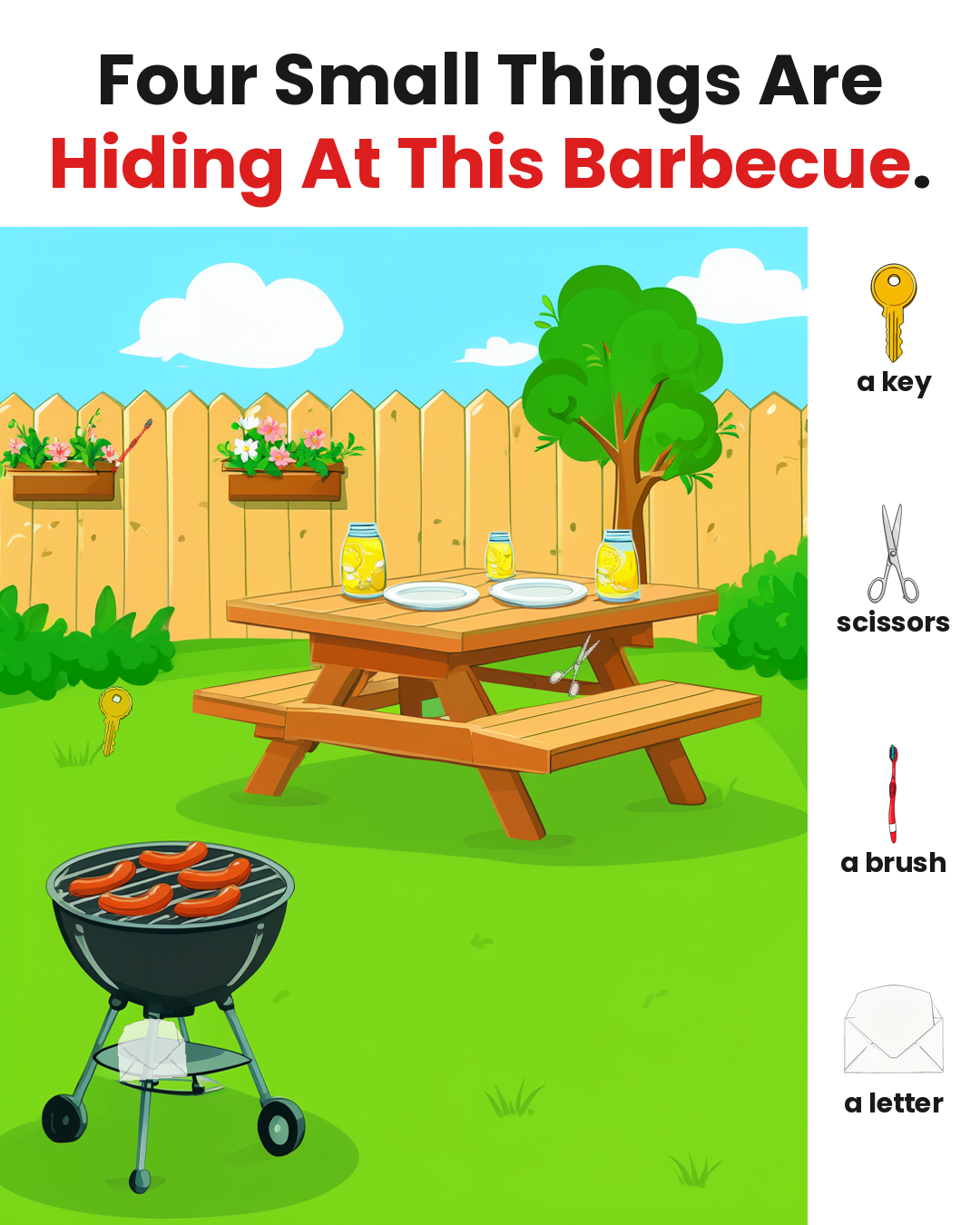
The grill is warm, the lemonade is cold, and the picnic table is ready for a sunny afternoon in the garden.
But four small things have been left in this backyard that really do not belong at a barbecue.
You can see them in the little column on the right: a key, a pair of scissors, a brush and a letter.
Every one of them is somewhere in the picture, in plain sight, and not one of them is behind anything.
They are simply small, quiet and the same colour as the things around them.
Find all four and you are doing better than most people today.
Take your time and look closely before you scroll down!
Work The Picture Like A Map
The worst way to search a busy picture is to stare at the middle and hope something jumps out. It almost never does. Hidden objects are small, and small things only appear when your eyes are actually resting on them.
Try this instead. Divide the garden into four quarters in your mind: top left, top right, bottom left, bottom right. Search one quarter at a time, slowly, from side to side like reading a line of print. Finish a quarter before moving to the next, and do not let your eyes drift back.
It also helps enormously to search for one object at a time. Hold the shape of the key in your mind and look only for that shape. When you have it, forget the key completely and switch to the scissors. Searching for four things at once is how most people end up finding none.
Why Things Vanish In Plain Sight
Nothing in this picture is really hidden. Everything is lying on top of the scene, in full view. Yet somehow objects seem to disappear, and there is a good reason for it.
Our eyes see fine detail only in a tiny spot at the centre of our gaze, about the width of a thumbnail held at arm’s length. Everything else is a blur that the brain fills in with a reasonable guess. If something small sits in the blurry part, the brain simply paints over it with more grass, more fence, more wood.
Colour makes it worse. An object that shares a colour with its background loses its outline, and the outline is what our visual system uses to say this is a separate thing. That is why a pale object on pale wood is far harder to see than a bright one on green grass.
The Old Art Of Hiding Things
Hidden object pictures have delighted families for generations. Victorian illustrators drew puzzle pictures with faces and animals tucked into trees and clouds, and children’s magazines in the last century made a weekly feature of them.
Artists worked out early on that the cleverest hiding place is a boundary: the edge of a table, the line where the fence meets the lawn, the rim of a flower box. Our eyes follow edges in order to understand a scene, so anything sitting exactly on an edge gets read as part of it.
The same principle is used in nature. A moth on tree bark is not covered up at all. It simply matches the pattern, and matching is enough.
Four In Under A Minute?
Most people find two objects quickly, the third after a little work, and then spend a surprisingly long time hunting for the fourth. That last one is where the real challenge lives.
If you get stuck, change your method rather than looking harder in the same place. Move your eyes along the edges in the picture: the fence line, the table edge, the legs of the grill. Edges are where small things love to sit.
When you have all four, pass the picture to a friend without saying a word, and enjoy the quiet while they search. It is a very pleasant way to spend five minutes together.
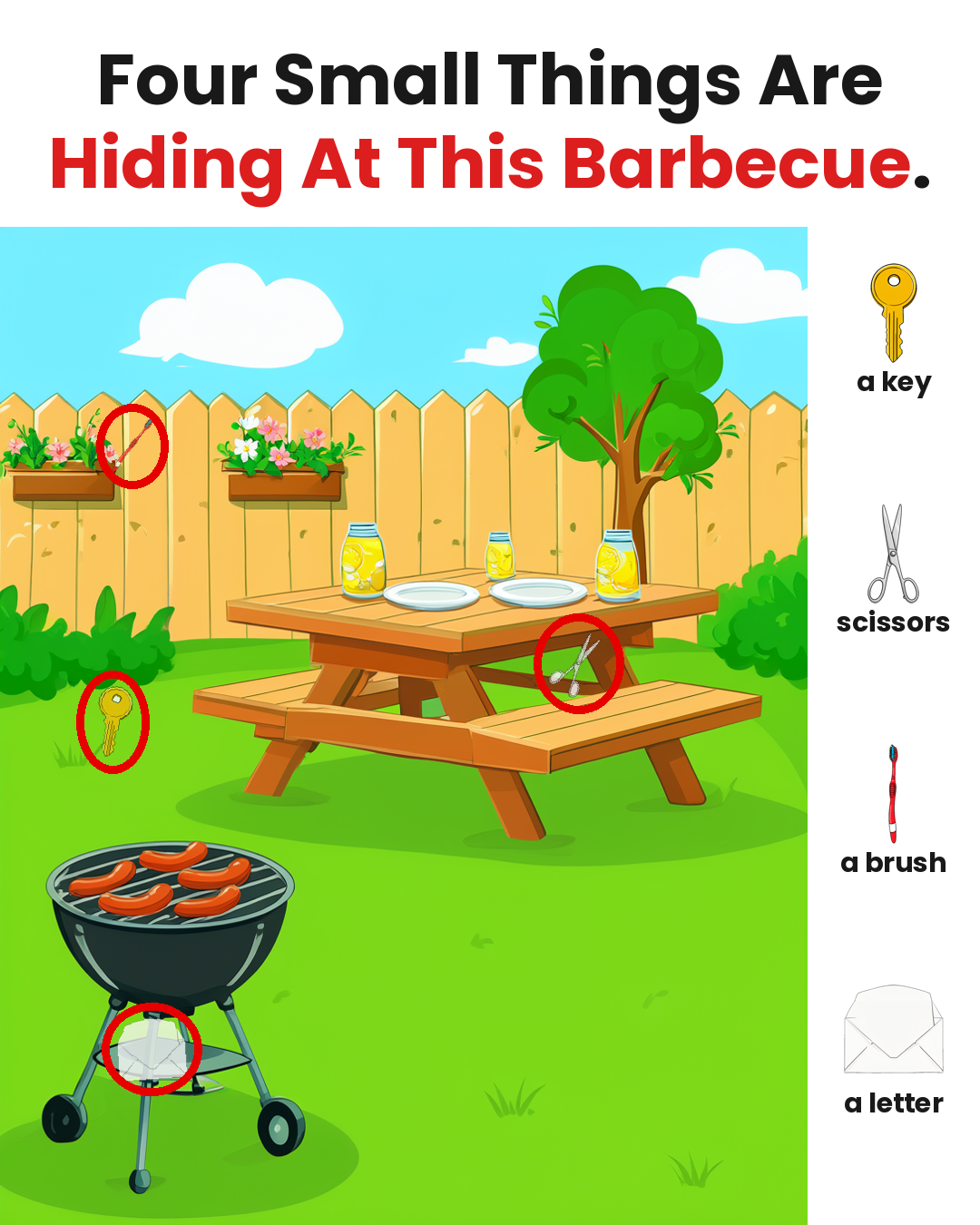
ANSWER: The key lies in the grass on the left, the scissors hang on the edge of the picnic table, the brush sits in the left flower box on the fence, and the letter rests on the lower shelf of the grill
Where All Four Were Waiting
The key is on the left-hand side of the lawn, lying flat in the grass just beside a small tuft, roughly level with the table legs. Its warm gold colour sits quietly against the green, and because it is tilted it does not look like a key at first glance.
The scissors are on the picnic table, right at the front edge of the table top above the bench, with the blades pointing down. The silver matches the pale wood almost perfectly, which is why so many eyes slide straight past.
The brush is up on the fence, tucked into the left flower box among the pink blossoms. The red handle looks exactly like another flower stem. And the letter is tucked onto the lower shelf of the grill, down between the legs, where its white shape reads as part of the grill itself.
Why The Last One Is Always The Hardest
Once people find three objects they often start searching the same busy areas over and over, because those areas rewarded them before. The missing object is usually somewhere plain and empty, exactly where nobody bothers to look twice.
In this garden the brush in the flower box catches most people out. It is high up, near the top of the picture, and our attention naturally sinks towards the table and the grill where all the interesting things are happening.
The cure is to deliberately search the dull parts: empty grass, blank fence, open sky. That is almost always where the final object has been waiting patiently for you.
How Did You Do?
All four in under 20 seconds: genuinely eagle eyes, and a method rather than luck.
All four in under a minute: a very strong result, better than most readers manage.
Three out of four: excellent work, and the one you missed was almost certainly the brush on the fence.
Two or fewer? Do not be discouraged for a second. Scroll back up, search one object at a time, and watch how quickly they appear once you know they are really there. Finding them the second time is a pleasure of its own.