Hello, puzzle friends, and welcome into a very cosy living room!
A woman has settled on the sofa with a good book, the cat has claimed the footstool, and the lamp is ready for the evening.
You can see the same peaceful room twice, side by side.
Almost everything matches, but one detail in the picture on the right has quietly changed.
It is not hidden in a corner and it is not tiny, yet most people look straight past it.
Take a slow breath, compare the two halves piece by piece, and see how long you need.
Good luck, and no peeking at the bottom just yet.
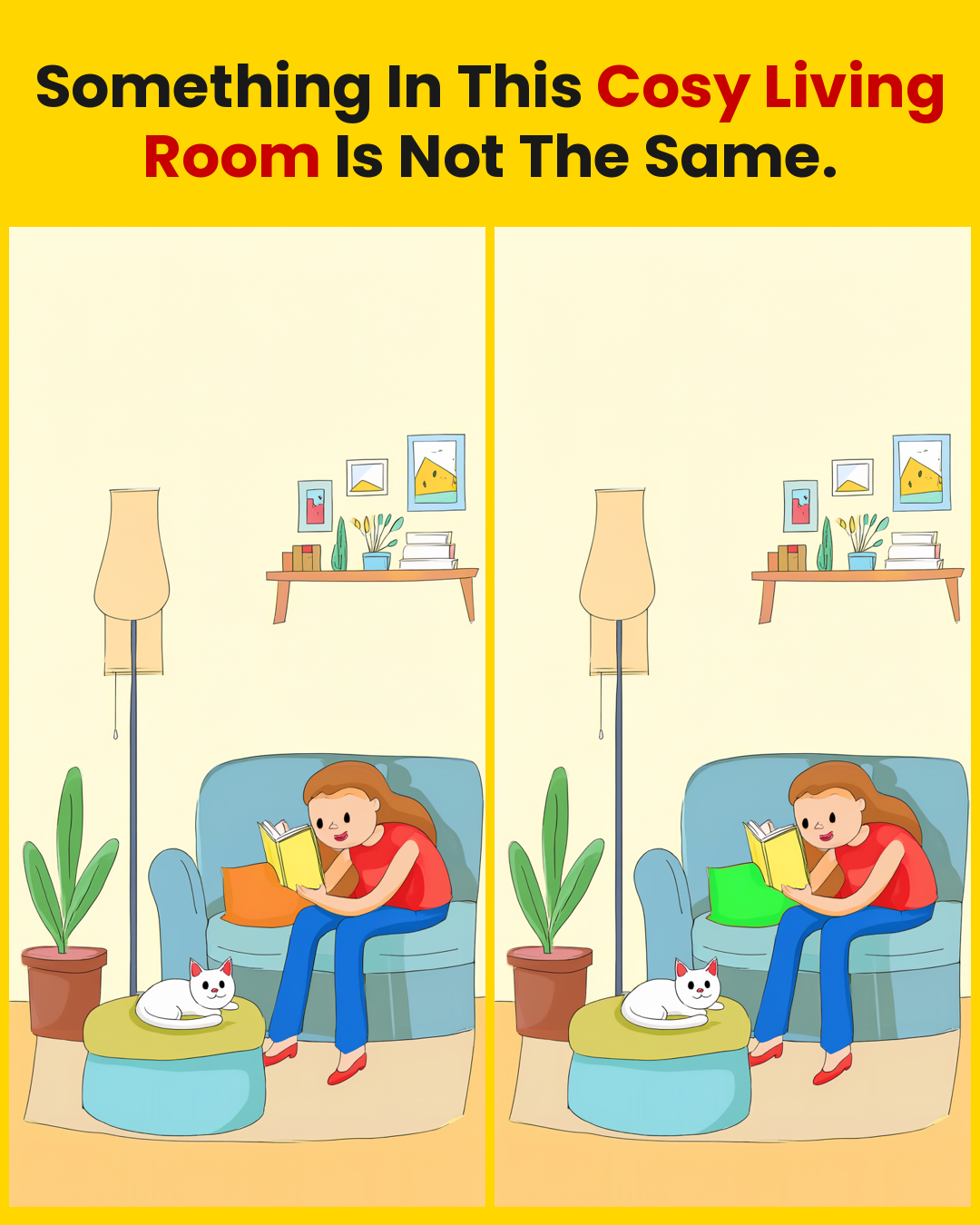
Take your time and look closely before you scroll down!
Where To Look First
In a room scene like this one it helps to think like a person tidying up. Go through the furniture one object at a time, in the order you would walk past them: the lamp, the shelf, the little pictures on the wall, the plant, the sofa, the person, the cat, the footstool, the floor.
Name each object quietly to yourself as you compare it, left and right. Naming slows your eyes down just enough to make them actually look, instead of gliding over the scene the way they normally do.
If you reach the end of your list with nothing found, start again, but this time look only at colours and ignore shapes completely. Many puzzles change neither position nor size, only the colour of one thing, and a colour change is far easier to catch when you stop reading the picture as objects.
Why The Middle Of A Picture Is A Great Hiding Place
We all assume that a difference will be tucked away in a corner, so that is where we hunt. Clever puzzle makers know this and often place the change near the centre, where our attention passes through constantly but never stops.
There is another effect at work here. When a person appears in a picture, our eyes are pulled to the face first, then to the hands, then to whatever the hands are doing. Everything around that path becomes scenery. The sofa behind the reader is a perfect example: we see a soft comfortable couch and we never store the details of it.
Psychologists call this inattentional blindness. We are not blind at all, we simply spend our attention where we expect something interesting, and a cushion is rarely interesting.
A Game With A Long Life
Side by side puzzles were already popular in magazines a hundred years ago, drawn by hand twice over by patient artists. They sat beside the crossword as the picture puzzle for everyone, young or old, because they need no reading and no special knowledge.
They have aged very well. The same simple idea now travels around the world on telephones, and the pleasure of the moment when you finally see it has not changed one bit.
Your Challenge
Most people take twenty five to forty five seconds with this living room. Under fifteen seconds is a very sharp result, and under seven is remarkable.
Give it one last look before you scroll down for the answer, then send it to a friend and quietly time them. It is always fun to see somebody study the cat for half a minute.
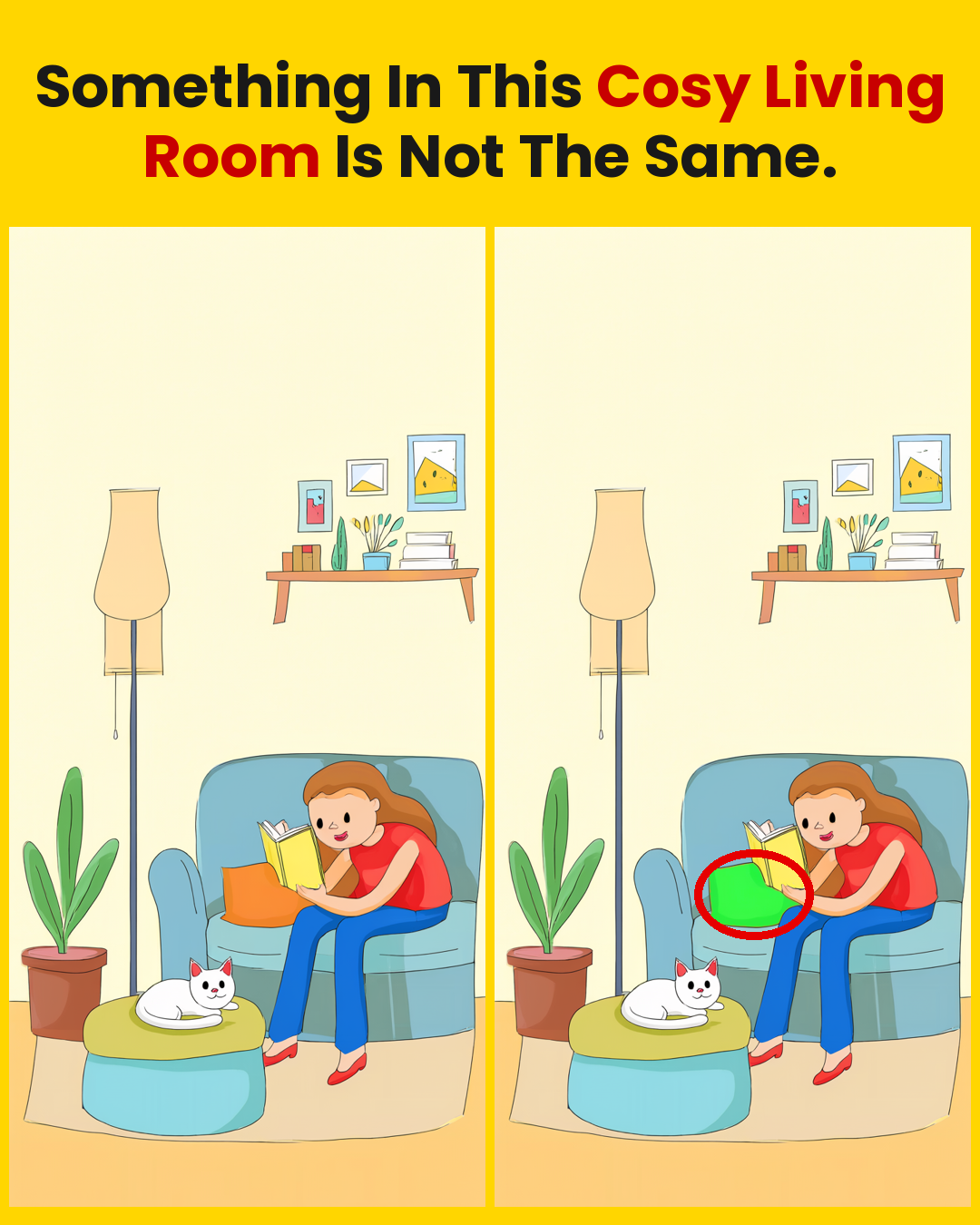
ANSWER: The cushion on the sofa is green in the second picture instead of orange
The Change Was On The Sofa
Look at the cushion resting against the arm of the sofa, just in front of the reader’s elbow. In the first picture it is a warm orange. In the second picture that same cushion has turned bright green.
It is a big, bold change in a plain colour, right in the middle of the picture. Once you see it, it feels impossible to have missed. That is what makes this puzzle such a nice surprise.
Why So Many People Miss It
The cushion is partly covered by the woman’s arm and by the yellow book she is holding, so it never forms a complete shape for the eye to lock onto. Half an object attracts far less attention than a whole one.
It also sits in the busiest spot in the picture. Face, hands, book, arm and cushion are all crowded into one small area, and the face wins every time. Our eyes read the person and treat the rest of that corner as padding.
Finally, the room is full of soft colours already, with the green plant, the olive footstool and the blue sofa. One more friendly colour does not feel out of place at all until you compare both halves side by side.
How Did You Do?
Under 10 seconds: eagle eyes. You looked at the whole picture, not just the people.
10 to 30 seconds: a very good result and a well organised search.
30 to 60 seconds: this is where most people land, and it is nothing to be shy about.
Over a minute: perfectly fine. Puzzles like this train attention precisely because they are a little unfair at first. Try another one now and you will almost certainly be quicker.