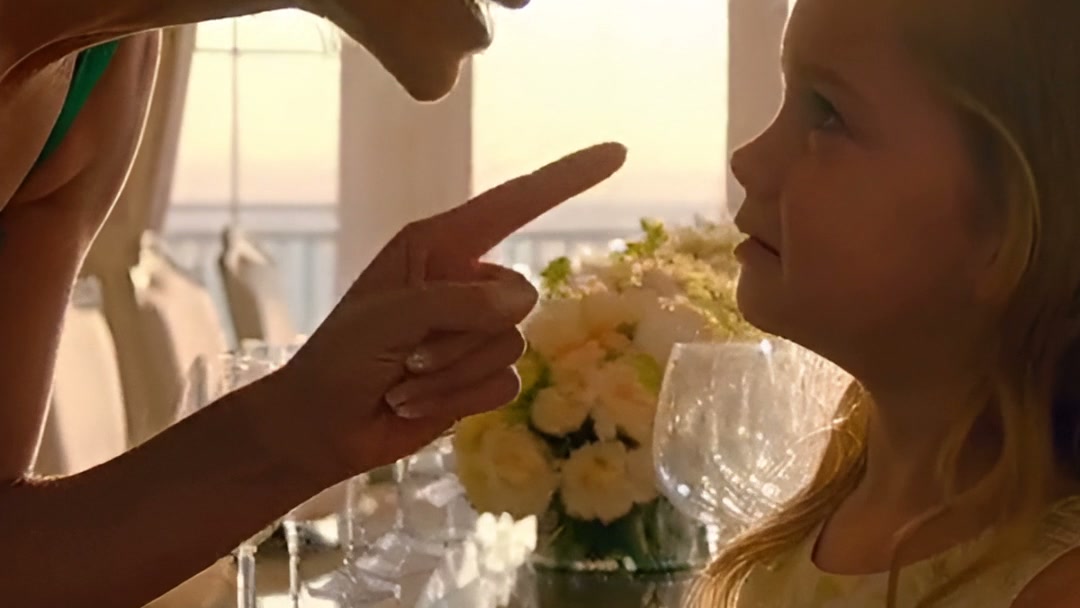
At his own engagement dinner, CEO Marcus Hale caught his bride-to-be ripping a four-year-old’s crayon drawing… But when the child pointed to the crumpled paper and said, “Your mama taught me to draw her face,” Marcus went completely still.
The penthouse gleamed sixty stories above the city. Golden hour poured through floor-to-ceiling glass, catching crystal and candlelight and the shine of emerald silk.
It was supposed to be the most elegant evening of Marcus Hale’s life.
His engagement dinner. Forty guests. White orchids on a table that stretched the length of the room.
He was mid-sentence with his CFO when he heard it.
A sharp, sudden crinkle. Then a child’s gasp.
He turned.
His fiancée, Vivienne Alcott, stood at the far end of the table, her emerald gown catching the light. In her manicured hand she held a crumpled sheet of paper. Crayon marks bled through the creases.
Beside her, barely reaching the tablecloth, stood a little girl.
Four years old. A white flower-girl dress. Blonde wisps escaping two small braids. Her bottom lip was shaking so hard it looked like it might never stop.
“This isn’t a daycare,” Vivienne said, her voice low and clipped, the kind of low that was designed to carry. “You don’t bring finger paintings to a formal dinner. Who let this child in here unsupervised?”
The little girl reached up with both hands. “Please,” she whispered. “I made it for him.”
“Out.” Vivienne pointed toward the hall, her arm rigid. “Now. Before I call your mother.”
She reached for the child’s arm.
Marcus was already moving.
He crossed the length of the table in seven steps. His hand closed around Vivienne’s wrist in the air, stopping her cold, half an inch from the girl’s sleeve.
Vivienne went rigid. She turned to look at him, and whatever she saw in his face made her breath catch.
“Marcus—”
“Don’t.” His voice was quiet. The whole room was quieter. “Don’t touch her.”
He released Vivienne’s wrist slowly. She stepped back, and guests along both sides of the table found sudden interest in their wine glasses, their bread plates, the view.
Marcus crouched down.
He was six-foot-two, broad-shouldered, built like a man who’d earned everything with his hands before he’d ever worn a dinner jacket. At eye level with a four-year-old, he looked enormous and careful, the way a mountain might look if it were trying not to frighten something small.
“Hey,” he said. “Can I see it?”
The little girl blinked up at him. Her tears hadn’t fallen yet. They were right there, teetering.
He held out his hand. Open. Patient.
She placed the crumpled ball of paper into his palm.
Marcus smoothed it flat against his knee. He took his time with it. He pressed each crease out with his thumb, slowly, the way you’d handle something that mattered.
He looked down at the drawing.
The world lurched sideways.
Crayon lines. Shaky and bright and absolutely certain of themselves. A woman with silver hair. A garden. A yellow house with a red door.
His mother’s house. His mother’s red door. The garden she’d kept until the very end, where the tomatoes grew along the south-facing fence and the hydrangeas went blue every July.
His mother had been dead for three years.
He hadn’t told anyone about the red door. It wasn’t in any photograph he’d ever shared publicly. He’d sold the house eight months after the funeral to a family from Ohio and he’d never gone back because he couldn’t.
“Who are you?” he said, very quietly.
“Emmy,” the little girl said. “I’m Emmy. I’m in the wedding for the flowers.”
“Emmy.” He nodded slowly. “This is beautiful. Who showed you how to draw this?”
Her face changed. The tears finally spilled, rolling straight down both cheeks, but she was smiling through them.
“The lady,” she said.
“What lady?”
Emmy pointed to the drawing.
“Her,” she said. “The one with the silver hair. She sat with me at the window in my room last night and she showed me how to draw her house. She said you’d be sad and that I should give you the picture so you’d remember.” Emmy touched the edge of the paper with one small finger. “She said to tell you she still has the tomatoes.”
Marcus could not speak.
His chest had locked. His throat had locked. He was thirty-eight years old and had closed nine-figure deals without blinking, had sat across tables from men who wanted to ruin him and smiled, had lowered his mother’s casket into the ground on a gray November morning without making a sound because he’d promised himself he wouldn’t.
He had not cried in three years.
“She said to tell you she still has the tomatoes.”
His eyes burned. His vision blurred. He pressed his lips together hard and looked down at the drawing and the yellow house and the red door, and the force of it moved through him like something being unlocked.
Behind him, he heard Vivienne. “Marcus, she’s clearly making things up. Children do this, they—”
“Vivienne.” His voice was not loud. It did not need to be. “I need you to stop talking.”
Silence.
He looked back at Emmy.
She was watching him with four-year-old steadiness, the way small children watch things they don’t fully understand but know are important.
He folded the drawing gently, once, along a clean crease. He tucked it into the inner pocket of his dinner jacket, against his chest.
“Thank you, Emmy,” he said. His voice came out rougher than he intended. “This is the best thing anyone has brought to one of my dinners.”
She nodded gravely. “I worked on it for a long time.”
“I can tell.”
He straightened up. He turned to face his guests, forty people in formal wear arranged along a white-orchid table, all of them watching him with the careful non-expression of people who had witnessed something they didn’t know how to categorize.
He turned to find Vivienne.
She was standing exactly where he’d left her, three feet back, her arms crossed under the emerald silk, her jaw set at the angle it always took when she was preparing a version of events.
He looked at her for a long moment.
He thought about the red door.
He thought about how Vivienne had been to his mother’s house exactly once, for forty minutes, on a Sunday afternoon two winters before his mother got sick, and had spent most of it talking about the drive back. He thought about how she’d described the neighborhood afterward, quietly, to her sister on the phone in their bathroom with the door not quite closed. He thought about how he’d told himself it didn’t matter, that people were complicated, that love was a choice you made every day.
He thought about a four-year-old sitting at a window the night before a wedding, with a box of crayons, drawing a house she had never visited, being shown a red door by someone who wasn’t there.
He reached into his jacket.
He laid the engagement ring on the table between them. Quietly. Not a scene. Just a fact.
“I think we both know this isn’t right,” he said. “I think we’ve known for a while.”
Vivienne stared at the ring. Then at him.
“You’re ending our engagement,” she said, “because of a child’s drawing.”
“I’m ending our engagement,” he said, “because of a lot of things. But yes. Tonight clarified it.”
She picked up her clutch. She held herself very straight, which he respected, and she left without another word, which he respected more.
The room exhaled.
Marcus reached down and offered Emmy his hand.
“Are your parents here somewhere?”
“My aunt is,” she said, and took his hand without hesitation, the way small children do when they’ve decided you’re safe.
He walked her to the window. The city burned orange and gold below them. He crouched beside her, both of them looking out.
“The lady with the silver hair,” he said carefully. “Did she tell you her name?”
Emmy thought about it very seriously.
“She said to tell you it’s Eleanor.” She glanced up at him. “She said you’d know.”
He pressed his hand flat over his jacket pocket. Over the folded drawing. Over Eleanor Hale’s yellow house and red door and the garden full of tomatoes she’d loved better than almost anything.
“I know,” he said.
His eyes were wet and he let them be wet, sixty floors above the city, in the light that was almost gone now.
He was not alone.
He had the feeling, specific and warm and completely irrational and completely certain, that he had not been alone for a single minute of the past three years.
He stayed there with Emmy until her aunt came to find her, a kind woman in a blue dress who apologized twice and tried to take the child away quickly.
“Please don’t apologize,” Marcus said. He looked at Emmy. “She did something important tonight.”
Emmy beamed up at him, gap-toothed and proud.
He stood in the empty penthouse long after the last guest had gone, the drawing pressed flat against his chest, the engagement ring sitting alone on a white linen tablecloth, and for the first time in three years he said out loud, quietly, to no one visible:
“I remember, Mom. The tomatoes. I remember everything.”
The city lights blurred below him.
He let himself cry.
And somewhere, he was almost entirely sure, a garden was still growing.