Tennis club owner Marcus Hale caught the heiress’s wrist before she could slap the eighteen-year-old ball girl… But when the girl looked up through her tears and whispered “You sound exactly like my father,” Marcus went completely still.
The golden hour light stretched long across the Pineridge Country Club tennis terrace, turning the clay courts amber and the white linens on the member tables a soft, warm rose. It was a beautiful evening. Nobody was paying attention to Lily Chen.
Lily was eighteen, five-foot-three, wearing the club’s standard black polo and white shorts, her dark hair pulled into a tight ponytail. She was the youngest ball girl on staff and she knew better than to speak unless spoken to. But when Mrs. Pauline Ashworth’s miniature Labrador bolted from under the table, tangled its leash around Lily’s ankles, and sent her stumbling directly into the guest Mrs. Ashworth had been entertaining for twenty minutes, Lily knew the kind of trouble that followed was not the leash’s fault. Not in Pauline Ashworth’s world.
“I’m so sorry,” Lily said quickly, steadying herself. She looked at the guest, a silver-haired woman in a cream blazer, who looked more startled than angry. “The dog—”
“Oh, I know,” the woman said warmly. “Are you all right?”
That was the mistake.
Pauline Ashworth rose from her chair so fast the ice in her glass rattled. She was fifty-four, surgically precise, in a white tennis dress that probably cost more than Lily’s monthly rent. Her cheeks were flushed red beneath a perfect blowout and her eyes were the kind of pale blue that looked cold even in warm light.
“She is staff,” Pauline said. Not loudly. She didn’t need to be loud. “She is not part of this conversation. She is not permitted to speak to you.”
“Pauline, she only—”
“She only what?” Pauline picked up her glass of orange juice from the table. Her eyes didn’t leave Lily. “She bumbled into my private table, interrupted a business lunch, and had the nerve to speak to my guest as though she were a person worth addressing.”
Lily opened her mouth. She couldn’t help it.
“I apologized,” she said. “Mrs. Ashworth, I genuinely—”
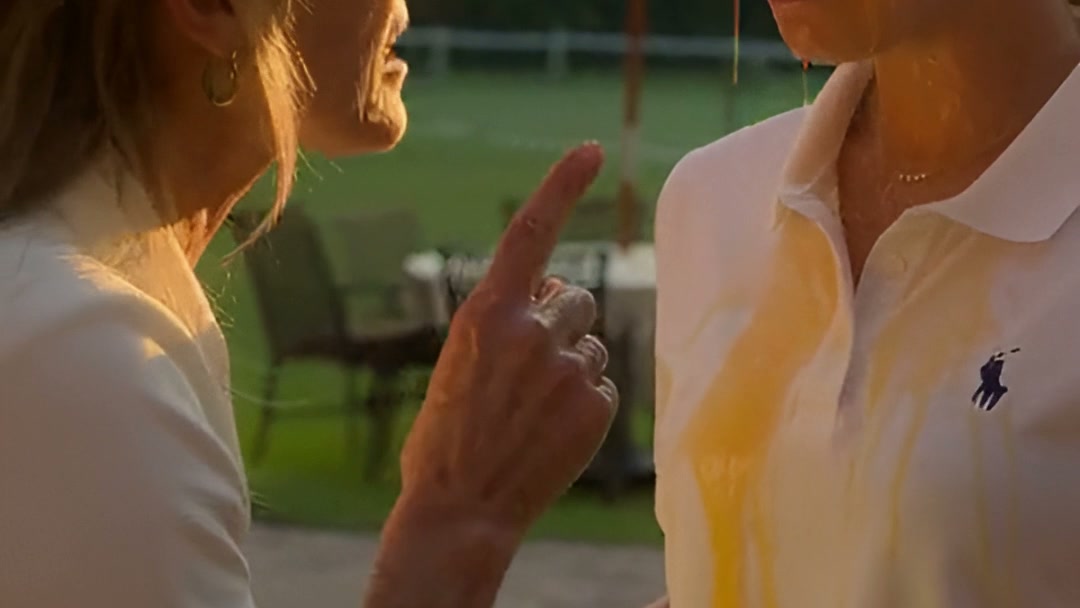
Pauline threw the orange juice directly into her face.
The terrace went silent. Every head turned. The ice cubes scattered across the terrace stone and the silver-haired guest let out a sharp sound of shock. Juice dripped from Lily’s nose, from her chin, soaked into her collar. She stood there blinking, hands at her sides, too stunned to breathe.
“You do not,” Pauline said, stepping forward, right hand rising, “speak to me or my guests without permission. You are help. Do you understand what that means?”
The slap never landed.
A hand caught Pauline’s wrist mid-air, firmly, from behind her right shoulder. Not hard. Not violent. Just absolutely, completely certain.
“No,” said the man.
Marcus Hale was forty-seven, six feet tall, broad through the shoulders in a navy blazer over a white open-collar shirt, with dark grey at his temples and laugh lines around his eyes that were not laughing right now. He was the fourth-generation owner of Pineridge Country Club, which meant Pauline Ashworth had been paying his family dues for sixteen years. He had never once intervened in a member dispute on the terrace in his life. His club manager, Derek, who was standing twenty feet away with a clipboard, looked as though he had witnessed a solar eclipse.
“Marcus,” Pauline said. Her voice had gone very careful. “This is not your—”
“It became mine,” Marcus said quietly, “when you put your hand in the air.”
He released her wrist. Then he stepped around her, reached to the nearest linen service cart, lifted a clean white towel, and crouched down in front of Lily.
She was shaking. She hadn’t realized she was shaking until he was right there in front of her, at eye level, holding out the towel with both hands the way you’d offer something to a spooked animal you didn’t want to frighten further.
“Take it,” he said. “Take your time.”
Lily took the towel. She pressed it to her face. When she pulled it away, her eyes were red but her chin was up.
“I’m sorry,” she said. She didn’t know why she was apologizing. It came out anyway.
“You have nothing to apologize for,” Marcus said.
Behind him, Pauline said his name again, sharper. He didn’t turn around.
“You threw a drink on one of my employees,” he said, still not turning, still looking at Lily. “In front of twelve guests and two staff members. You were about to strike her. I’d like you to go inside now and wait in the Founder’s Lounge. We need to talk about your membership.”
“My membership.” The temperature in Pauline’s voice dropped twenty degrees. “Marcus Hale, my family has been members of this club since before your father—”
“Derek,” Marcus said.
“Yes, sir.” Derek was already moving.
“Please escort Mrs. Ashworth to the Founder’s Lounge.”
There was a pause that felt geological. Then the sound of Pauline Ashworth’s tennis shoes on stone, very deliberate, moving away.
Lily let out a breath that had been sitting in her chest like a stone.
“Thank you,” she said. Her voice was still shaky. She hated that it was shaky.
“Are you hurt?” Marcus asked.
“No. No, it was just—it was juice.” She almost laughed. It came out wrong. She pressed the towel to her eyes instead and when she pulled it away, to her absolute humiliation, she was crying. Not the kind you can stop. The kind that had been building for nine years and just chose this moment, this terrace, this particular white towel to finally arrive.
“Hey,” Marcus said, very quietly.
“I’m sorry.” She wiped her face. “I don’t know why I’m—I’m fine.”
“You’re not fine. You just got a drink thrown at you by a grown woman in front of strangers.” He paused. “You’re allowed to cry about that.”
Something about his voice made her look at him properly for the first time. Not at his blazer or his title or the uncomfortable reality of him being her employer’s employer. Just at his face. The steadiness in it. The absence of irritation or pity or performance.
She frowned.
“You sound like my father,” she said.
Marcus tilted his head slightly. “Do I?”
“The way you said that.” She gestured vaguely. “You’re allowed to cry about that. He used to say things like that.” She swallowed. “Sorry. That’s a weird thing to say to someone.”
“It’s not weird,” Marcus said. “What’s your name?”
“Lily. Lily Chen.”
Something shifted in Marcus’s face. It was subtle—a stillness, a rearrangement—and then it was gone so fast she might have imagined it.
“How long have you worked here?” he asked.
“This is my second summer. I started the summer before last.” She wiped her eyes again. “I really am okay. You don’t have to—”
“Lily.” He said her name like he was testing the weight of it. “Chen. Your father—does he still live in the area?”
She looked at him. “No. He left when I was nine. We haven’t—we haven’t heard from him since.” She said it the way you say a thing you’ve said so many times it’s lost its edges. “It’s fine. It was a long time ago.”
Marcus sat back slightly on his heels. He looked at her with an expression she couldn’t read, something between want and caution, and he said nothing for a moment.
“My mother’s name is Nancy Chen,” Lily said. She didn’t know why she said it. “She worked at the Riverside Radisson. Banquet staff. In 2015.”
Marcus went very still.
“That’s—” He stopped.
“Did you know her?” Lily asked.
He looked at her face the way someone looks at a photograph they thought they’d lost. Like he was cataloguing features. Dark eyes. The particular shape of her jaw. The way she held herself even crying, spine straight, chin trying to stay up.
“Marcus?” said Derek from somewhere behind them.
Marcus didn’t answer. He was still looking at Lily.
“Your mother,” he said carefully. “Nancy. She had a—she used to wear a small blue pin on her uniform. A forget-me-not. Did she ever tell you why?”
Lily’s mouth opened.
“I gave her that pin,” she whispered. “I mean—I asked her about it once and she said—” She stopped. “She said someone gave it to her to remember something important. She never said who.”
Marcus put one hand over his eyes. Just for a second. Then he lowered it and looked at her and his voice, when it came, was rough in a way that had nothing to do with authority or ownership or anything to do with the club.
“I need you to do something for me,” he said. “I need you to call your mother right now and ask her a question. Can you do that?”
“What question?”
“Ask her if she ever told a man at the Riverside Radisson banquet that she was pregnant.” He held her gaze. “Ask her what he said when she did.”
Lily stared at him.
“She said he cried,” Lily said slowly. “She told me once. She said he cried and then his wife called and he left and she never heard from him again.” Her voice had dropped to almost nothing. “She said she never blamed him. She always said that. She never blamed him.”
“She told the hotel,” Marcus said. “She left a message. I was—there were circumstances. I didn’t get it until eight months later and by then—” He exhaled sharply. “I hired someone to find her. A private investigator. He told me she’d moved away. Left no forwarding address. He told me—” Marcus stopped. “He lied to me. I found out later he lied to me. He took the money and filed a false report.”
Lily was very still now.
“I have been looking,” Marcus said, “on and off, for nine years. I never stopped looking.”
The terrace was completely quiet. The string lights above them had begun to glow as the golden hour deepened toward dusk. Somewhere on the far court, a tennis ball hit a racket, a clean, hollow sound that carried in the evening air, and then nothing.
Lily’s hands were trembling around the white towel.
“Say it,” she said. “Just say it.”
“I think,” Marcus said, “that you need to call your mother. And I think I need to be there when you do.”
An hour later they were sitting across from each other in the club’s private dining room, Marcus’s phone on the table between them showing a photograph of a small blue forget-me-not pin in a jeweler’s box—the receipt dated March 2015, his handwriting on the gift tag, still readable: *For Nancy. So you don’t forget that I won’t.*
Nancy Chen answered on the third ring.
When Marcus said her name, the line went so quiet Lily could hear her mother breathing. When Nancy finally spoke, her voice was twenty-six years old again.
“Marcus.”
“Nancy.” He closed his eyes. “I found her.”
What followed was not a single dramatic moment but a series of small, irreversible ones: Nancy Chen on a flight from Portland the next morning, a DNA test that confirmed what every person in that room already knew, Marcus Hale sitting across a lawyer’s table three days later signing documents that acknowledged Lily formally as his daughter and established a trust in her name, not as a payment but as an apology rendered in the only solid language available.
Pauline Ashworth’s membership was terminated. The letter cited conduct unbecoming of Pineridge standards. She appealed. The board, which answered to Marcus, declined to hear it.
The private investigator who had filed the false report was found, his license revoked on the strength of a civil suit that Marcus’s attorneys filed and won in under four months.
Lily finished her summer at the club. Then she enrolled at the University of Washington in September, her tuition paid in full by a father who had spent nine years leaving a light on in the window of a house she hadn’t known existed.
On her first day of college, Marcus texted her a photograph. It was the forget-me-not pin, cleaned and polished, in a new box.
*Your mother said you should have it now,* the message read. *She’s been holding it for you.*
Lily texted back a single word: *Dad.*
He kept that message. He would keep it for the rest of his life.