Hello again, puzzle friends!
This morning we are stepping into a small village post office.
The mailman is behind the counter with his cap on straight, the shelves are stacked with parcels, and the old wall clock is ticking away.
Two pictures, side by side, and they certainly look like twins.
Yet one small thing in the picture on the right is not the way it was.
Look at the counter, the scales, the red mailbox, the plant in the corner, and the mailman himself.
A friendly tip: start at the bottom of the picture and work upwards, because that is the opposite of what your eyes want to do.
Take a deep breath, and off you go.
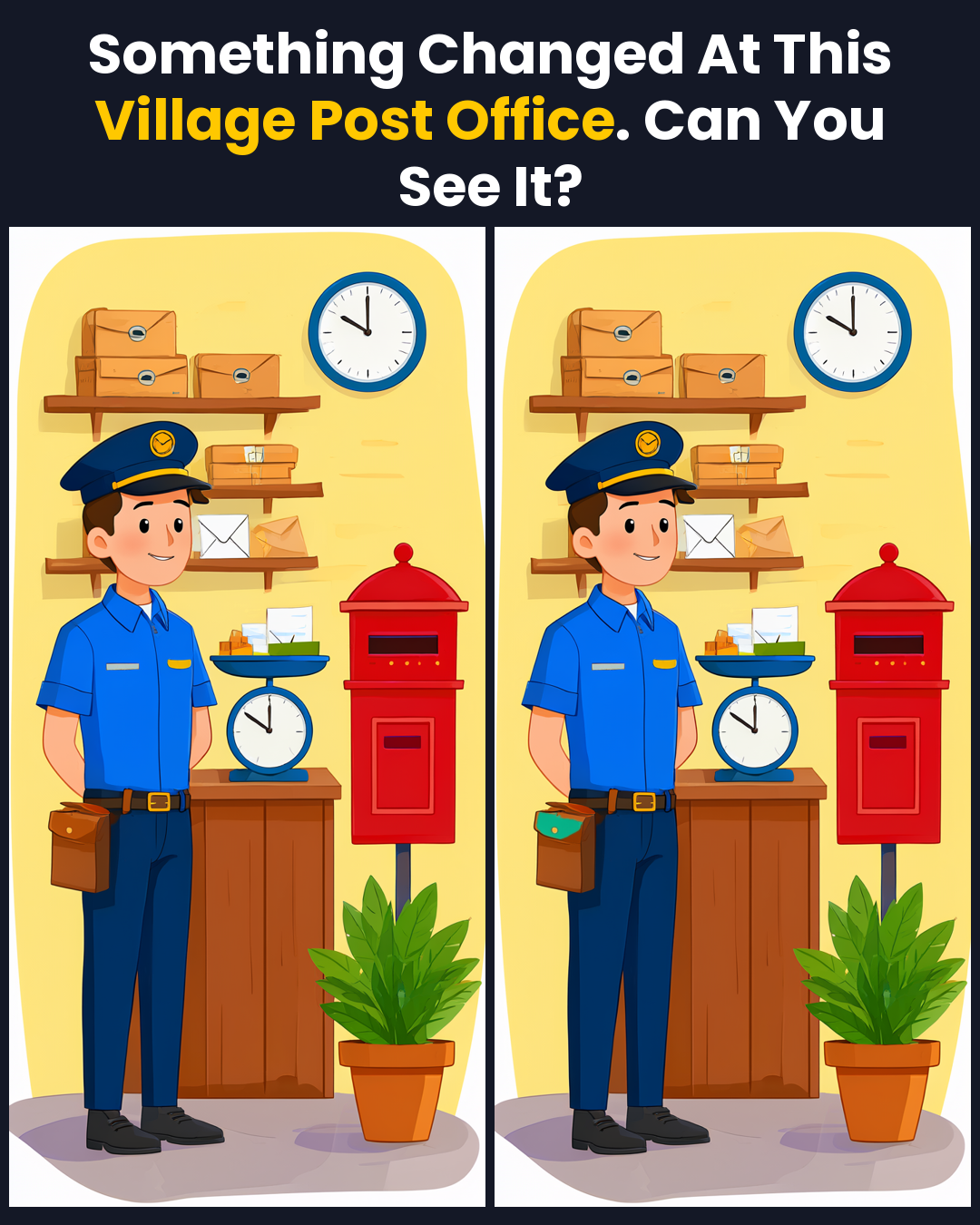
Take your time and look closely before you scroll down!
A Smart Way To Search
Most people hunt for differences by flicking their eyes back and forth between the two pictures as fast as they can. It feels busy and productive, but it is actually the slowest method there is, because nothing ever stays in your memory long enough to compare.
Try this instead. Pick one object, look at it properly in the left picture, and then look at the very same object in the right picture. Then move to the next object and do it again. The watering of the plant, the hands of the clock, the buckles, the shoes, the shelf brackets.
It helps to work in a fixed order, for example from the floor upwards, or from left to right. A fixed order means you can never lose your place, and you will not waste time checking the same parcel three times while the real change sits quietly somewhere else.
Why Our Brain Takes Shortcuts
Our eyes send a huge amount of information to the brain every second, far more than anyone could sensibly use. To cope, the brain writes a short summary and throws away the details. In this picture the summary is something like: a mailman, a counter, parcels, a red mailbox.
The trouble is that a summary has no room for the colour of a small flap of leather. So when we look at the second picture, the summary still fits perfectly, and the brain cheerfully reports that nothing has changed.
Uniforms make this even stronger. We know what a mailman looks like, and our memory quietly fills in the familiar details instead of actually checking them. Puzzle makers love that, because a tidy, predictable scene is the perfect place to hide something.
Did You Know?
Picture puzzles of this kind have been printed since the late nineteenth century, when cheap colour printing first arrived and magazines were looking for something the whole family could share.
They travelled well, too. The same puzzle works in any language, which is why you will find them in newspapers all over the world, often tucked between the weather and the crossword.
And they are good for us. Searching for small differences gives the attention muscles a gentle workout, the same muscles we use to read a timetable, check a receipt or find one particular jar at the back of the cupboard.
Your Friendly Challenge
Most people take about thirty seconds to find this one. Some find it in five, and then cannot understand how anybody could miss it.
Give yourself a full minute before you look at the answer. Then pass the picture to somebody else and watch their face. Sharing a puzzle is half the fun, and the laughter when they finally see it is the best part of the game.
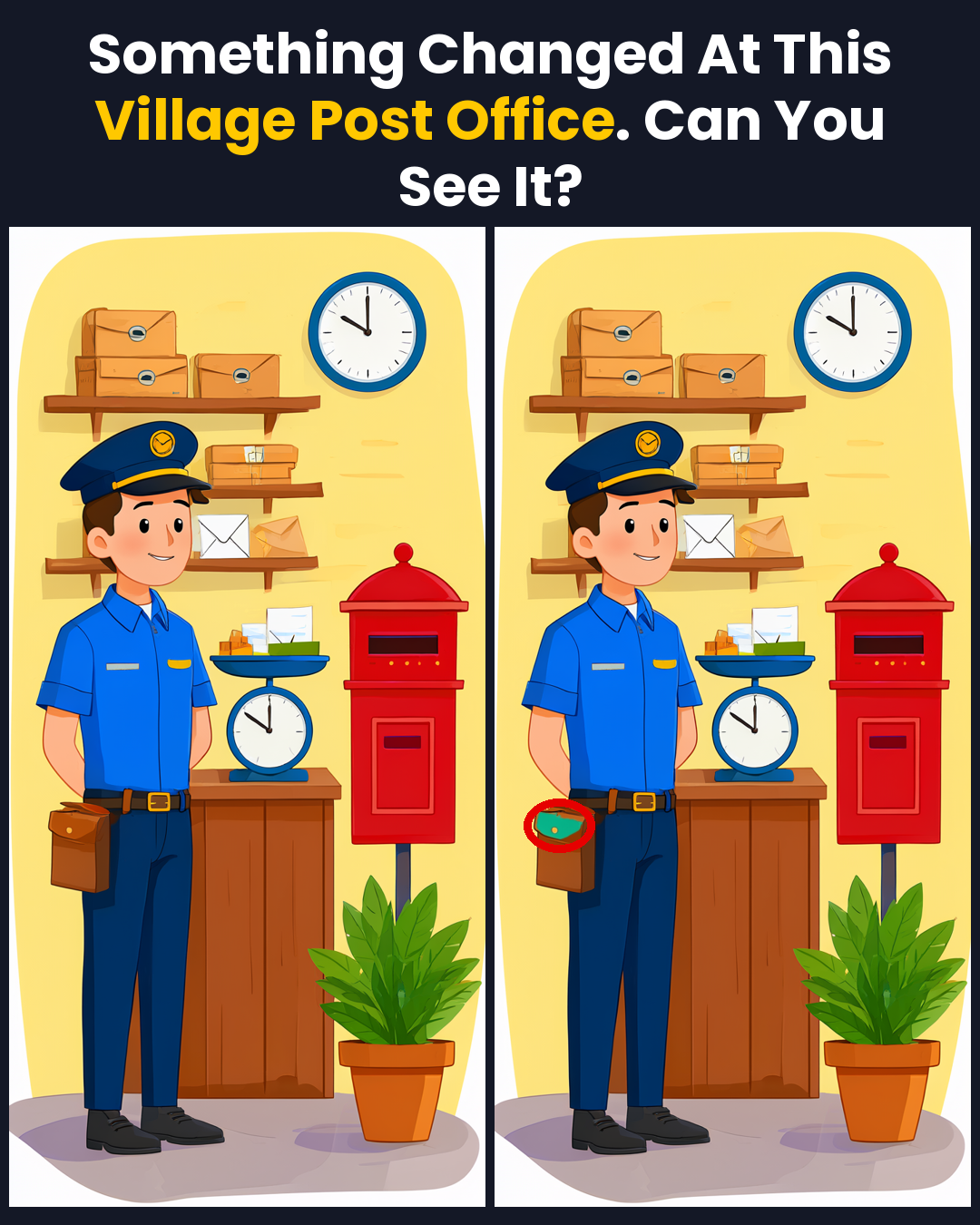
ANSWER: The flap of the mailman’s shoulder bag has changed colour from brown to green.
Where The Change Is Hiding
Look at the mailman’s shoulder bag, the little satchel hanging from his belt on his right-hand side. In the first picture the bag is brown from top to bottom, flap and all. In the second picture the flap over the top of the bag has turned a soft green, while the rest of the bag stays exactly the same.
It is a small patch of colour, and it sits low in the picture, below the level of his hands. Our eyes are drawn upwards to his friendly face and to the bright red mailbox, so that little flap hardly gets a moment of attention.
Why Most People Walk Right Past It
Bags, belts and pockets are what psychologists call low-information areas. We expect them to be there, we do not expect anything interesting to happen on them, so we look at them for the shortest possible time.
The red mailbox makes it harder still. Strong colours act like a magnet, pulling the eye to the right side of the picture again and again, while the quiet brown corner on the left is left to look after itself.
There is one more trick at work. The change keeps the shape, the size and the outline exactly the same. Only the fill colour moves, and shape is what our memory holds on to most firmly.
How Did You Do?
Under 10 seconds: eagle eyes, and probably a very tidy sock drawer as well.
10 to 30 seconds: excellent work. That is a careful, methodical way of looking.
30 to 60 seconds: very good indeed, and right where most people land.
More than a minute: you are in good company. Now that you know where to look, the next one will go much faster.