Hello, puzzle friends!
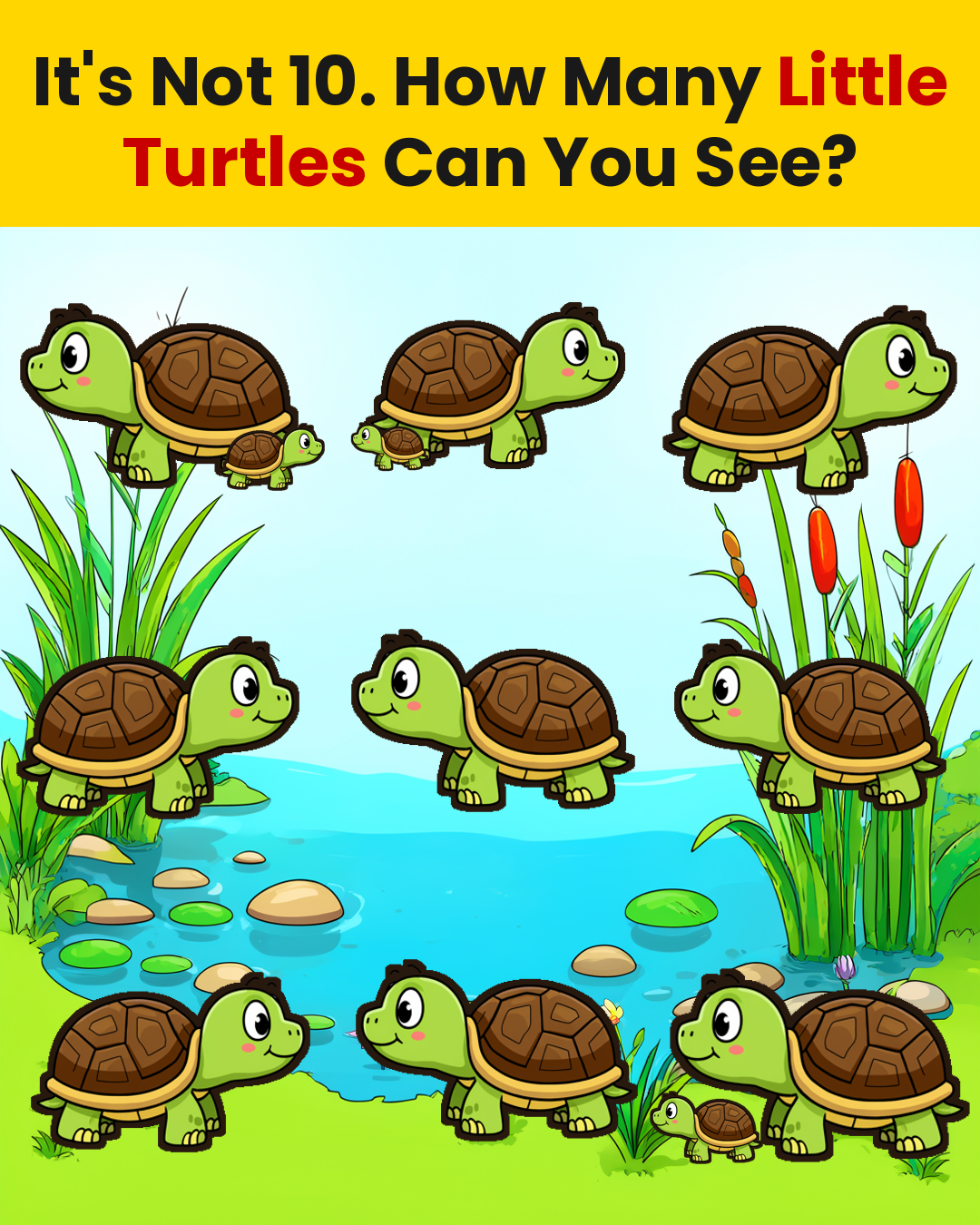
A family of little turtles has come out to enjoy the sunshine by the garden pond.
They are sitting on the grass, near the reeds and along the water’s edge, all of them looking very pleased with themselves.
Your job is simple: count every single turtle in the picture.
It sounds easy, and it is not. Most people answer too quickly and get it wrong.
The big ones are easy. The question is whether you can find the little ones as well.
A gentle tip: count in rows, from the top of the picture down to the bottom, and say each number out loud.
Take your time and count twice. Good luck!
Take your time and look closely before you scroll down!
How To Count Without Going Wrong
Counting puzzles are not really about counting. They are about searching. The arithmetic is easy, but finding every single object is not, and that is where almost everybody slips up.
The safest method is to count in rows. Start at the top of the picture, count everything across that line, then drop down to the next line and do the same. Never jump about, because the moment you jump you lose track of what you have already counted.
It also helps to use your finger. Touching each turtle as you count forces your eyes to stop on it properly, instead of skimming past. And say the numbers out loud if you can. Hearing yourself count gives your memory a second thread to hold on to, and it makes double counting much less likely.
Why Our Brain Finds This Hard
Human beings are surprisingly bad at counting groups. We can see one, two, three or four things instantly, without thinking. Beyond four, we have to count one by one, and that is slow, effortful work that our brain would rather avoid.
So it takes a shortcut. It glances at the picture, decides that there are about ten turtles, and offers that as an answer. The guess feels like knowledge, which is why so many people are certain they are right before they have finished looking.
Size makes it harder again. When several large shapes fill the picture, small versions of the same shape are quietly treated as part of the background, almost like decoration. They are in plain sight, and still we do not count them.
A Little Turtle Fact
Turtles have been on this earth for more than two hundred million years, which makes them older than almost anything else with a backbone. They were already plodding about when the dinosaurs arrived, and they were still here long after the dinosaurs had gone.
A baby turtle is tiny, no bigger than a coin in many species, and it must look after itself from the first day. Staying small and still is exactly how it survives, which is rather fitting for a puzzle like this one.
And they take their time. A turtle is never in a hurry, which is a very good reminder for anyone counting this picture too fast.
Your Friendly Challenge
Most people give their first answer within fifteen seconds, and most of those answers are too low by two or three.
So here is the challenge. Count once, write your number down, then count a second time going in the opposite direction, from bottom to top. If the two numbers agree, you can be fairly confident. If they do not, somebody small is hiding.
Then pass the picture to a friend and see whether they get the same number as you.
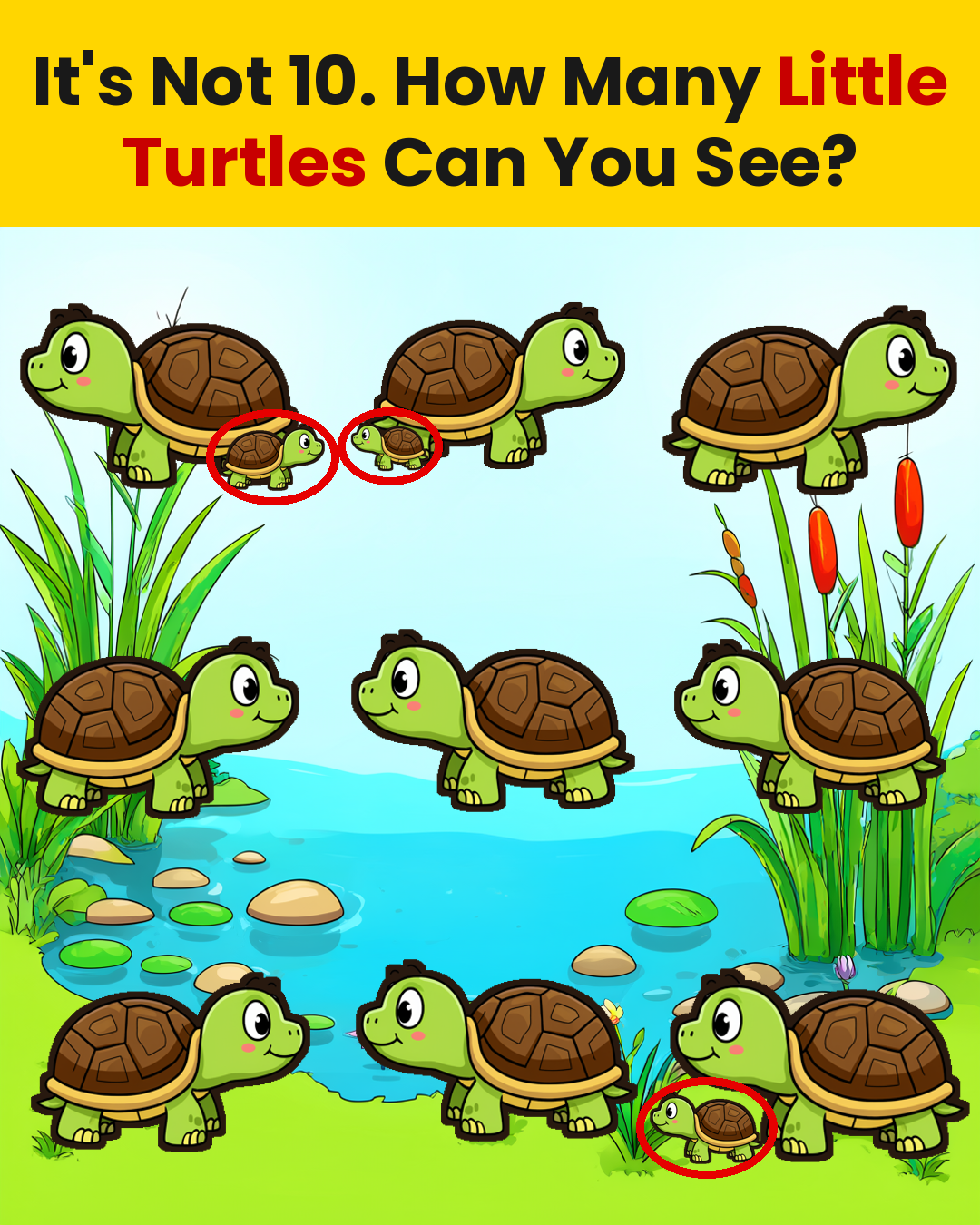
ANSWER: 12 turtles – three tiny babies are hiding right beside the big ones.
Where The Hidden Ones Are
There are twelve turtles in the picture altogether. Nine of them are big, easy to see, and arranged in three neat rows across the scene. Those are the ones nearly everybody finds.
The other three are babies, and they are much smaller. One is walking beside the big turtle in the top left corner, almost under its shell. A second one is just in front of the turtle at the top of the picture, so close that the two shapes seem to merge. The third is down in the bottom right corner, tucked in among the grass beside the biggest turtle of all.
Each little one is placed right next to a big one, which is the whole trick of the puzzle.
Why Most People Say Nine Or Ten
When a small shape sits against a large shape of the same colour and pattern, our eyes tend to read the two of them as one object. This is called grouping, and our brain does it automatically to keep the world simple.
On top of that, once you have counted the nine big turtles, the counting feels finished. The picture looks neat and complete, and the brain is quite happy to stop there. The babies are not hidden behind anything at all. They are simply small, and small things in a busy picture get treated as scenery.
How Did You Do?
You said 12 on the first try: eagle eyes. That is genuinely excellent searching.
You said 11: very close. You found two of the three little ones.
You said 10: a good, careful count of the obvious turtles, and the most common answer of all.
You said 9: you counted the big ones perfectly. Now go back and look beside each of them, and you will see the babies appear one by one.