Hello, puzzle friends, and welcome into the garden shed!
It is a tidy little place with clay pots, hanging tools, a watering can and a wheelbarrow waiting for spring.
But four small things have slipped in here that really do not belong in a shed.
You can see them all down the right hand side: an apple, a pencil, a butterfly and a key.
Every one of them is somewhere in the picture, in plain sight, at its normal little size.
A gentle tip to start: look at the edges and the shadows, not only at the shelves in the middle.
Take your time, find all four, and then read on to see exactly where they were.
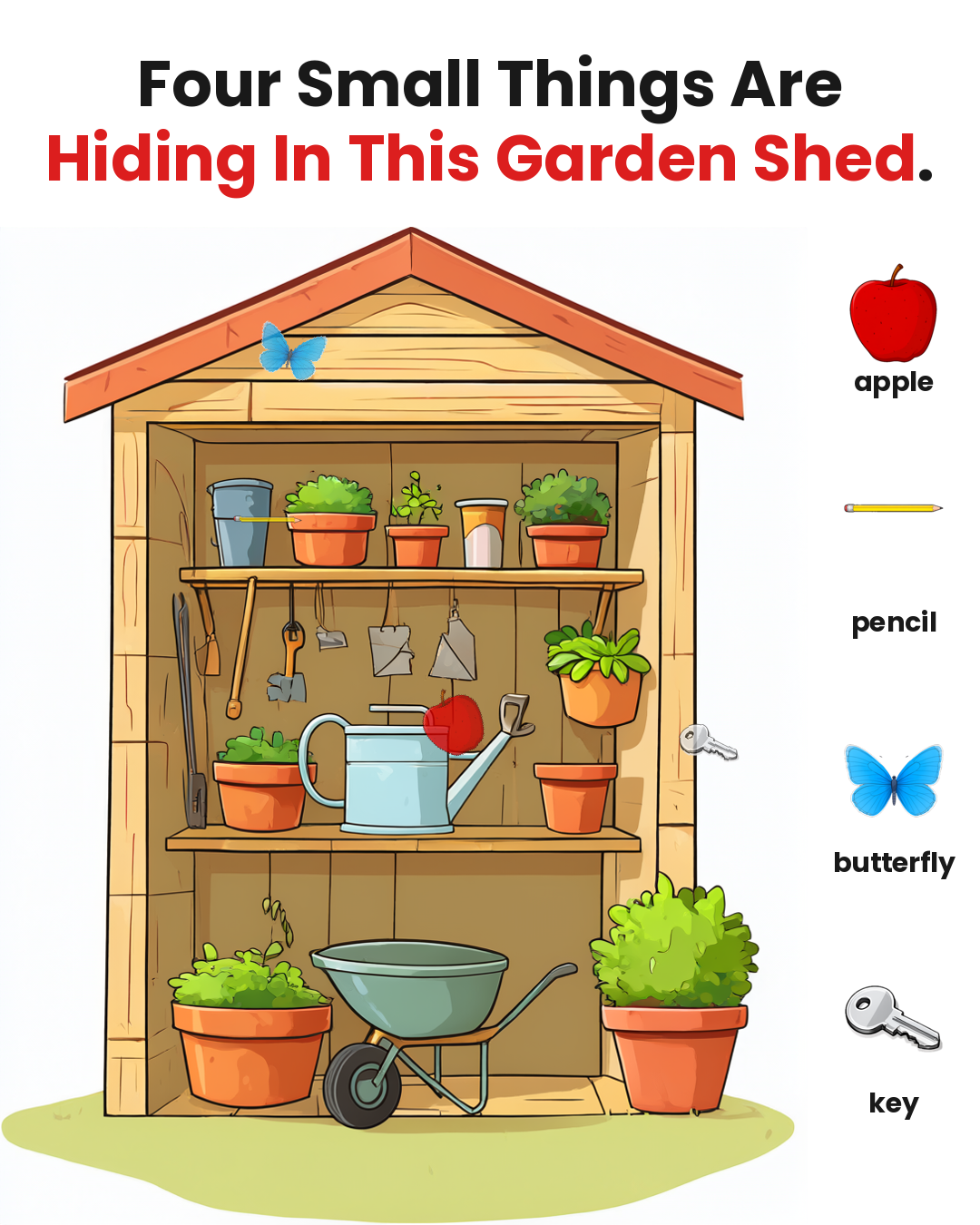
Take your time and look closely before you scroll down!
Search The Picture Like A Gardener
A hidden object picture rewards a plan. Wandering eyes find the big obvious shapes and then run out of patience, which is why so many people find two objects quickly and then give up on the other two.
Here is a method that works. Divide the shed into four parts in your mind: the roof, the top shelf, the middle shelf with the tools, and the floor with the wheelbarrow. Search one part completely before you move to the next, and do not allow yourself to jump back.
Then do one extra pass that almost nobody thinks of. Run your eye all the way around the outside edge of the shed, along the roof line and down both walls. Small objects love edges, because the eye treats the border of a picture as the frame rather than as part of the scene.
Why Small Things Disappear In Plain Sight
Nothing in this picture is really hidden. Everything is fully visible and nothing is covered up. What hides the objects is the clutter around them, and the way our attention works.
Psychologists call it inattentional blindness. When a scene is busy, the brain cannot process every detail, so it builds a quick summary: shelves, pots, tools, plants. Anything that fits the summary is accepted without a second look, and a small object sitting among the clutter is swallowed whole.
Colour matters too. A red apple against a wooden wall ought to shout, but set it beside a watering can and a row of terracotta pots and it becomes just another warm patch. A grey key against pale wood has almost no contrast at all, and low contrast is the oldest camouflage there is.
Size is the last piece. We expect important things to be large. A tiny object is quietly filed under background by a brain that is trying to be efficient.
A Puzzle With A Long History
Hidden object pictures go back to the puzzle pages of the eighteen hundreds, where engravers would tuck faces and animals into the leaves of a tree and ask readers to find the hidden hunter. They were a favourite way to pass a winter evening.
The form never really went away. It grew into the picture books many of us read with our children and grandchildren, and today it is one of the most shared kinds of puzzle in the world.
The Friendly Challenge
Most people find three of the four objects in about forty seconds, and then spend another minute hunting for the last one. The fourth is always the slow one, whichever it happens to be for you.
Give yourself ninety seconds and see how many you can collect. Then hand the picture to a friend or someone in the family and watch them search. It is quite wonderful how often one person sees in a second what another has stared past ten times.
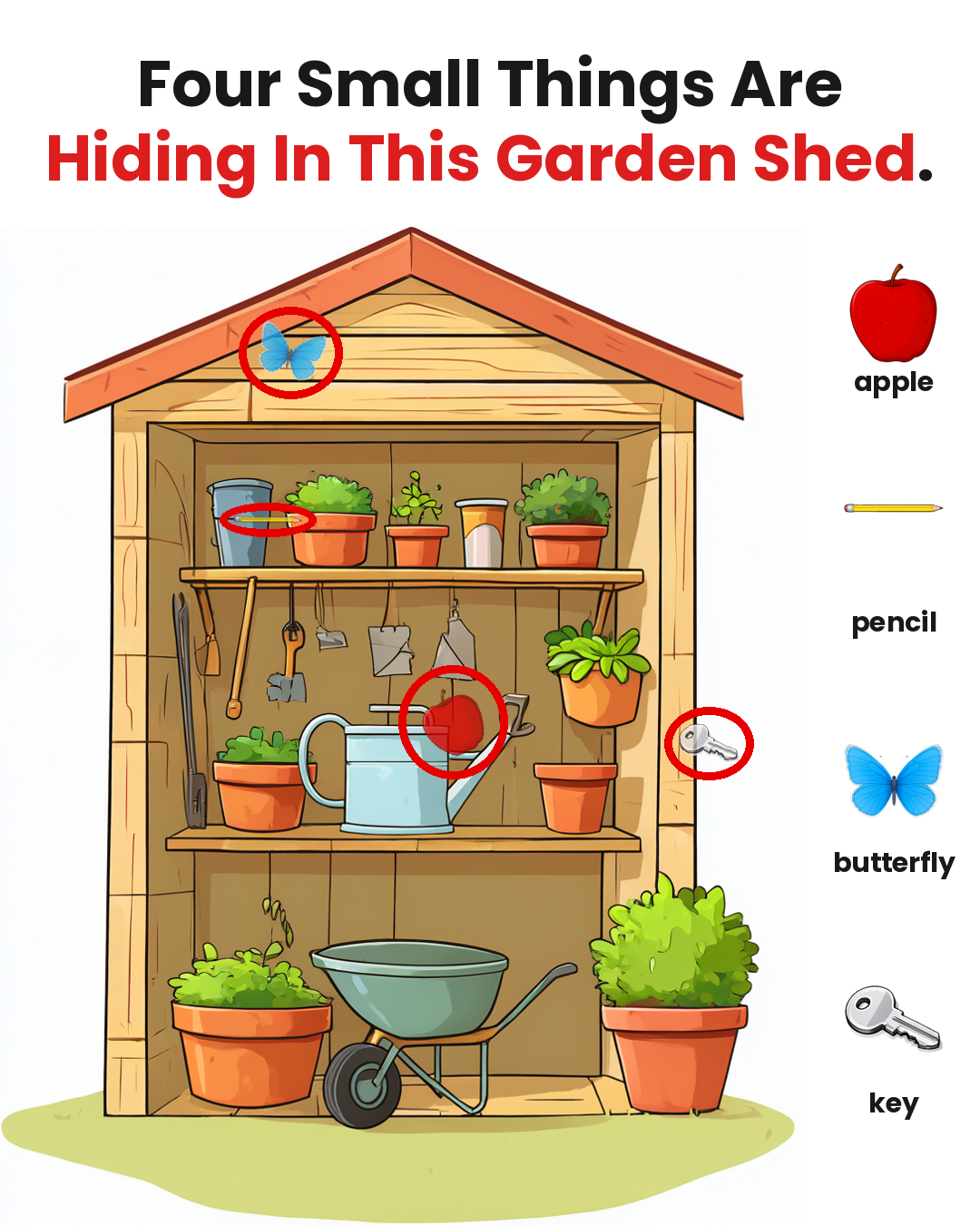
ANSWER: the butterfly is on the roof edge, the pencil lies on the top shelf by the grey bucket, the apple sits behind the watering can, and the key hangs on the right hand wall
Where All Four Were Hiding
The butterfly is the one most people spot first. It rests on the roof edge at the top left of the shed, just where the orange roof meets the wooden gable, and its blue wings are the only cool colour up there.
The pencil is lying flat on the top shelf, right next to the grey metal bucket on the left. It is yellow, thin and horizontal, so the eye reads it as part of the shelf edge and sails straight past.
The apple is tucked behind the big watering can on the middle shelf, with only its round red top showing above the spout. Red among terracotta pots is the perfect hiding place.
The key is usually the last to be found. It hangs on the wall on the right hand side, level with the watering can. It is small, grey and very close to the border of the picture, which is exactly the spot our attention treats as empty frame.
How Did You Do?
All four in under thirty seconds means you have genuine eagle eyes and you searched the edges early, which is the mark of an experienced puzzler.
All four in under a minute is an excellent result and better than most readers manage. Up to two minutes is a good, careful score and nothing to be shy about.
If you found three and the last one would not come, that is completely normal. The key defeats more people than the other three together. Next time, start your search at the outside edges and work inward, and you will be surprised how quickly those little things appear.