Hello, puzzle friends, and welcome to the forest!
Autumn has arrived in this little clearing. The leaves have turned golden, the grass is still green, and a family of round, friendly hedgehogs has come out to enjoy the sunshine.
Your task today is a simple one to explain and a surprisingly tricky one to do: count the hedgehogs.
Nearly everybody answers nine, and nearly everybody is wrong.
So before you say a number out loud, look again, slowly, across the whole picture and all the way into the corners.
A little tip: not every hedgehog in this clearing is the same size.
Take your time, count twice, and then decide.
Good luck!
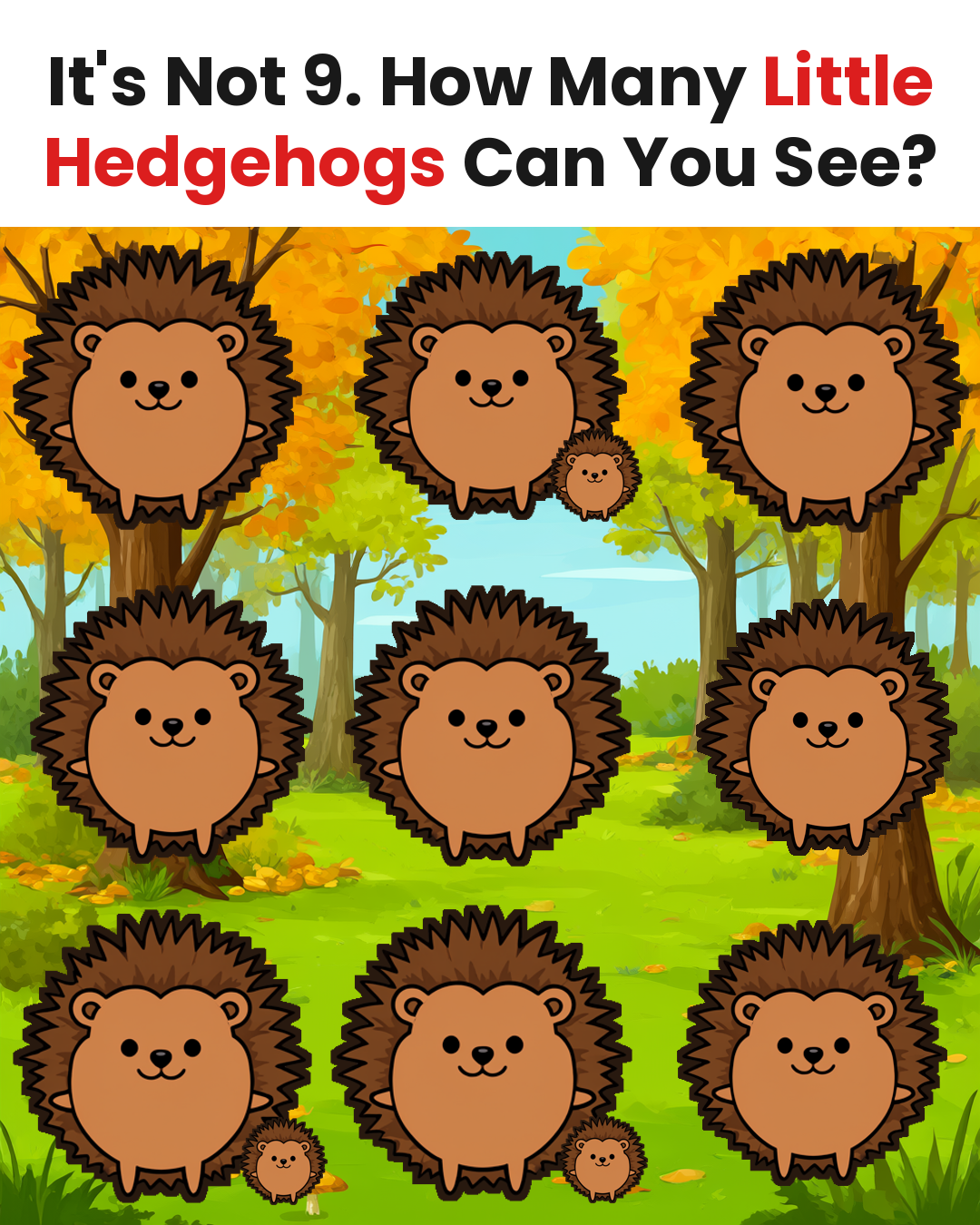
Take your time and look closely before you scroll down!
How To Count Without Losing Your Place
Counting looks like the easiest thing in the world until the things you are counting are scattered across a picture. Then the eye starts hopping, you count one animal twice, miss another altogether, and end up with a different number every time.
The fix is to impose an order on the picture rather than following your eyes. Read the scene like a page of a book: left to right along the top, then left to right along the middle, then left to right along the bottom. Say each number quietly as you go, or touch the screen with a fingertip.
Then, and this is the important part, do a second pass in the opposite direction, from the bottom right back up to the top left. If both passes give you the same number, you can trust it. If they do not, something in the picture is hiding from you.
Why Our Brain Guesses Instead Of Counting
Human beings are born with a rough sense of quantity. We can look at a small group and know instantly, without counting, that there are three or four of something. Beyond about five, that instant sense fades and we have to count properly, one item at a time.
The trouble is that the instant sense does not switch itself off politely. It makes a confident guess first, and the guess feels like knowledge. That is why so many people glance at a picture like this, feel sure of an answer, and never actually count at all.
Size fools us as well. When several objects are large and obvious, the brain treats them as the whole group and quietly drops the small ones from the tally. They are in your field of vision. They simply never reach the counting part of your mind.
The Hedgehog, A Garden Favourite
Real hedgehogs are a good match for a counting puzzle, because they spend much of their lives not being seen. They are mostly active at night, they move quietly through leaves and long grass, and when they feel uncertain they curl into a tight ball that looks remarkably like a clump of dried leaves.
A hedgehog carries somewhere around five to seven thousand spines, and those spines are hollow and surprisingly light. Gardeners in many countries are glad to see them arrive, because a hedgehog wandering through a flower bed at dusk is an excellent and entirely free pest controller.
They are also wonderful mothers. A litter of young hedgehogs, called hoglets, stays close to the adult for several weeks, following along in a tidy little line.
Your Challenge
Most people need between twenty and forty seconds to get this right, and a great many never get it right at all, because they answer in three seconds and stop looking.
So here is the test. Count once, quickly, the way you naturally would. Write that number down. Then count again, slowly, row by row, and look carefully at the edges of every large hedgehog before you move on.
If your two numbers are different, the second one is almost certainly the better one. And when you are happy with your answer, send the picture to a friend, let them give you their first number, and see whether they are willing to look twice.
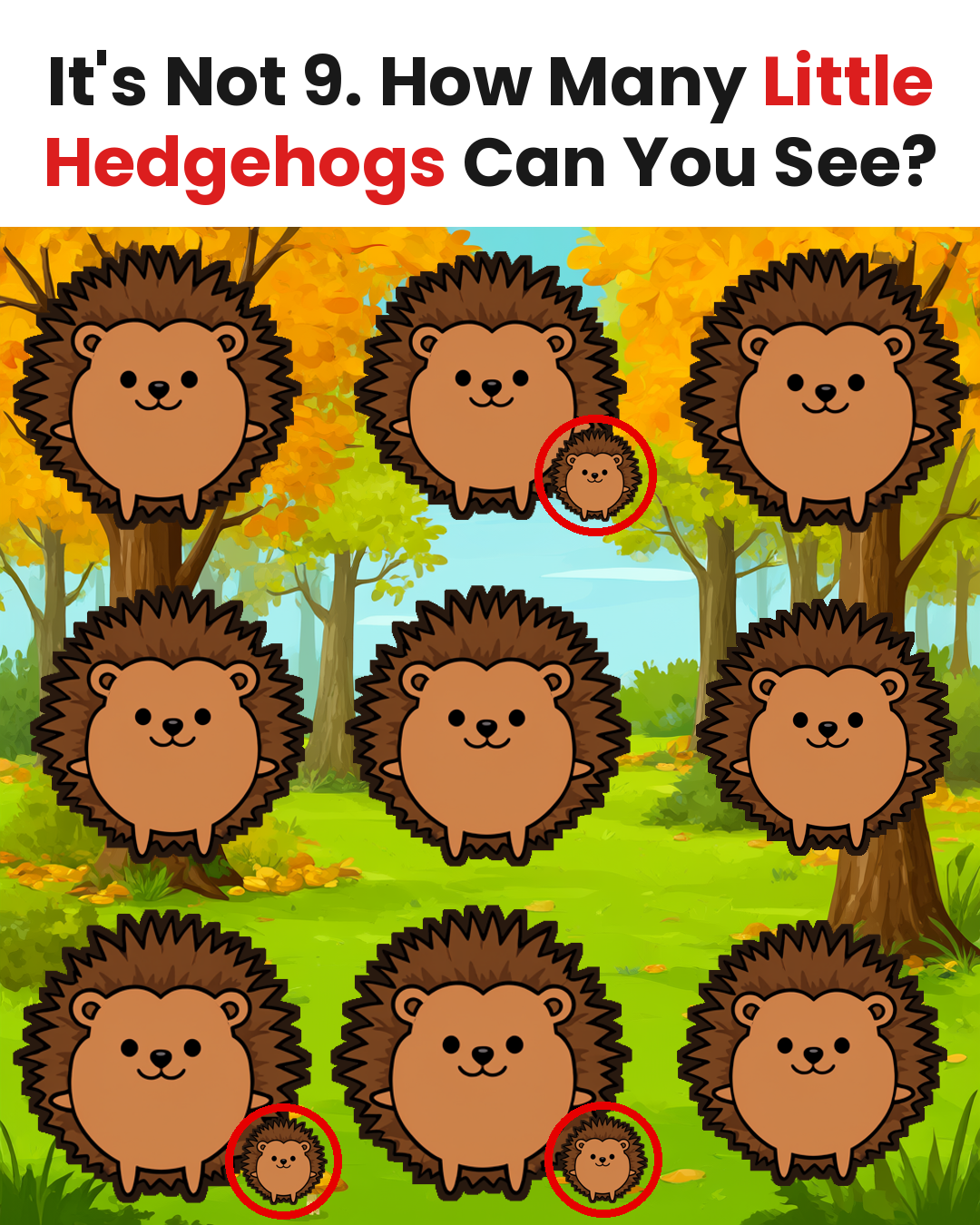
ANSWER: 12 hedgehogs – three tiny babies are tucked in close beside the big ones.
Where The Extra Hedgehogs Are
The nine large hedgehogs are easy. They sit in three neat rows of three, right across the clearing, and nobody has any trouble with those.
The other three are much smaller, and each one is tucked in close beside a big one, low down and slightly to the right. The first baby is sitting at the foot of the hedgehog in the middle of the top row, with its little face peeping out past the bigger one’s side. The second is on the ground beside the hedgehog at the bottom left, almost touching the mushroom in the grass. The third is beside the hedgehog in the middle of the bottom row, resting in the same low position.
Nine big hedgehogs plus three tiny ones gives the real answer: twelve.
Why Nearly Everybody Says Nine
Two things hide the babies. The first is their position. Each one sits right against the body of a large hedgehog, so the eye reads the pair as a single animal with a bumpy edge rather than as two separate animals.
The second is colour. The babies have exactly the same brown faces and dark spines as the adults, so there is no contrast to make them stand out. Had they been white or bright orange, every single reader would have found them immediately.
And there is the neat arrangement of the big ones. Three rows of three form such a tidy pattern that the brain declares the picture solved as soon as it recognises the grid. Once we have an answer we like, we stop looking, and the little ones never get counted.
How Did You Do?
Twelve in under ten seconds: eagle eyes. You looked at the whole picture before you trusted the pattern, which very few people manage.
Twelve in ten to thirty seconds: excellent counting. You felt that something was missing and went back for it.
Twelve after a minute or two: a fine result, and proof of real patience.
Nine, eleven, or any other number: you are in the large and cheerful majority. Now that you know the trick, look along the ground beside the big animals in the next counting puzzle, and you will catch the little ones first time.