Hello, puzzle friends, and come on into the kitchen!
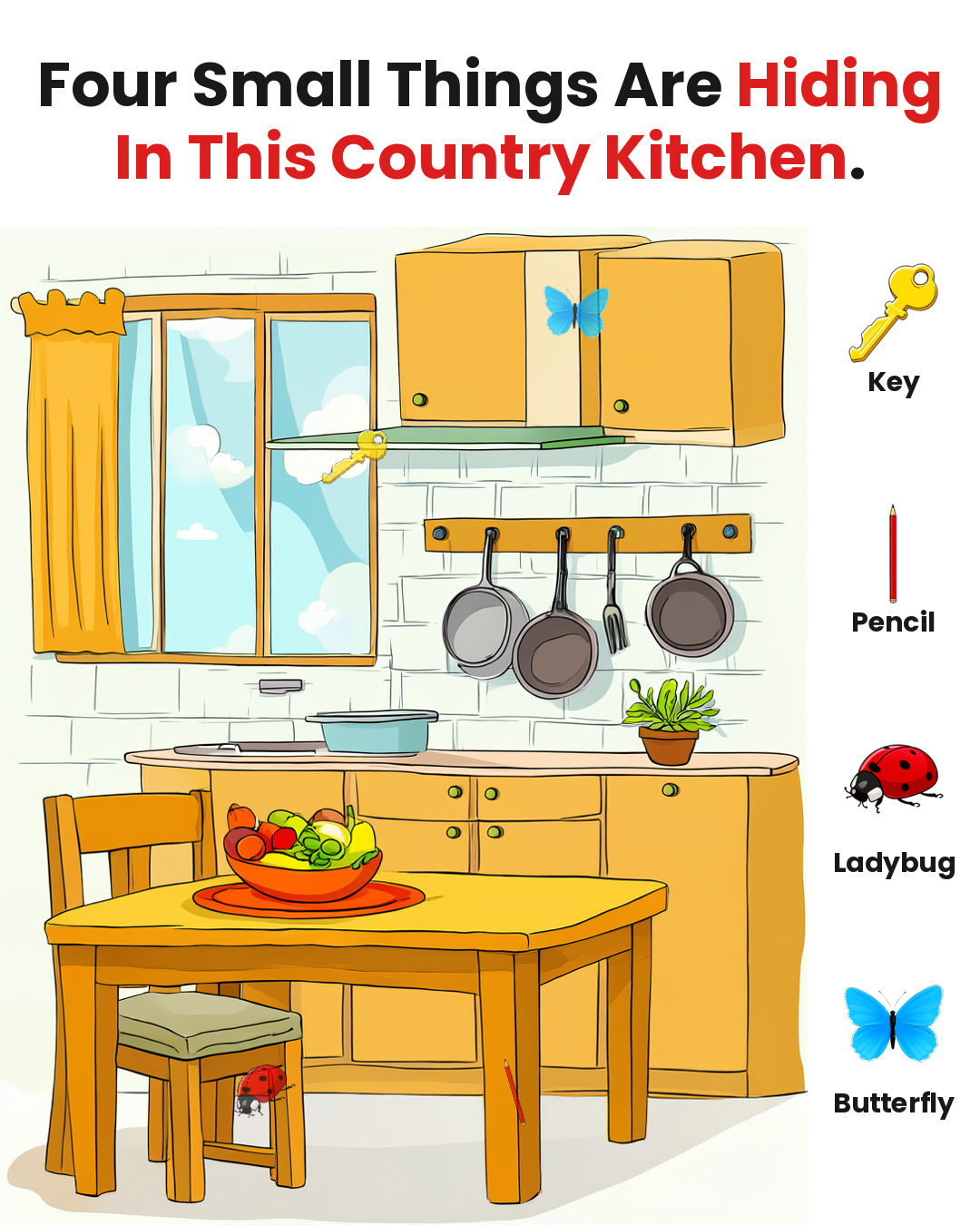
It is a bright country kitchen with wooden cupboards, a row of pans on the wall and a bowl of fruit on the table.
It looks perfectly ordinary, and that is exactly the problem.
Four small things have been tucked away in this room, and you can see all four of them in the column on the right: a key, a pencil, a ladybug and a butterfly.
Every one of them really is somewhere in the picture, in plain sight, not covered up and not cut in half.
Find all four and you are doing better than most people who look at this picture.
Take your time and look closely before you scroll down!
Hunt By Object, Not By Area
The natural way to search a picture is to sweep your eyes across it and hope something jumps out. It almost never does, because you are asking your brain to look for four completely different things at the same time, and it is not built for that.
Do it one object at a time instead. Start with the butterfly. Hold its shape and its blue colour in your mind, then run across the whole kitchen looking only for that. Ignore everything else, even if something else catches your eye. When the butterfly is found, clear your mind and start again with the key.
It feels slower and it is in fact much faster. Searching for one thing gives your attention a single clear target, and a single clear target is something the brain is extremely good at finding.
Think About Where A Small Thing Would Sit
Hidden object pictures are not random. The small things are nearly always placed where an edge, a leg or a shadow gives them somewhere to belong. So search the places where a tiny object would naturally come to rest.
Look along the line where a shelf meets a wall. Look at the legs of tables and chairs, where something could lean or rest. Look at the join between two cupboard doors. Look underneath things rather than on top of them, because the top of an object is the first place everybody checks and the puzzle maker knows that.
The middle of a bare wall or an empty stretch of floor is almost never the answer. Edges and joins are where the treasure is.
The Trick Is Colour, Not Size
You might think these objects are hard to spot because they are small. Size matters, but colour matters more. A dark object on a dark background disappears far more completely than a small bright one on a pale wall.
That is the principle behind camouflage everywhere in nature. A moth on tree bark is not hidden by a clever shape, it is hidden because its colours repeat the colours behind it, and the eye finds no edge to catch on. Our vision works by hunting for boundaries, and when there is no boundary there is nothing to see.
The makers of these puzzles use the same idea. Put a red pencil against warm brown wood and it practically vanishes, even though it is standing out in the open and is as long as your finger.
Your Friendly Challenge
Most people find two of the four within fifteen seconds. The third usually takes about half a minute. The fourth is the one that makes people put the picture down, pick it up again, and mutter at the screen.
Give yourself ninety seconds and try to get all four. If you only manage three, make a note of which one beat you before you read on.
Then pass it along without a word of help. Watching somebody stare straight at the answer and not see it is one of life’s small pleasures.
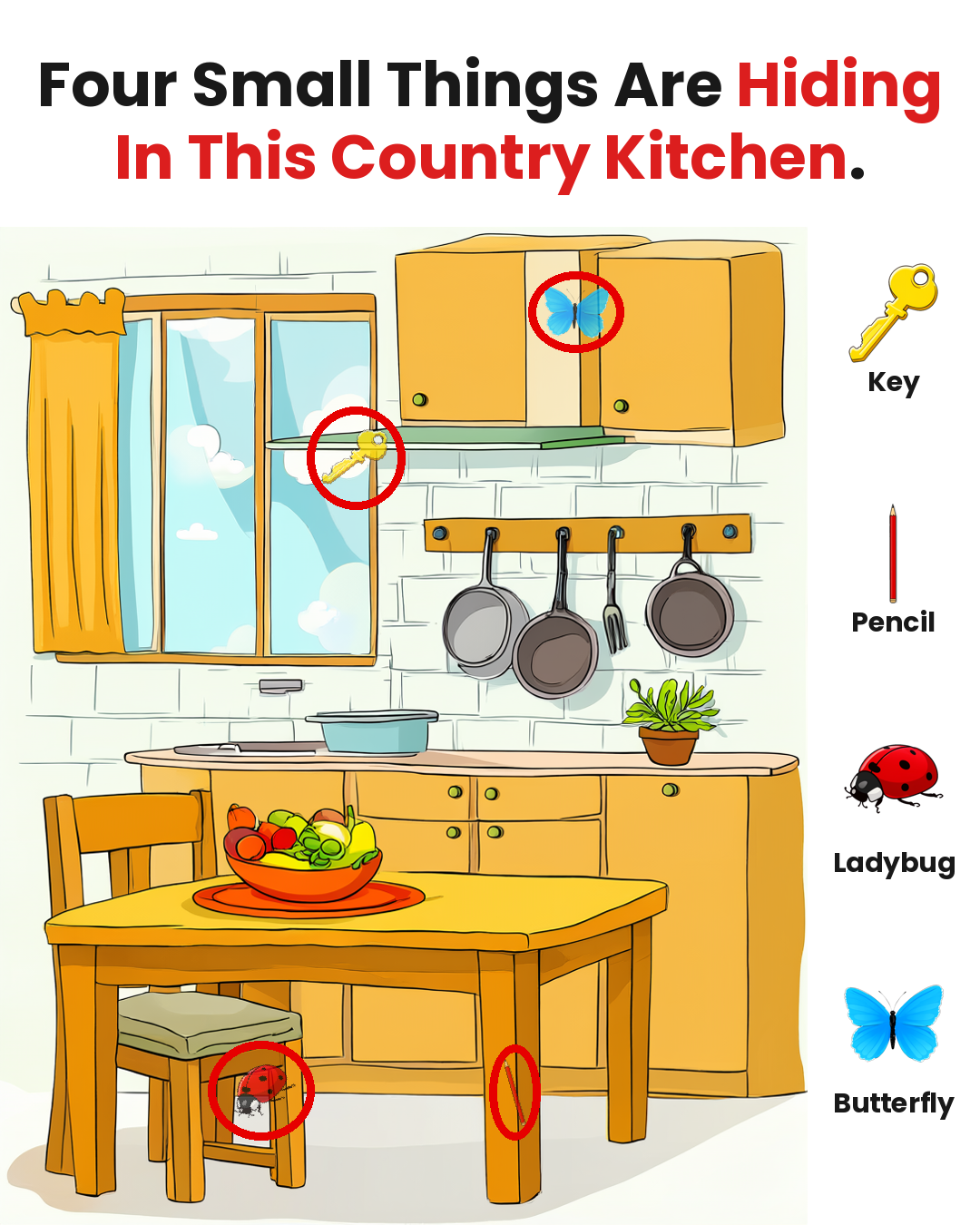
ANSWER: The butterfly is on the upper cupboard door, the key lies on the little green shelf by the window, the ladybug is under the chair seat and the pencil leans against the table leg.
All Four, One By One
The butterfly is the highest of the four. It is resting on the front of the upper cupboard, right where the two doors meet, its blue wings spread flat against the pale strip of wood.
The key lies on the narrow green shelf under the cupboard, close to the window. It is golden on a light background and almost in the middle of the picture, which is exactly why it slides past so many eyes.
The ladybug is down at the bottom left, tucked under the seat of the wooden chair in the shadow below the cushion.
And the pencil is leaning against the front leg of the table, near the bottom of the picture, standing upright like a thin red stripe on the wood.
Why These Four Are So Good At Hiding
Each one uses a different trick. The pencil is red on golden brown, a warm colour on a warm background, and it is also long and thin, which makes it read as an edge or a crack in the wood rather than an object.
The key is golden against a pale shelf, and it sits beside a window full of bright sky. Your eye is drawn to the brightest part of a picture, so it goes to the window and travels onward without ever stopping at the shelf.
The ladybug is in shadow, and shadow is the oldest hiding place there is. The butterfly is the boldest of the four, bright blue in the open, yet it sits high up in a corner of the room. We read pictures from the centre outwards, so the top corners get the least attention of all.
How Did You Do?
All four in under twenty seconds means you have truly sharp eyes and a very good search method.
All four in under a minute is an excellent result and puts you well ahead of the crowd.
Three out of four is the most common score of all, and the pencil is usually the one that gets away.
If you found two and gave up, there is no shame in it at all. Simply pass the picture on and let somebody else find out how hard it is.