Hello, puzzle friends, and welcome into the warmest room in the house!
Somebody has left the living room door open, and a whole litter of orange tabby kittens has taken over the wooden floor.
Your job today sounds easy: simply count the kittens.
Almost everyone answers ten in the first few seconds, and almost everyone is wrong.
A gentle hint before you start: not every kitten in this room is the same size, and the smallest ones have found very good places to sit.
Take your time, go over the picture twice, and only then say your number out loud.
Good luck, and enjoy the company!
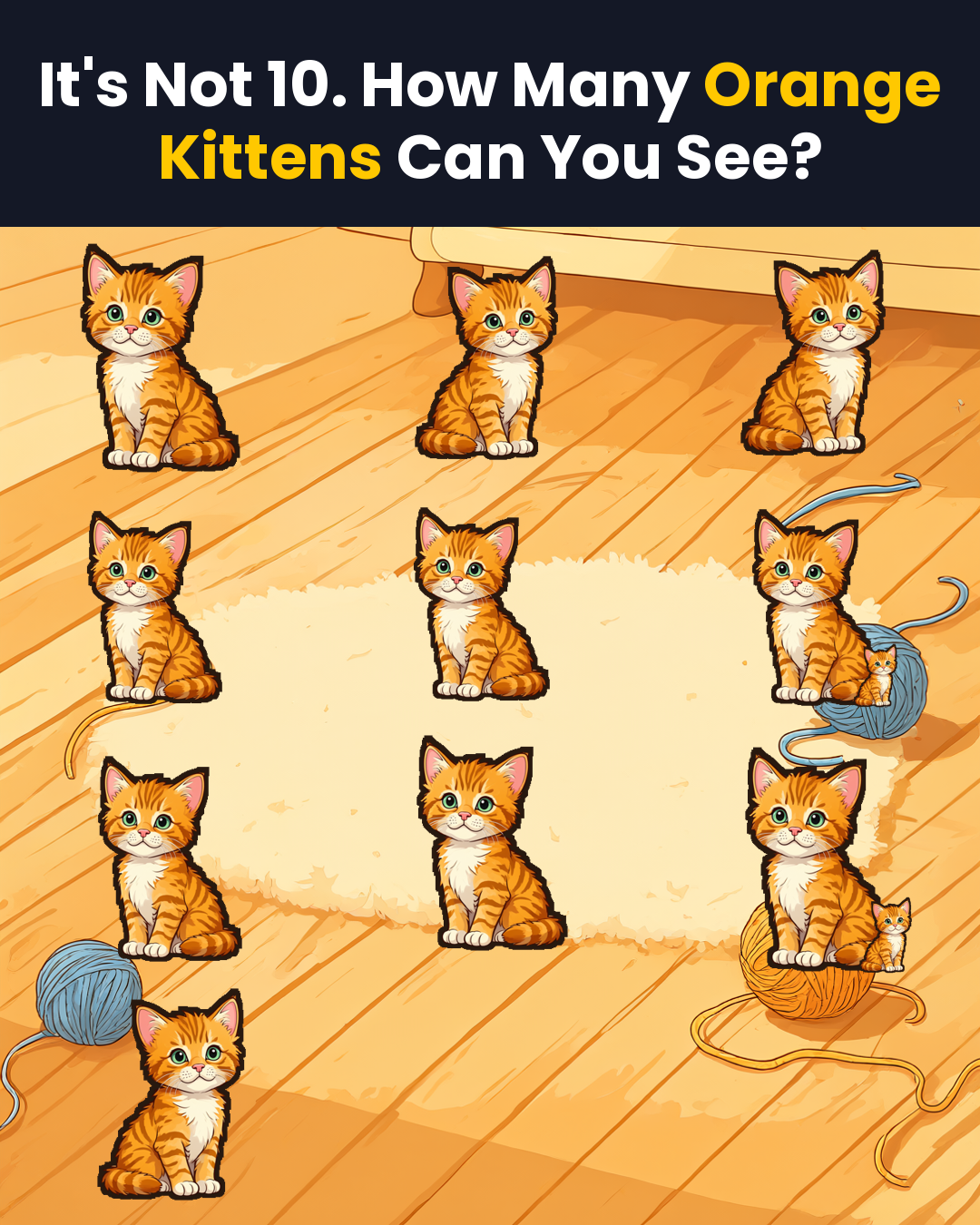
Take your time and look closely before you scroll down!
Count The Way A Careful Person Counts
Counting a handful of things is something we all think we can do without effort. Then somebody spreads those things across a picture, and suddenly the simple job turns slippery. The eye jumps about, lands on the same kitten twice, skips over another one completely, and the number changes every time you try.
The cure is to stop letting your eyes choose the order. Give the picture a route and follow it like a road. Read the floor the way you read a page: along the top row from left to right, then the middle, then the bottom, and finally the two side edges. Touch each kitten with your finger on the screen if that helps, because a finger does not wander the way a gaze does.
When you reach the end of your route, do not stop. Go back and run it a second time in the opposite direction, from right to left. If both passes give you the same number, you can trust it. If they do not, the difference is almost always hiding in a corner or behind an object, and that is exactly where you should look next.
Why Our Eyes Fall For This Every Time
There is a reason this kind of picture fools nearly everybody, and it has nothing to do with poor eyesight. Our brain is built to take shortcuts. When it sees several similar shapes arranged in a tidy pattern, it does not count them one by one. It recognises the pattern, estimates a number, and moves on to something more interesting.
That shortcut is wonderful in daily life. It is why you can glance at a table and know there are enough chairs for everyone without counting a single one. But a puzzle maker can turn the shortcut against you. Lay out ten kittens in neat rows and the brain happily reports ten, closes the case, and refuses to look any further.
Size is the second trap. We expect members of a family to look roughly alike, so a kitten that is only a third of the size of the others does not register as another kitten at all. It reads as part of the furniture, a smudge of colour, a pattern on a ball of yarn. Colour helps the trick along: orange on orange, warm wood on warm fur, and the little ones melt into the room.
A Puzzle As Old As The Newspaper
Counting puzzles have been entertaining people for well over a hundred years. They appeared in Victorian magazines, in the puzzle corners of Sunday newspapers, and on the back pages of children’s annuals long before anybody thought of putting them on a telephone screen. The style changes, but the idea never does: draw a crowd, hide a few members of it in plain sight, and let the reader argue about the total.
Psychologists eventually took an interest too. They found that most people can see up to about four objects instantly, without counting at all. Beyond four, we have to work, and working is exactly where mistakes creep in. That little gap between glancing and truly looking is the whole secret of this puzzle.
So if you answered too quickly, do not be hard on yourself. You were simply being efficient, as your brain was designed to be.
Your Friendly Challenge
Here is the test. Most people land on the right number in about forty seconds, once they slow down and stop trusting that first confident glance. A good many never get there at all and stay happily convinced that the answer is ten.
Give yourself one honest minute. Decide on a number, say it out loud so you cannot quietly change your mind later, and then read on.
And when you know the answer, pass the picture to somebody else without a single hint. Watching a friend announce ten with complete certainty is the very best part of the whole business.
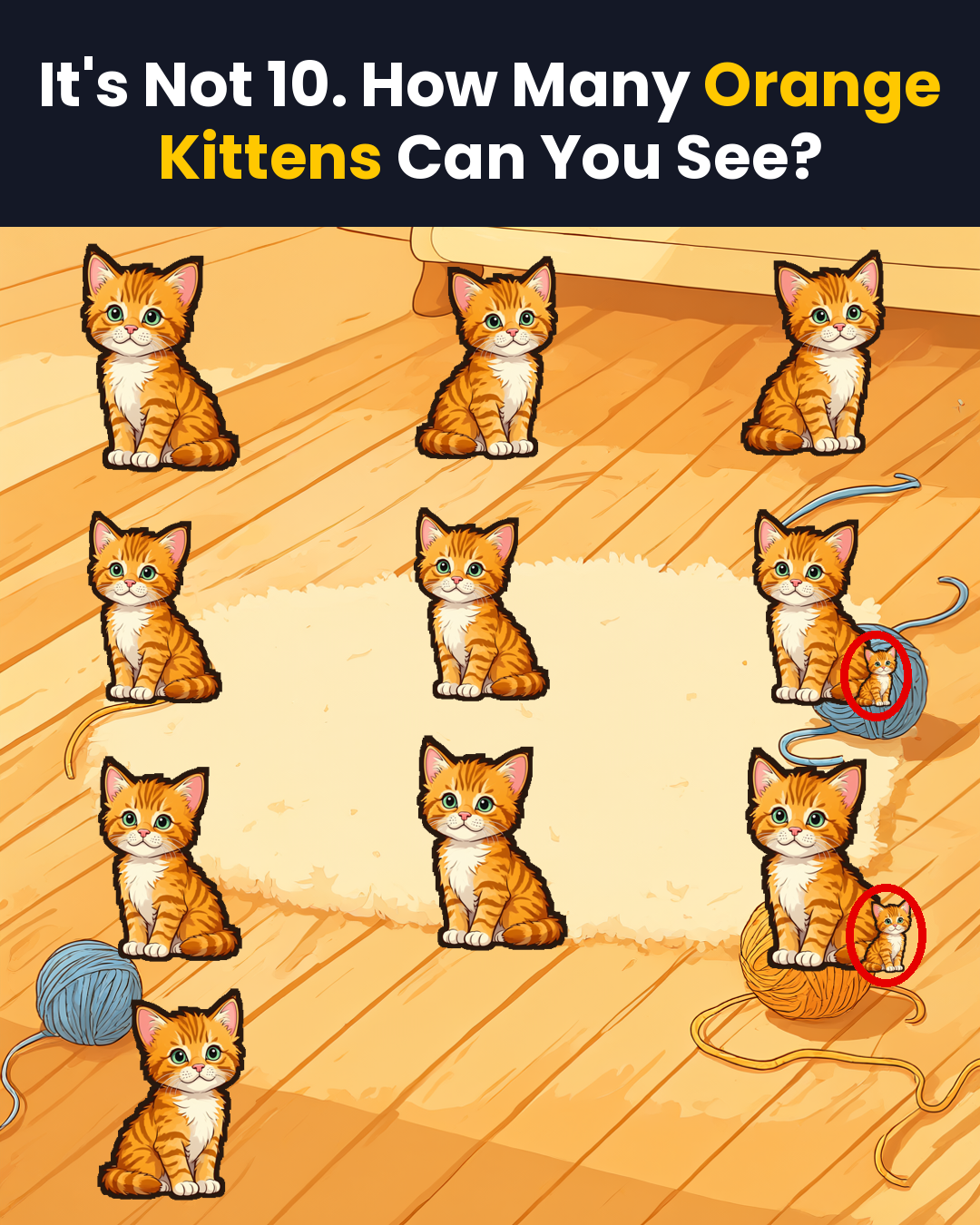
ANSWER: 12 kittens – two tiny ones are sitting on the balls of yarn on the right side of the room.
Where The Last Two Were Hiding
Ten kittens are easy. They sit in open view on the wooden boards and around the cream rug, each one a good hand’s width tall, each one looking straight out at you. Those ten are the number nearly everybody reports.
The other two are much smaller, and both of them are on the right hand side of the room, keeping company with the yarn. One tiny kitten sits tucked against the blue ball of wool, halfway up the picture, almost touching the big kitten beside it. The second is perched right on top of the golden ball of yarn near the bottom right corner, so small that at first glance it looks like a knot in the wool.
That makes twelve kittens in total.
Why Almost Nobody Sees Them
Both of the little ones are placed next to a full sized kitten, and that is the clever part. When two similar shapes sit side by side, the bigger one takes all the attention and the smaller one is quietly filed away as a shadow, a toy, or a bit of pattern. Our eyes also treat the edges of a picture as less important than the middle, so the right hand strip gets the shortest look of all.
Then there is the colour. Orange fur against a golden ball of yarn and a honey coloured wooden floor gives almost no contrast at all. Nature uses the very same trick: a fawn in dry grass, a moth on tree bark. Camouflage is not about being invisible, it is about matching your surroundings well enough that a busy brain does not bother to stop.
How Did You Do?
Under ten seconds and you have eagle eyes, the kind of vision that spots a missing earring on a patterned carpet.
Ten to thirty seconds is very good indeed, and means you went back for a second look instead of trusting your first impression.
Thirty to sixty seconds puts you with the careful majority, which is excellent company to keep.
Over a minute, or still certain that the answer is ten? You are in the biggest group of all, and you now have a wonderful picture to pass on to somebody else.