Good morning, puzzle friends!
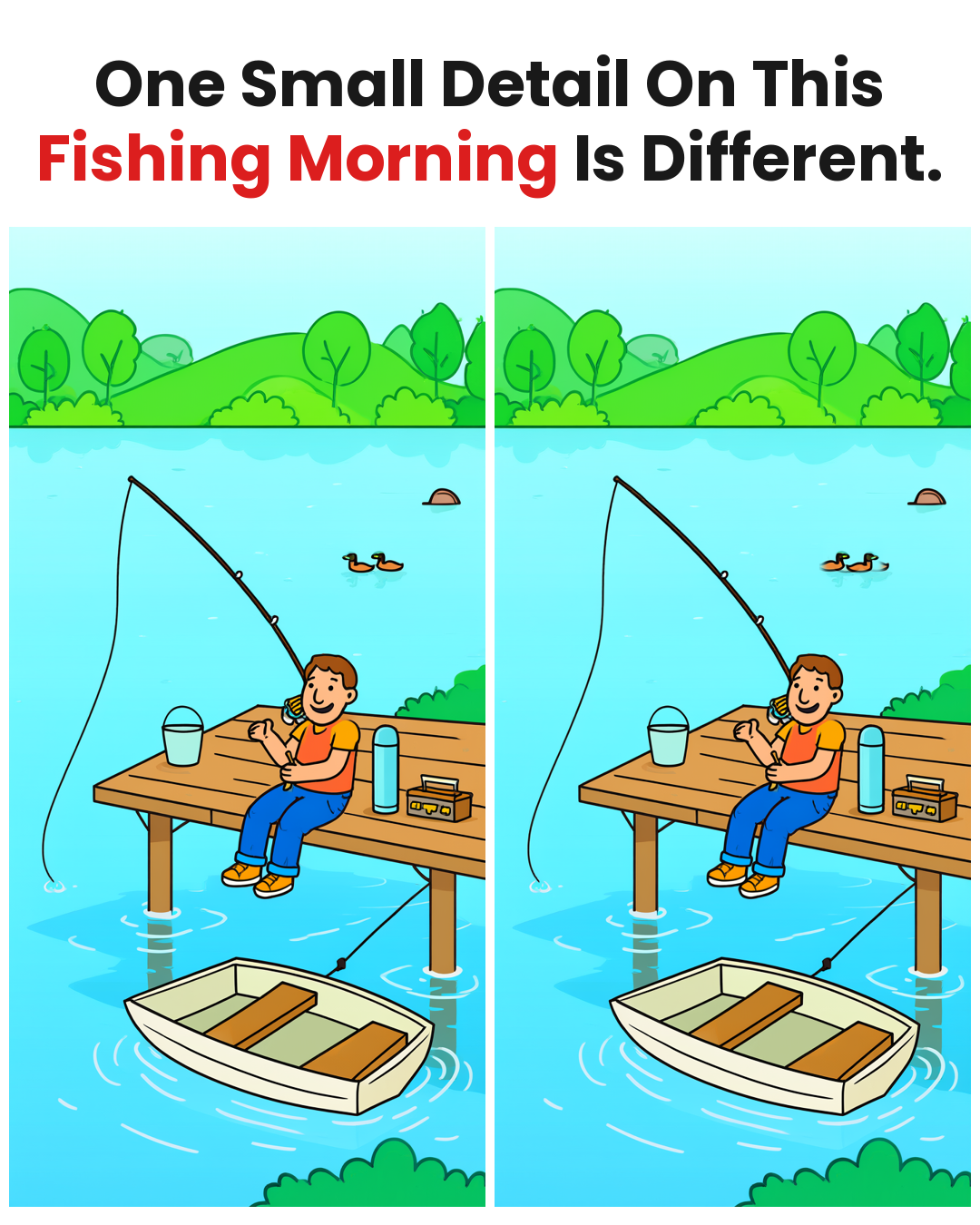
Today we are sitting on a wooden jetty at a quiet lake.
A man has his rod in the water, a bucket and a thermos beside him, and a little rowing boat is tied below.
Out on the water there are two ducks paddling along.
The two pictures of this peaceful morning are almost the same – but only almost.
One small detail has changed, and it is not on the jetty.
Look slowly, enjoy the view, and see whether you can catch it.
Take your time and look closely before you scroll down!
Do Not Forget The Quiet Corners
In a calm scene like this one, the eye goes straight to the person. We look at the man, his rod, his red shirt, then down to the boat because it is big and bright. The empty blue water in between hardly gets a glance.
That is a mistake worth correcting. Puzzle makers love the quiet corners precisely because nobody visits them. Make a rule for yourself: before you compare the main character, give five seconds to the sky, five to the background hills and five to the empty space.
Then go through the objects in a fixed order. Bucket, thermos, tackle box, boat, rope, the posts under the jetty. Naming each thing out loud in your head slows you down in the best possible way, because you cannot name a thing without truly looking at it.
Direction Is Harder Than Colour
A change of colour shouts. A change of direction whispers. When something simply faces the other way, every colour, every shape and every size stays exactly the same, so none of the usual alarm bells ring in your head.
Our brain stores pictures as meaning rather than as detail. It remembers two ducks on the water. It does not bother to record which way their beaks were pointing, because in ordinary life that detail never matters. When the second picture arrives, the brain checks its note – two ducks, yes – and happily reports that nothing has changed.
This is why mirrored details are the most difficult kind of difference of all. If you have hunted for a while and found nothing, stop searching for a wrong colour and start asking a different question: is anything here pointing the other way?
Fishing, Patience And Puzzles
There is something fitting about a fishing picture here. Anglers will tell you that the whole art is in waiting quietly and watching the surface for the smallest sign. A spot the difference puzzle asks for exactly the same skill, only the water is made of ink and pixels.
Puzzles of this kind have appeared in newspapers since Victorian times, and they have never gone out of fashion. Every generation discovers the same small pleasure: the moment when the picture suddenly gives up its secret and you cannot understand how you ever missed it.
How Long Will It Take You?
Most people need between thirty and sixty seconds for this one, because the change is a quiet one. Under twenty seconds is an outstanding result.
Give it one honest try before you look at the answer, and then pass the picture on to a friend. It is always fun to watch somebody search the jetty for a full minute while the real answer floats calmly on the water.
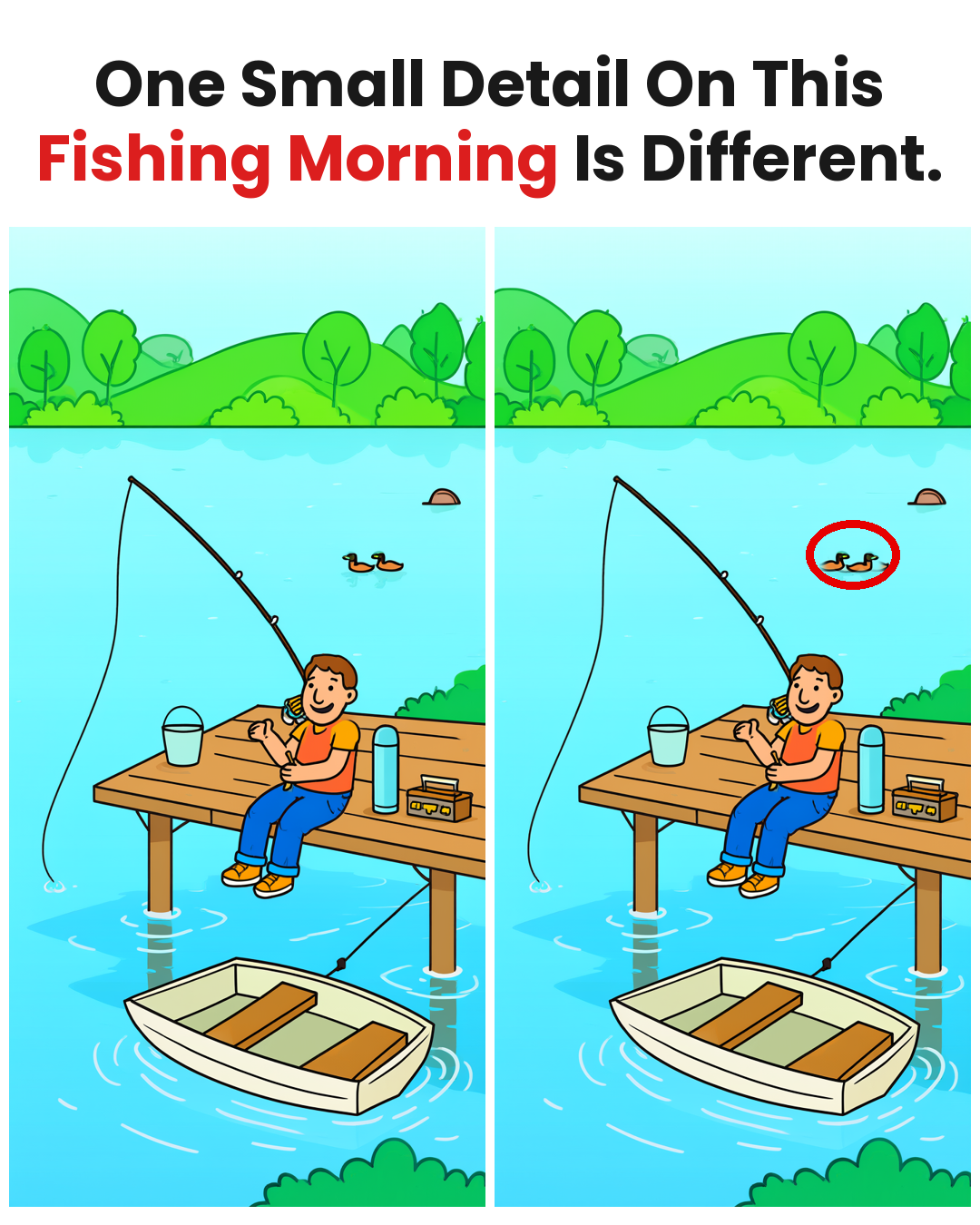
ANSWER: The two ducks have turned around – in the second picture they are swimming the other way.
Out On The Water, Not On The Jetty
The answer is the pair of ducks swimming in the middle of the lake, above the man’s shoulder. In the first picture they are facing to the left. In the second picture they have been turned around and are facing to the right.
Everything on the jetty is untouched. The bucket, the thermos, the tackle box, the rod, the man’s clothes, the rowing boat and the rope that ties it are all identical in both pictures, and so are the hills and the trees behind.
Why Almost Everybody Misses It
The ducks are small, they are far from the middle of the action, and they are the only things in the picture that have no clear line of their own to compare. Our eyes are drawn to the man and to the boat, and the open water between them reads as empty space.
There is also the matter of memory. We recognise a duck instantly, but we do not store its direction. The brain is satisfied as soon as it confirms that two ducks are present. Add the fact that a mirrored object keeps its exact colour and size, and you have the hardest kind of difference there is.
How Did You Do?
Under fifteen seconds: eagle eyes, and you clearly check the background first. Fifteen to forty seconds: very good indeed, that is a sharp result for a mirrored change. Forty to ninety seconds: a normal and honest score for a puzzle built to be quiet.
If you did not find it at all, take the lesson rather than the disappointment. Next time, after your first sweep, ask yourself which way things are pointing. That single question turns the hardest puzzles into easy ones.