Hello again, puzzle friends!
Today we are spending the morning beside a quiet little pond, and the frogs have come out to say good morning.
Your task is a simple one to explain: count every single green frog you can find in the picture.
The big ones are easy. They sit up straight with their round eyes and almost count themselves.
But the big ones are not the whole story, and that is where most people slip up.
Look along the edges of the lily pads and right beside the big frogs, where a smaller friend could be sitting.
Decide on your number first, say it out loud, and only then scroll down to the answer.
That is the honest way to play, and it makes the surprise much more fun!
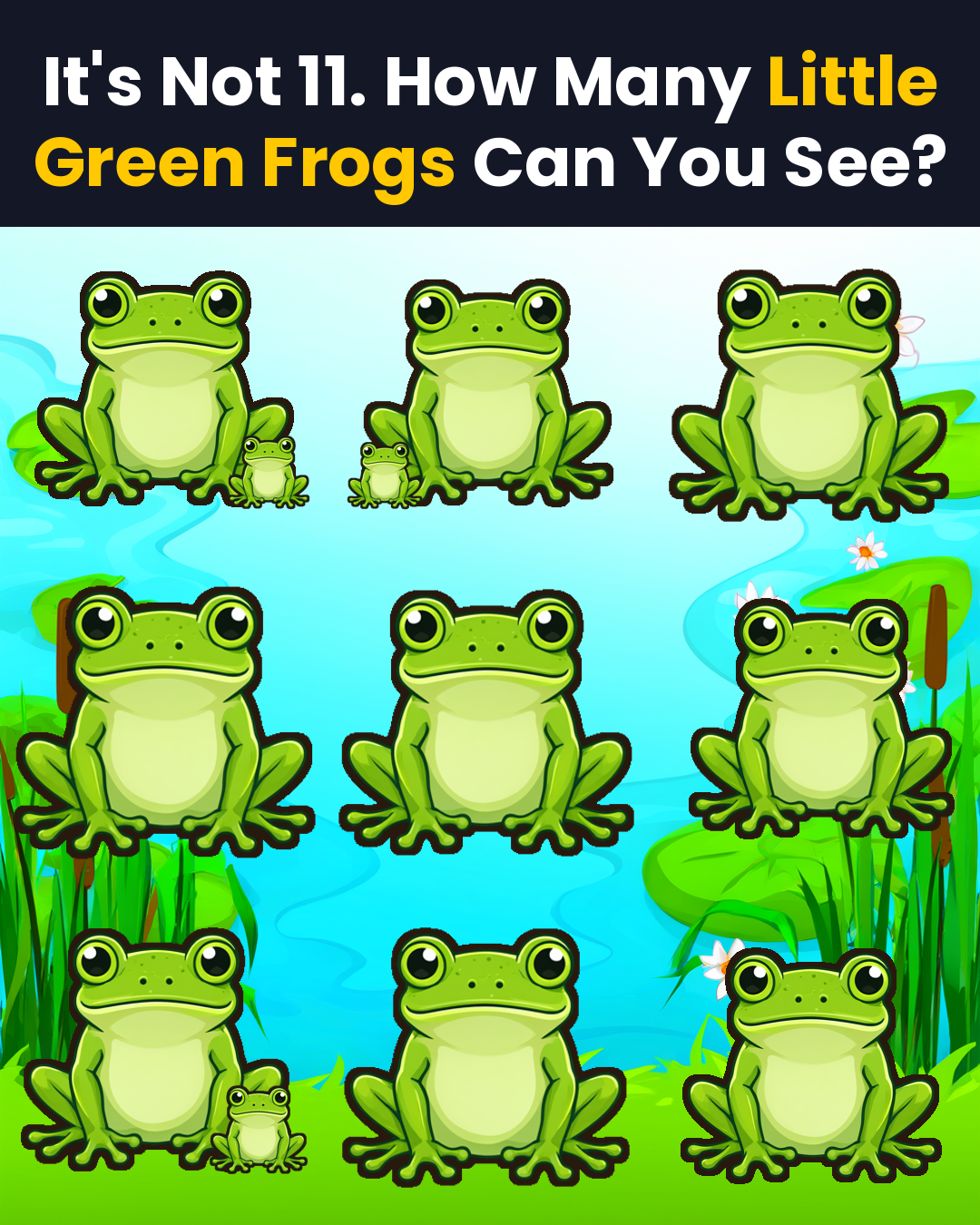
Take your time and look closely before you scroll down!
Count In Rows, Never In Circles
The fastest way to get a counting puzzle wrong is to let your eyes wander wherever they please. They jump to the brightest frog, then to the one with the funniest face, then back to the first one again, and before you know it you have counted the same frog twice and missed another one completely.
The cure is wonderfully simple. Treat the picture like a page of writing. Start in the top left corner, move slowly to the right until you reach the edge, then drop down to the next row and do exactly the same thing. Three tidy rows, left to right, every time.
If you have a pencil handy, tap the screen or the paper gently as you count. That little movement keeps your place for you, and it slows you down just enough to notice the things a quick glance skips over.
Why Our Eyes Miss The Small Ones
There is a good reason this picture fools so many people, and it has nothing to do with your eyesight. Our brains are built to notice the biggest, boldest shape in a scene first. In the days when we lived out in the open, spotting the large thing moving towards you mattered far more than spotting the small thing sitting still.
So when you look at a pond full of frogs, your attention locks onto the large, clearly outlined ones straight away. Once your brain decides it has understood the scene, it quietly stops looking. The small frogs, which are the same colour and the same shape, simply blend into what your mind has already filed away as finished business.
It is the same reason we walk past our own reading glasses on the kitchen table. The brain is not being lazy. It is being efficient, and efficiency sometimes costs us three little frogs.
A Game As Old As The Printing Press
Counting puzzles like this one are far older than the internet. Victorian magazines printed pictures full of hidden animals for families to argue over by the fireside, and newspapers in the nineteen thirties ran weekly counting pictures that readers posted their answers to by letter.
The idea has never gone out of fashion because it needs nothing at all. No pieces to lose, no board to set up, no rules to remember. One picture, one simple question, and a few happy minutes of concentration.
Teachers and therapists still use them today, because careful counting asks the brain to hold a number in mind while the eyes keep working. That is a real little workout, and it feels like play rather than practice.
So, How Brave Are You Feeling?
Most people give their first answer in about seven seconds, and most of those first answers are too low. The number in the title is not the right one, so if you landed there, go back and look once more.
Here is a friendly challenge. Count once quickly, write the number down, then count again slowly using the row method. If the two numbers are different, the second one is almost certainly right.
Then send this picture to a friend and ask for their number before you tell them yours. Comparing answers is half the fun, and somebody always swears there is one more frog than anybody else can find.
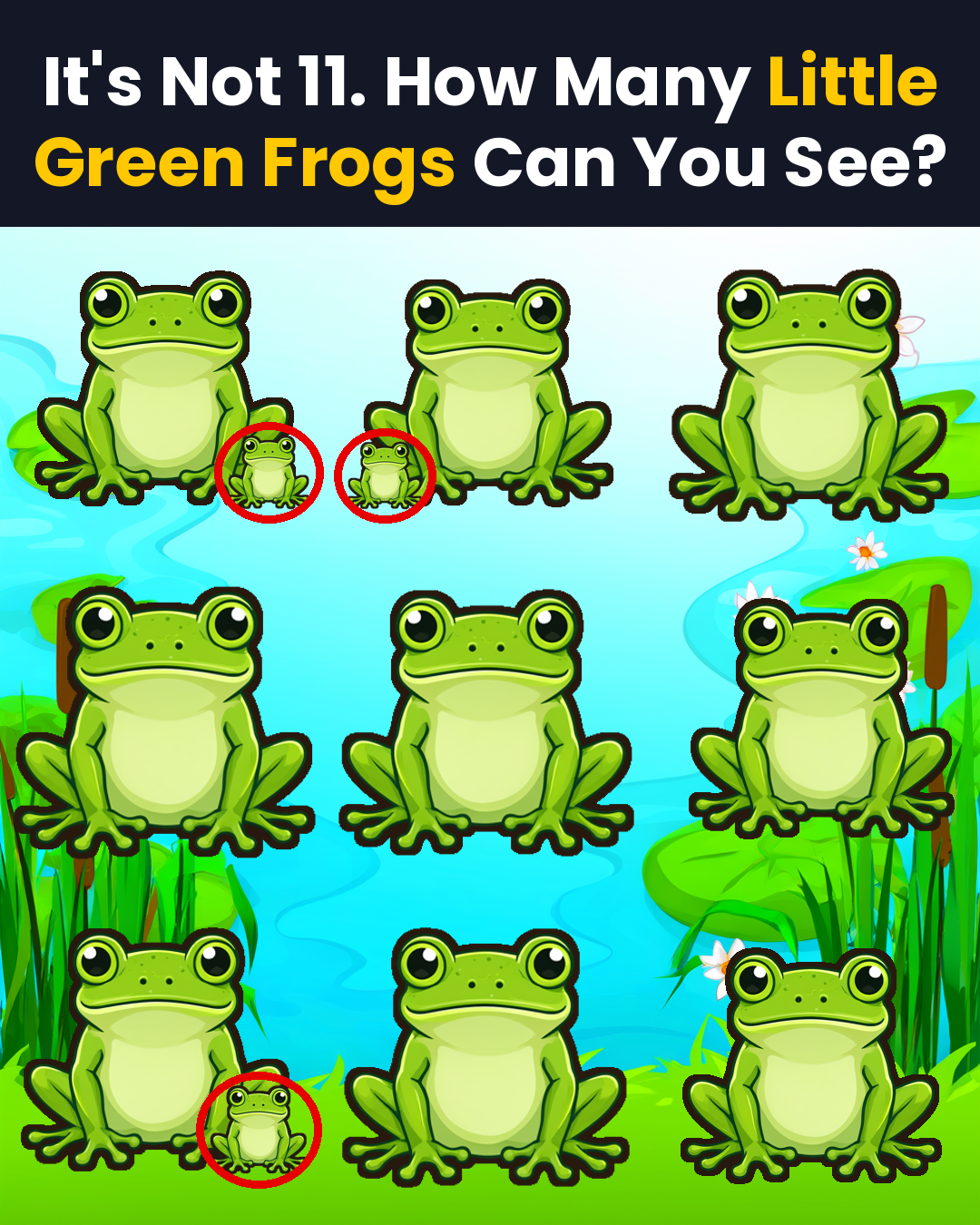
ANSWER: 12 frogs – three tiny ones are sitting right beside the big ones.
Where The Hidden Frogs Are Sitting
There are twelve frogs in the picture altogether. Nine of them are the big, confident ones arranged across the three rows, and those are the frogs almost everybody finds.
The other three are much smaller, and each one is tucked up close against a bigger frog. One sits at the bottom right of the frog in the top left corner. Another is just to the left of the frog in the middle of the top row. The third is nestled beside the big frog in the bottom left, half resting on the grass.
Because the little ones share the same green colour and the same round shape as their big neighbours, your eye reads each pair as a single frog with an odd outline. That is the whole trick, and it works on almost everyone the first time.
Why Most People Say Nine Or Eleven
Nine is the number you get when you count only the large frogs, which is exactly what a quick glance gives you. Eleven is the number you get when you spot two of the small ones and miss the third, usually the one at the bottom.
The small frogs are not hidden behind anything. They are in plain sight, which is what makes this kind of puzzle so satisfying when the answer finally clicks. Nothing was ever concealed. Your attention simply skipped over it.
If you want to prove the point, look at the picture again now that you know. The three little frogs practically shout at you, and it becomes almost impossible to see the picture the old way again.
How Did You Do?
Under ten seconds with the right answer means you have genuine eagle eyes, and you should be very pleased with yourself.
Twenty to forty seconds is a fine, careful result. That is the score of somebody who checks their work, which is a good habit in puzzles and in life.
Over a minute, or a first answer of nine or eleven, puts you in the biggest group of all, so you are in excellent company. Try the row method on the next puzzle and watch your score improve straight away.