Hello, puzzle friends, and welcome to the park!
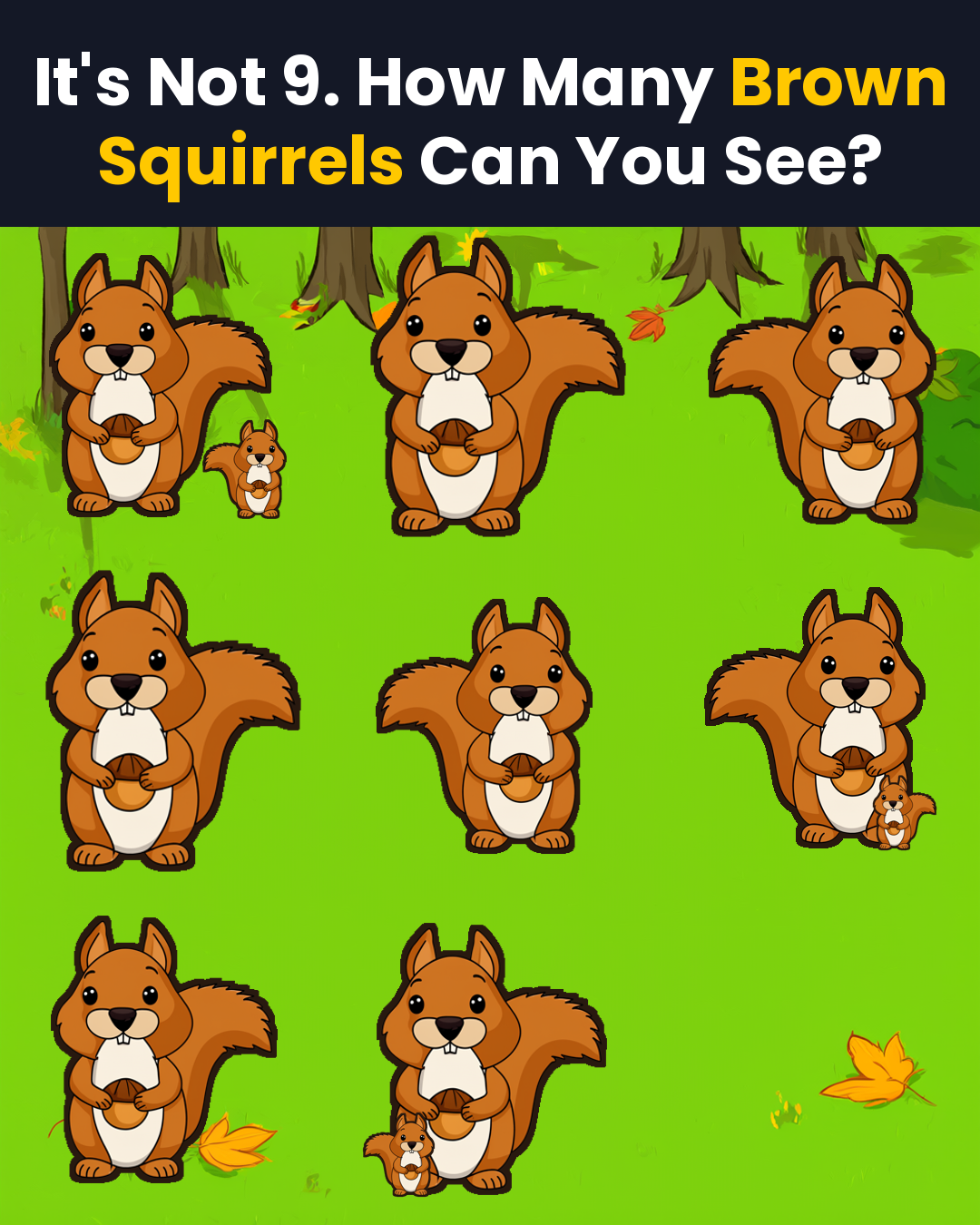
The leaves are falling, the grass is still green, and a whole family of brown squirrels has come out to collect nuts.
Your job today is simple to explain and surprisingly hard to do: count the squirrels.
Count every single one of them, big or small, near or far.
Most people answer much too quickly and get it wrong, so please take a second look before you decide.
A gentle hint: the big squirrels are easy, but they are not the whole family.
Have your number ready, then read on to see how you did.
Take your time and look closely before you scroll down!
Count In Rows, Never At Random
The single biggest reason people get counting puzzles wrong is that they count in a random order. The eye jumps about, counts one squirrel twice, misses another completely, and the total comes out wrong even though nothing was hidden at all.
The cure is to give yourself a route and stick to it. Read the picture like a page of a book: left to right along the top, then left to right along the middle, then left to right along the bottom.
It also helps to point at each one with your finger as you count, or to say the numbers quietly out loud. That sounds old-fashioned, but it works. Pointing forces your eyes to stop on each animal instead of gliding over the group, and it is the method professional stock-takers have used for a hundred years.
Why The Small Ones Disappear
Our brain is very good at spotting a shape it already knows. Once it has learned what a big squirrel looks like in this picture, it starts searching for that exact size, and anything much smaller is quietly filed away as background.
There is a second trap. When a small object sits right next to a large one of the same kind, the two are read as a single thing. Scientists call this grouping, and it happens automatically, without you ever deciding to do it.
Colour helps the little ones hide as well. They are the same warm brown as their big relatives, and brown on green grass next to more brown does not stand out. Nothing in the scene is actually covered up. The small squirrels are in full view. Your brain just chooses not to count them.
A Little Squirrel Wisdom
Real squirrels are quite the puzzle themselves. A grey squirrel can bury several thousand nuts in a single autumn, scattered across a wide area, one nut at a time.
They do not remember every hiding place perfectly, and a fair number of those nuts are never dug up again. Those forgotten nuts grow into trees, which means squirrels have quietly planted a great many of the oak woods we walk through today.
They also pretend to bury nuts when they think another squirrel is watching, digging an empty hole and patting it down to fool the thief. For a small animal with a bushy tail, that is a remarkable piece of cleverness.
Your Challenge
Most people give their first answer in about ten seconds, and most of those first answers are too low. A careful count takes nearer thirty seconds.
So here is the real test: count once quickly, write that number down, then count again slowly in rows. If the two numbers are different, the second one is almost certainly the right one.
Then send the picture to a friend and ask for their number before you tell them yours. It is always interesting to see who counts carefully and who guesses.
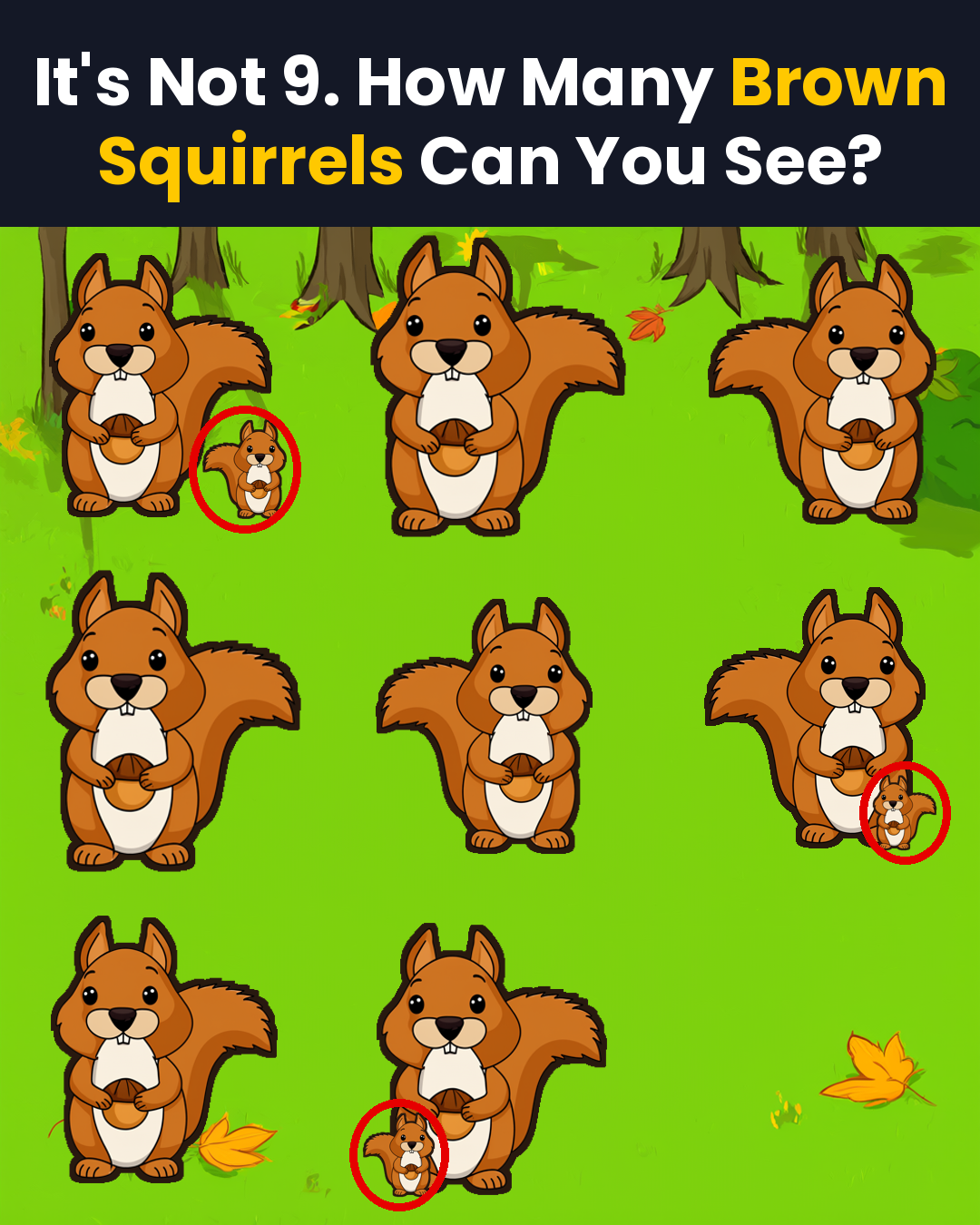
ANSWER: 11 squirrels – eight big ones and three little ones tucked in beside them.
Where The Hidden Ones Are
There are eight large squirrels standing in the grass, arranged in three loose rows across the picture, and they are the ones everybody finds.
The other three are much smaller. One little squirrel is up in the top row, standing just to the right of the first big squirrel. Another is on the right side of the middle row, tucked in beside the big squirrel’s front paws. The third is at the bottom, sitting right in front of the large squirrel in the centre.
Eight plus three gives eleven, and that is the full family.
Why So Many People Say Eight Or Nine
Each of the three small squirrels is touching, or almost touching, a big one. That closeness is the whole trick. Your brain joins the pair together and counts them as a single animal, so three creatures vanish from your total without you ever noticing.
They are also the same shade of brown as the big ones, on the same green grass, in the same pose. Nothing about them says look here.
The moment you know to search for small squirrels beside big ones, all three appear immediately – and after that you can never unsee them.
How Did You Do?
Eleven on the first try, in under fifteen seconds: eagle eyes. That is a genuinely rare result.
Eleven after a careful second count: excellent. That is exactly how a good counter works.
Nine or ten: very close. You found one or two of the little ones and the others slipped past.
Eight: you are with the majority, and the puzzle did its job. Look again now and you will see all three of them smiling back at you.