Hello, puzzle friends, and welcome to today’s little challenge!
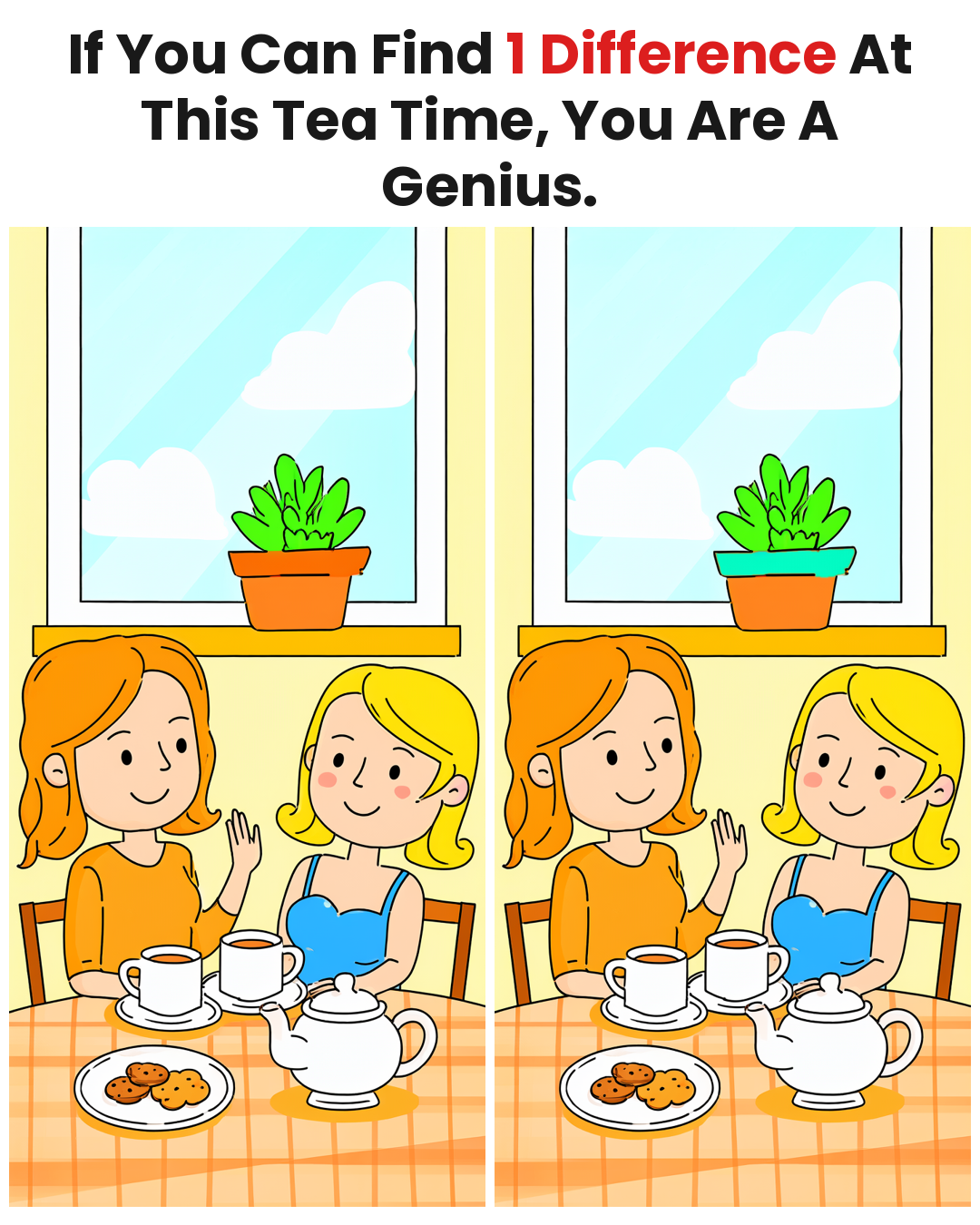
This morning we are sitting down for a quiet cup of tea with two good friends.
The teapot is full, the cookies are fresh, and the sun is shining through the kitchen window.
At first glance the two pictures look exactly the same, down to the last stripe on the tablecloth.
But somewhere in the picture on the right, one small thing has quietly changed.
Give yourself a moment, look at the whole scene first, then start checking the small objects one by one.
When you are sure you have found it, say it out loud before you read on.
Take your time and look closely before you scroll down!
Start At The Edges, Not At The Faces
When we look at a picture of people, our eyes go straight to the faces. That is how we are built. We have been reading faces since we were babies, so a smile pulls our attention like a magnet. The trouble is that in a spot-the-difference puzzle the change is almost never in the face.
A better method is to ignore the middle of the picture for a moment and work around the outside. Begin in the top left corner, move slowly along the top, down the right side, along the bottom and back up. Then do the same with the second picture and compare each stretch.
After that, go through the objects by category. All the cups first. Then the plate. Then the plant. Then the furniture. Our eyes are much better at comparing two of the same kind of thing than at scanning a whole busy scene at once.
Why Our Brain Finds This So Hard
Here is a surprising fact. Your eyes take in the whole picture, but your brain only holds a small part of it in memory at any moment. When you look from the left picture to the right picture, almost everything you just saw is already gone.
Scientists call this change blindness. In famous experiments people failed to notice when a whole wall in a photograph changed colour, simply because they looked away for half a second. The change was huge, but the comparison never happened.
Colour changes are the sneakiest of all. If the new colour still looks sensible in the scene, your brain accepts it as normal and moves on. A green pot in a kitchen is perfectly ordinary, so nothing inside you rings an alarm bell.
A Puzzle With A Long History
Spot-the-difference pictures are much older than the internet. They appeared in family magazines and newspapers more than a hundred years ago, drawn by hand, usually on the children’s page at the back.
Parents quickly discovered that they enjoyed them just as much as the children did. The puzzles travelled from newspapers to puzzle books, then to restaurant place mats, and now to the screen you are holding.
The reason they have lasted so long is simple. They need no special knowledge, no mathematics and no reading. A puzzle like this is fair to everyone, whether you are twenty-five or eighty-five, and the little jump of joy when you finally see it never changes.
Here Is Your Challenge
Most people need between twenty and forty seconds to find the change in this picture. Anything under fifteen seconds is genuinely quick, and it usually means you started with the objects rather than the people.
If you are still searching after a minute, do not give up. Cover the bottom half of both pictures with your hand and compare only the top half. Then do the opposite. Splitting the work almost always does the trick.
When you have found it, send this puzzle to a friend and see how long they take. It is a very pleasant way to start a conversation.
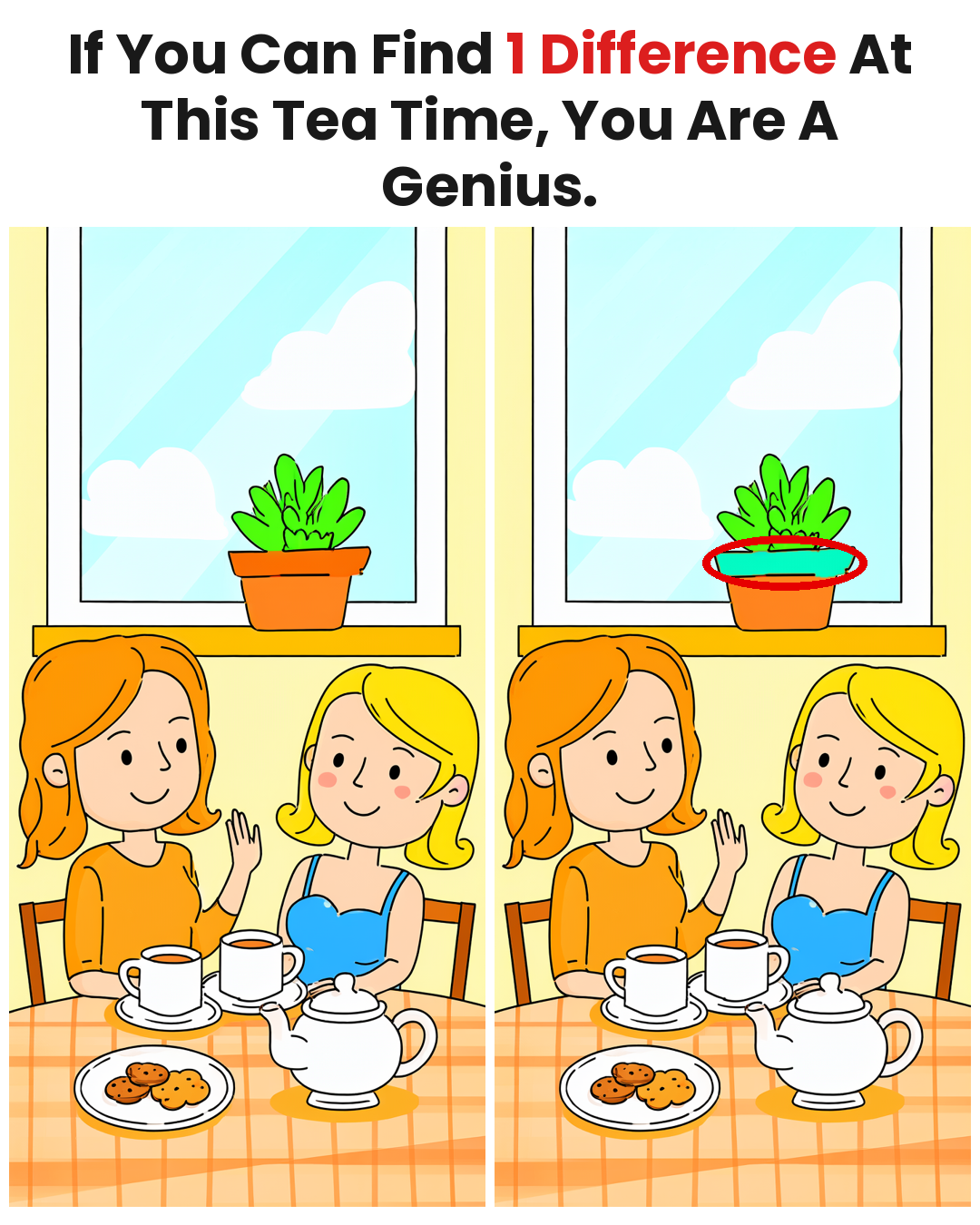
ANSWER: The top of the flower pot on the windowsill changed colour – it is orange on the left and green on the right.
Where The Change Was Hiding
Look up at the window behind the two friends. On the windowsill there is a little potted plant in a round terracotta pot.
In the picture on the left, the whole pot is warm orange from top to bottom, exactly as you would expect a clay pot to be. In the picture on the right, the wide rim at the top of the pot has turned a soft green, as though somebody had painted it.
The pot itself is the same shape, the same size and in the same place. Only that band of colour at the top is different.
Why Almost Everyone Misses It
There are three good reasons this one is so slippery. First, the pot is up near the window, far away from the warm, busy part of the picture where the tea and the cookies are. Our eyes are drawn down to the table.
Second, the green leaves of the plant sit directly above the rim. Green is already the expected colour in that spot, so a little more green blends straight in.
Third, nothing about the change looks wrong. A painted pot rim is perfectly believable. Your brain sees it, decides it is normal and never bothers to compare it with the other picture.
How Did You Do?
Under ten seconds: eagle eyes. You almost certainly scanned the objects instead of the faces.
Ten to thirty seconds: excellent. That is a sharp, well-organised way of looking.
Thirty to sixty seconds: right where most people land, and nothing at all to be ashamed of.
Over a minute, or you needed the answer: you are in very good company. Try the next one with the corner-to-corner method and you will be surprised how much faster you get.