Hello there, puzzle friends, and welcome to a sunny little challenge.
Below you will find two pictures of the very same happy beach picnic.
At first glance they look like twins, taken one second apart.
But somewhere in the second picture, one small detail has quietly changed.
Your job is to find that single difference, and only that one.
Look at the couple, the blanket, the basket, the umbrella, the cooler and the sand.
Here is a gentle tip to start you off: the change is a colour, not a missing object.
Take your time, enjoy the sea air, and trust your eyes.
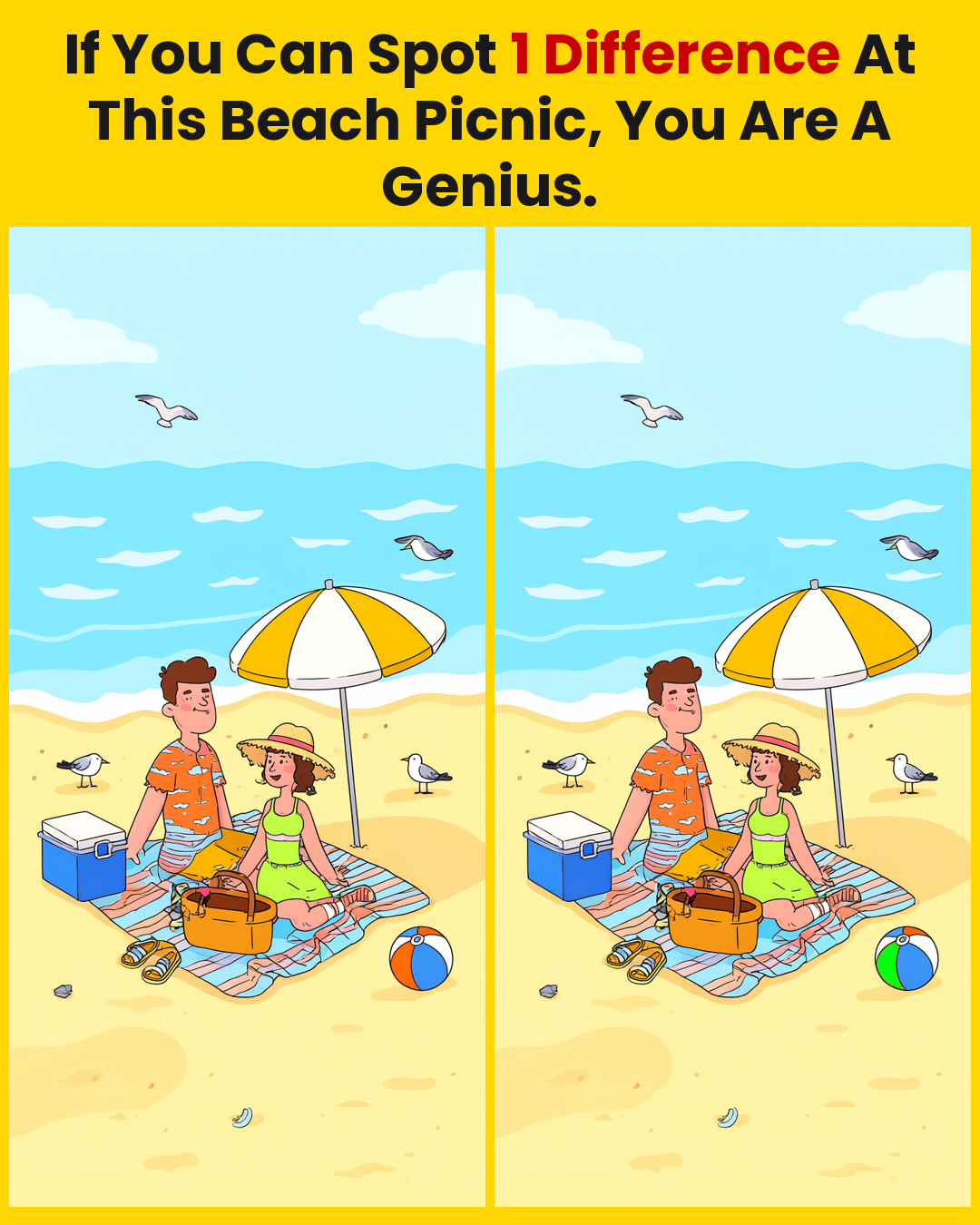
Take your time and look closely before you scroll down!
Start With A Plan, Not A Stare
The most common mistake is to look at the whole picture at once and hope that something jumps out. Our eyes are not built for that. When we stare at a busy scene, we drift from one bright spot to another and keep visiting the same places again and again, while the quiet corners never get a proper look.
A much better method is to divide and conquer. Imagine a line down the middle of each picture, and then another one across, so you have four neat squares. Compare the top left square of the first picture with the top left square of the second, then move on. Finish one square completely before you allow yourself to move to the next.
It also helps to compare objects, not areas. Umbrella against umbrella. Basket against basket. Sandals against sandals. Say the name of each item quietly to yourself as you check it. Naming slows you down in the best possible way, because a named object gets a longer look than one your eye simply skims over.
Why Our Brain Finds This So Hard
Your brain is wonderfully lazy, and that is usually a blessing. Instead of storing every detail of what you see, it keeps a rough summary: a beach, a couple, an umbrella, some sand. When you glance at the second picture, your mind compares it with that summary rather than with the real image, and a summary has no room for the colour of a small ball in the corner.
There is a well known effect behind this. Researchers call it change blindness, and it is surprisingly powerful. People can miss quite large changes in a scene when they look away for even a fraction of a second, simply because the fresh look overwrites the old one.
Colour changes are especially sneaky. We remember shapes far better than shades. If an object keeps its outline and only swaps its colour, the shape still matches our memory, so the alarm bell never rings.
A Short History Of Spot The Difference
Puzzles like this one are older than most people think. Side by side drawings with small changes appeared in newspapers and family magazines more than a hundred years ago, printed next to the crossword and the riddles, and they were loved by readers of every age.
They have also been used far away from the funny pages. Trainee pilots, nurses, quality inspectors and photo analysts have all practised with comparison exercises, because spotting a tiny difference quickly is a real skill with real value.
Today these puzzles have found a second life on the internet, where millions of people compare two pictures every single day. The drawings are brighter and the scenes are friendlier, but the pleasure is exactly the same as it was a century ago.
Your Friendly Challenge
Most people need between twenty and forty seconds to find the difference in a scene like this one. Anything under fifteen seconds is genuinely sharp eyed, and if you need a full minute, you are still in very good company.
So here is the challenge. Give yourself one quiet minute, no hints and no scrolling ahead. Then show the same two pictures to a friend or a family member and watch them search. Comparing how two people hunt is half the fun, and you will be surprised how often one of you looks exactly where the other never did.
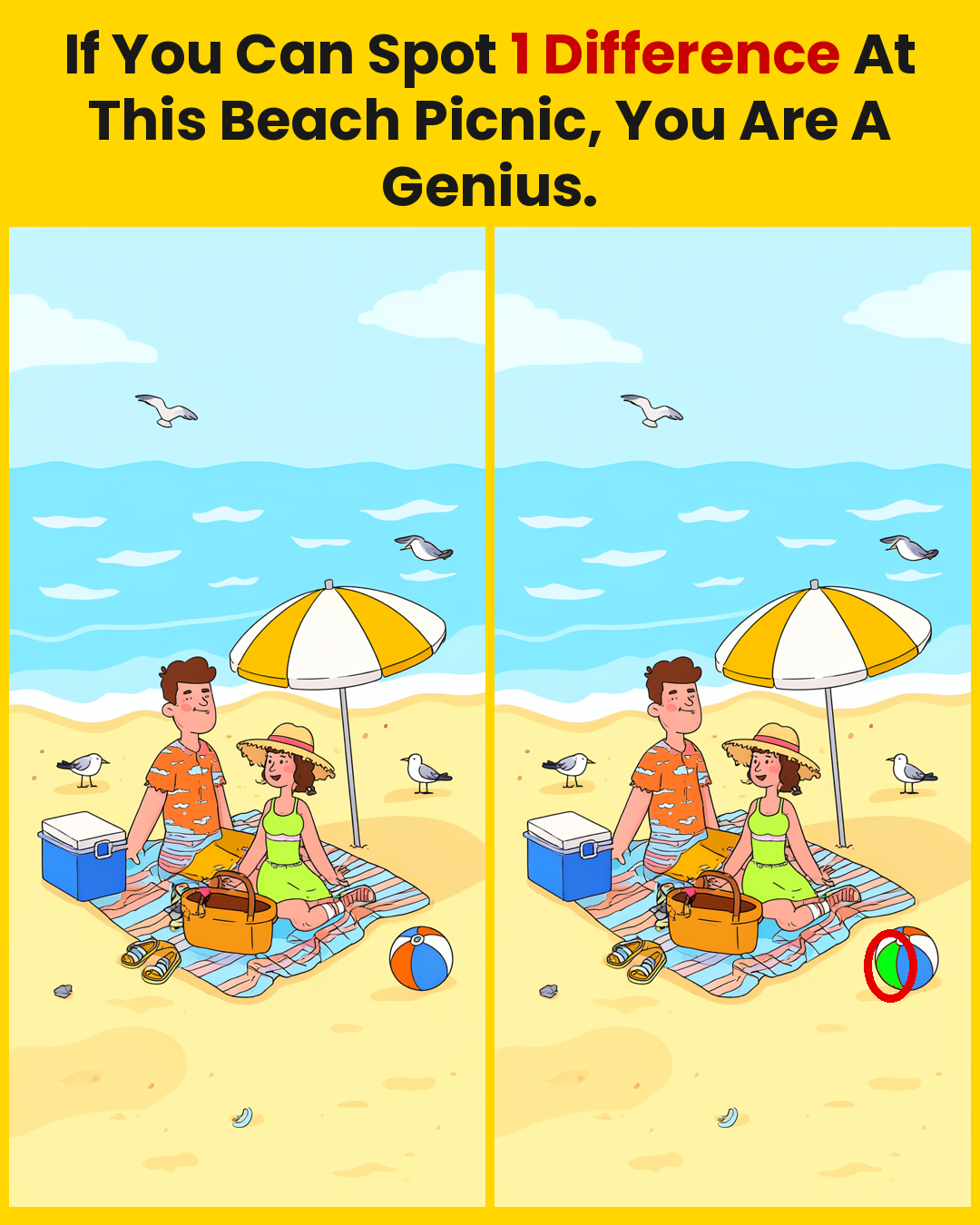
ANSWER: The beach ball changed colour – the orange stripe on the ball is green in the second picture.
Where The Change Is Hiding
Look at the lower right corner of each picture, down on the sand beside the blanket, where the beach ball is resting. In the first picture the ball has a bright orange stripe between its white and blue panels. In the second picture that same stripe has turned a fresh green.
Nothing else moved. The couple sit exactly as they did, the umbrella leans at the same angle, the cooler and the sandals have not shifted by a single pixel. Only that one band of colour on a small ball is different, which is why it can sit in plain sight for a surprisingly long time.
Why Most People Miss It
Two things work against us here. First, the ball sits at the edge of the picture, away from the faces. Faces are magnets for human attention, so most of us spend our first ten seconds studying the smiling couple and the picnic basket in the middle.
Second, the ball keeps its size, its position and its round shape. Our memory stores it as the beach ball and files it away as checked. Since the shape is identical, the quick comparison our brain makes comes back as a match, and the eye moves on to something else without ever questioning the colour.
How Did You Do?
Under ten seconds means you have real eagle eyes, and you probably notice when a friend changes their glasses.
Ten to thirty seconds is a very good result and the range most sharp observers land in. Thirty to sixty seconds is perfectly normal and shows a careful, patient method.
Over a minute, or a peek at the answer, is nothing to worry about at all. These puzzles are a skill, and the skill grows every time you play. Try the next one and see how much faster you get.