Good day, puzzle friends, and welcome to a bright morning on the farm.
The hens are being fed, the rooster is on the fence, and the sun is already high.
You will see the same farmyard twice, one picture beside the other.
Somewhere in the second picture, one small detail has been changed.
The barn, the hay, the chickens and the farmer all stay exactly where they were.
Look carefully at the tools and the things standing on the grass.
A small tip from us: this time the change is not on a living creature.
Take a comfortable seat and start comparing.
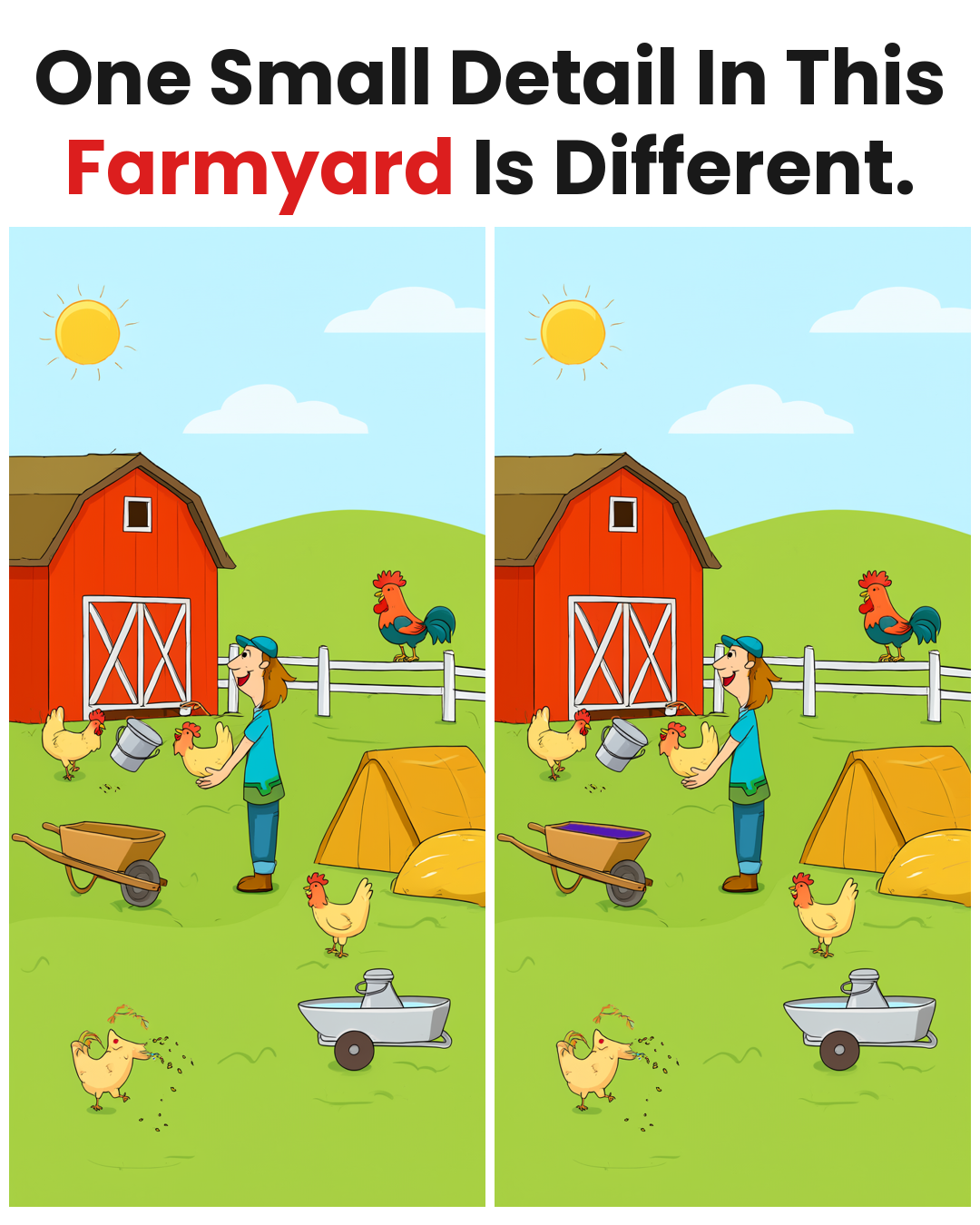
Take your time and look closely before you scroll down!
Where To Look First
In a farm scene like this one, the eye is drawn straight to three things: the big red barn, the people and the animals. That is exactly why the answer is so rarely found there. The picture maker knows where you will look, and the little change usually waits somewhere quieter.
A good plan is to check the objects nobody loves. The wheelbarrow, the bucket, the milk can, the trough, the fence posts. These are the props of the scene, the things your eye treats as furniture, and furniture is almost invisible to a quick glance.
Work along one line at a time, left to right, as if you were reading a sentence. When you reach the right edge, drop down and read the next line back again. A steady path means no corner is ever skipped.
Why Our Eyes Play Tricks
We do not photograph the world, we describe it to ourselves. Your brain looks at this picture and writes a short note: sunny farm, red barn, woman feeding six hens, wheelbarrow on the left. When you move to the second picture, you compare it with that short note, and the note never mentioned what colour the inside of the barrow was.
There is also the matter of expectation. We know what a farm looks like, and the stronger our expectation, the less we actually inspect. Familiar scenes are scanned faster and less carefully than strange ones, which is why a change hides better on a farm than it would in an unfamiliar room.
Finally, bright green grass fills most of this picture and keeps pulling the gaze across it. Large areas of flat colour act like a smooth road for the eye, and we slide over them without stopping.
A Little Background
Side by side picture puzzles have been a part of family life for well over a century. They appeared in farming almanacs and weekly papers, right next to the weather notes and the market prices, and readers would mark the differences with a pencil at the breakfast table.
The reason they have lasted is simple. They need no equipment, no rules to learn and no special knowledge, yet they give the same satisfying click of success that a crossword does.
They are also kind to every age. Younger eyes may be quicker, but experience teaches patience and method, and method wins more often than speed.
A Challenge For You
Most people need around thirty seconds for a farmyard scene with this many objects. Under fifteen seconds is excellent, and if it takes you a minute, you are still well within the normal range.
When you have found it, try this: show the pictures to someone else, but tell them only that the change is somewhere on the grass. Watching how much faster a single hint makes the search is almost as interesting as the puzzle itself.
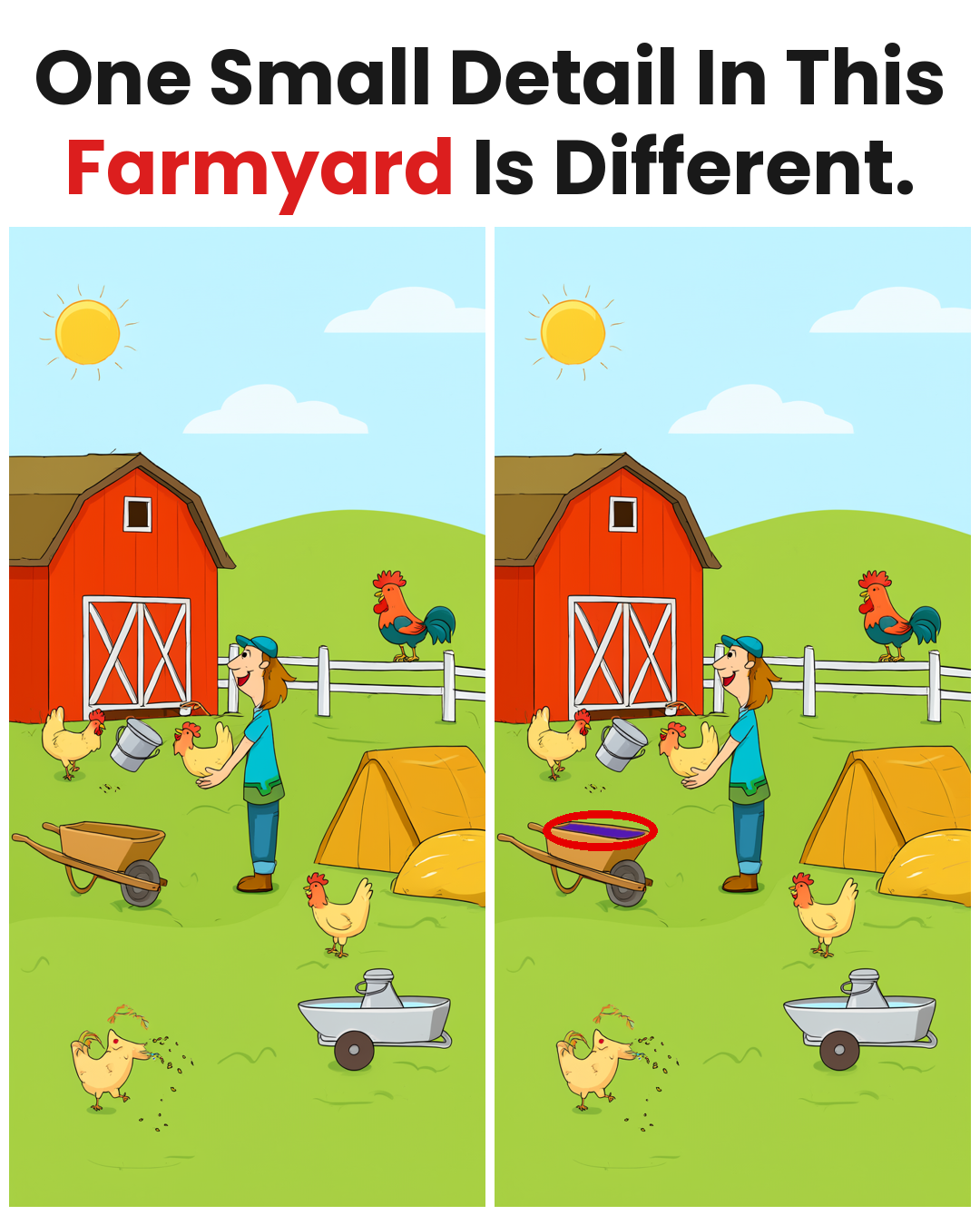
ANSWER: The wheelbarrow changed colour – the inside of its tray is plain wood in the first picture and painted purple in the second.
The Change Is In The Wheelbarrow
Look at the left side of the picture, at the old wooden wheelbarrow standing on the grass. In the first picture the inside of its tray is the same warm brown as the rest of the wood. In the second picture the inside of the tray is painted a deep purple.
Everything else has stayed the same. The farmer still holds her bucket and her hen, the rooster still crows on the fence, the milk can still stands in the trough, and all six chickens are exactly where they were.
Why Most People Walk Past It
The wheelbarrow sits low and far to the left, outside the busy middle of the picture where the action is. Our attention naturally settles on the smiling farmer and the hens she is feeding, because movement and faces always win the first look.
The tray is also a narrow strip, half hidden behind the rim of the barrow, so it covers only a tiny part of the picture. And because the barrow itself is unchanged in shape and position, our memory marks it as already checked after the briefest glance and sends the eye somewhere else.
How Did You Do?
Under ten seconds means truly sharp eyes, the kind that notice a picture hanging crooked from across the room.
Ten to thirty seconds is a very good score and the range most careful observers land in. Thirty to sixty seconds shows steady, methodical looking, which is the habit that pays off in the long run.
More than a minute is nothing to be sorry about. Each puzzle trains the eye a little more, so give the next one a try and see the difference for yourself.