Hello again, puzzle friends!
Today we are visiting a cheerful little pet shop.
A friendly shopkeeper is showing off her shelves, a happy puppy is wagging his tail, and a calm cat is resting on the floor.
The two pictures look like perfect twins, but one single detail has been changed.
Only one. Nothing has been moved, nothing has been added or taken away.
Have a good look at the shelves, the bowls, the animals and the counter.
A gentle tip: start at the bottom of the picture and work your way up.
Good luck, and enjoy the hunt!
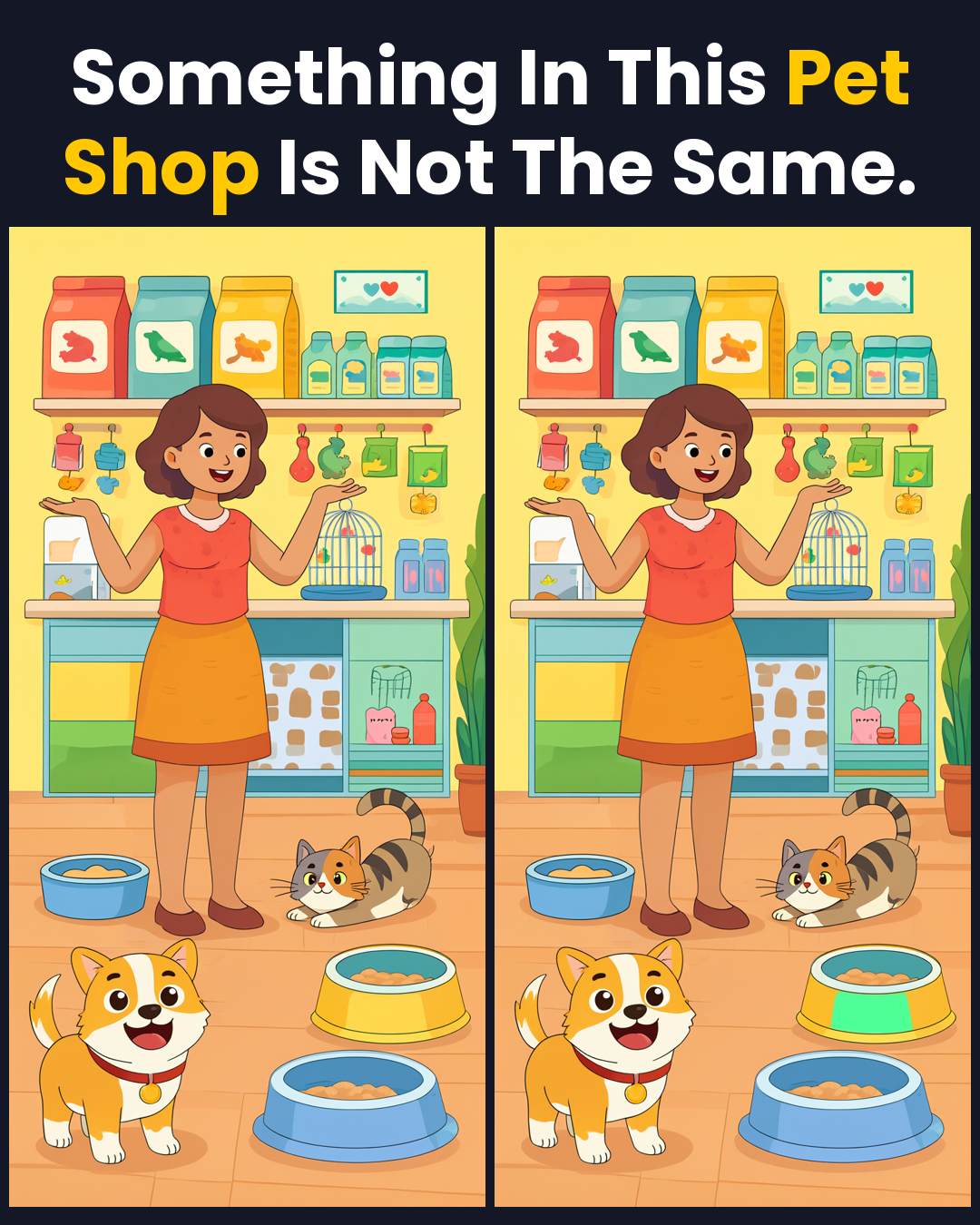
Take your time and look closely before you scroll down!
A Smart Way To Search
When a picture is as busy as this pet shop, searching at random is the slowest possible method. There are food bags, bottles, hanging toys, a birdcage, a counter, two animals and three bowls. If you let your eyes wander freely, they will simply bounce from one bright colour to the next and you will keep checking the same spots twice.
Try this instead. Pick one row at a time, like reading a book. Start with the top shelf and compare it from left to right in both pictures. Then the hanging toys. Then the counter. Then the floor. One band at a time, all the way down.
It also helps to compare pairs of identical objects. The scene has three water and food bowls. Whenever a picture gives you a set of similar things, check that set first, because a change inside a group is much harder for the eye to catch than a change to something that stands alone.
Why Busy Pictures Fool Us
Our eyes take in a surprisingly small area in sharp focus at any moment, roughly the size of a thumbnail held at arm’s length. Everything else is a blur that our brain fills in from memory and expectation.
In a crowded, colourful scene like a shop, that filling-in works overtime. The brain decides very quickly that it is looking at shelves full of products, and then it stops checking the details. It simply trusts its own summary.
Colour plays a part too. The picture is already full of oranges, yellows, blues and greens. When one more colour appears somewhere in that cheerful mix, it does not stand out. It blends right in with everything else. Puzzle makers know this very well, which is why the best hiding place for a change is always inside a rainbow.
A Fun Fact About These Puzzles
Researchers have used spot-the-difference pictures for years to study how attention works. In one famous experiment people watched two photographs flash back and forth, and even a large object disappearing completely went unnoticed for many seconds. Entire buildings vanished and people did not see it.
The lesson is a comforting one. If you did not find the change immediately, that is not a sign of tired eyes or a tired mind. It is how human vision is built, for everyone, at every age.
The cure is simply method. People who solve these puzzles quickly are not seeing more than you are. They have just learned to search in an orderly way instead of hoping the answer will jump out.
Can You Beat The Average?
Most people find this one in about twenty five seconds. Some need a full minute, especially if they start with the shelves, which is the most tempting place to look and the wrong one.
Set yourself a target of thirty seconds. Scan the floor first, then the counter, then the shelves. If you find it faster than that, you can be quite proud of your eyes today.
When you are done, pass the picture along to a friend and time them. It is always entertaining to watch someone else stare straight at the answer without seeing it.
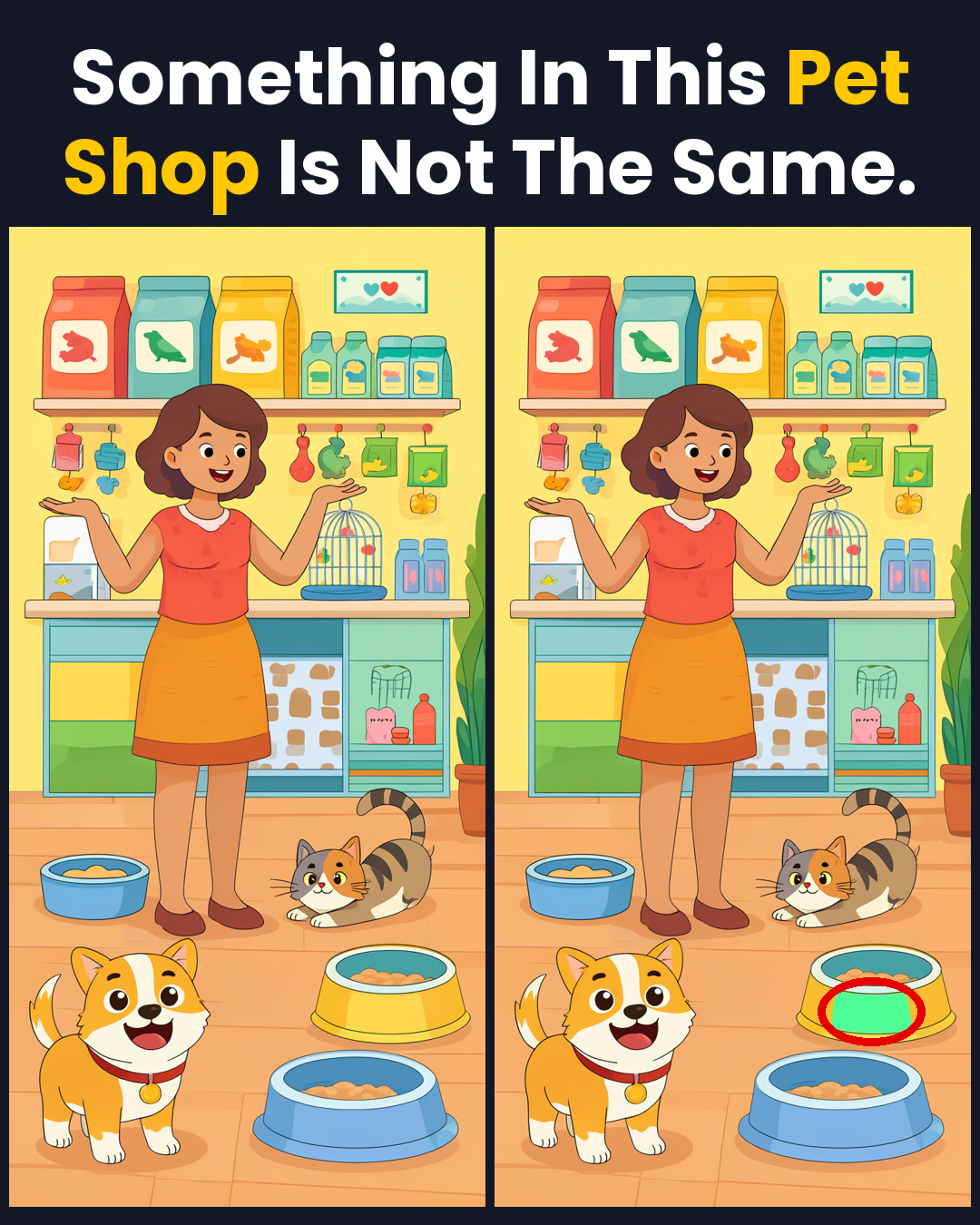
ANSWER: The food in the yellow bowl changed colour – it is green in the second picture instead of orange.
The Answer Is In The Bowl
Look at the bottom right of the picture, at the yellow pet bowl standing on the wooden floor. In the first image it is filled with ordinary orange kibble, the same colour as the food in the blue bowl below it. In the second image the food inside that yellow bowl has turned green.
The bowl itself is unchanged. Same shape, same yellow rim, same position, same shadow. Only what is inside it is a different colour.
That is a very quiet kind of change. The contents of a bowl are a small area, they sit low in the picture, and they are partly hidden by the rim. Our eyes register bowl and move on without ever asking what is actually in it.
Why So Many People Walk Past It
There are three bowls in this scene, and that is the trap. Groups of similar objects make wonderful camouflage. The brain treats them as one single item called the bowls, and a change inside the group never breaks the overall pattern.
On top of that, the lower part of the picture competes with two adorable animals. The puppy with his red collar and the striped cat both pull the eye like magnets. Faces and animals always win the race for our attention, and while we are busy comparing whiskers and ears, a green bowl of food sits quietly in the corner being overlooked.
How Did You Do?
Under 10 seconds: outstanding. You ignored the people and the pets and went straight for the small objects, which is exactly the professional approach.
10 to 30 seconds: very strong. That is better than most readers manage.
30 to 60 seconds: a good, steady result. You kept looking and you found it.
More than a minute: do not worry in the slightest. Now you know that groups of identical objects are the favourite hiding place of these puzzles, and that single piece of knowledge will make the next one much easier.