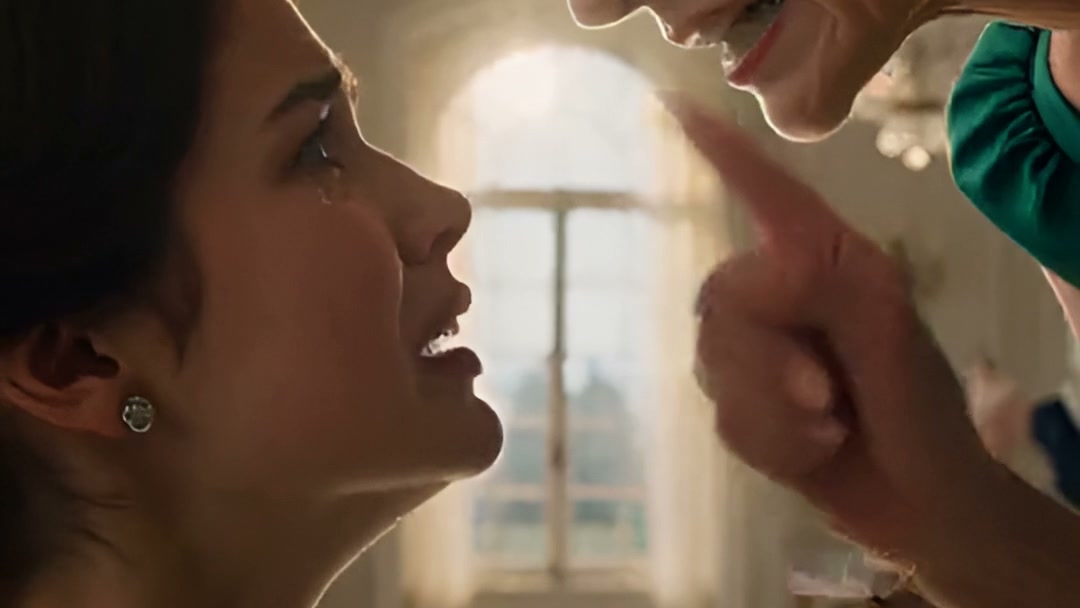
Augusto Varela, the most feared man in Lisbon couture, watched a client slap the pincushion from a young seamstress’s hands… But when the girl opened her palm and showed him a plain silver thimble, he stopped breathing.
The morning light poured through the tall windows of Atelier Varela like warm milk, catching the gilded mirrors and turning the white marble floor gold. Bolts of pale silk leaned against every wall. The crystal chandeliers hummed faintly overhead, though no one could explain why.
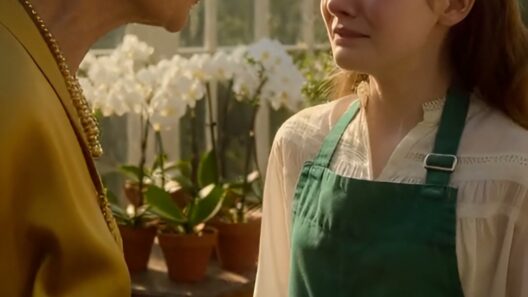
Nineteen-year-old Inês Mourão knelt at the hem of an emerald gown, her mouth full of pins, her fingers moving in quick, certain stitches. She had been at the atelier three months. She was the best they had seen in a decade, though no one had told her so yet.
The woman inside the gown was Donata Reis, wife of the shipping magnate Henrique Reis, and she had been trouble since she walked through the door.
“It’s still crooked,” Donata said, staring down at Inês the way you stare at a stain on a good tablecloth.
Inês looked up, calm. “Senhora Reis, the hem is level. I measured it twice.”
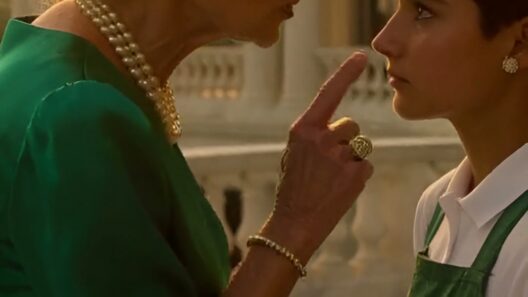
“Are you arguing with me?” Donata said. And then she reached down and slapped the pincushion clean out of Inês’s hand.
Pins scattered across the marble like tiny silver rain. The whole salon went still. Three other seamstresses froze at their stations. The junior manager took one step forward and stopped.
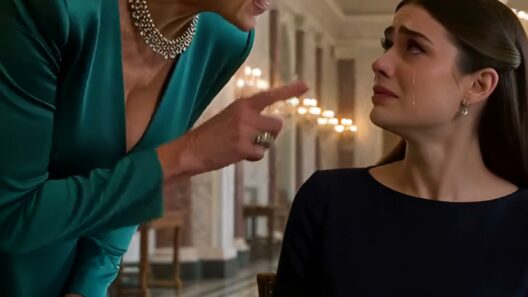
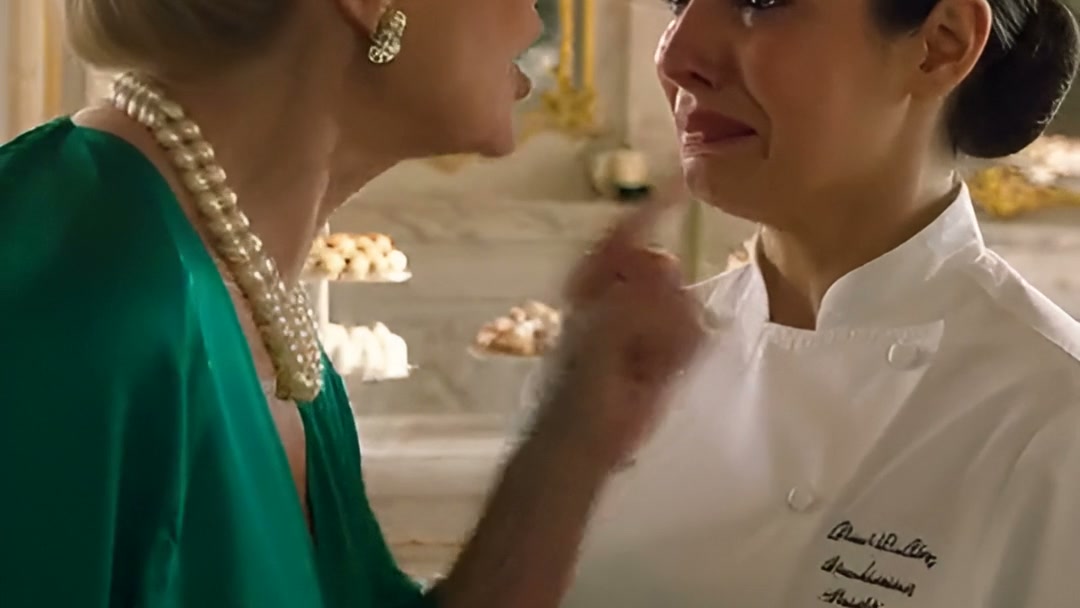
Donata grabbed Inês’s arm above the elbow, her rings pressing into the girl’s skin. “Clumsy nobody,” she said, loud enough for the room. “Get out. I’ll have you fired before lunch.”
Inês did not cry. She looked at the scattered pins and started to gather them.
“I said get out.”
“Let go of her arm.”
The voice came from the back of the room, quiet and absolutely final.
Everyone turned.
Augusto Varela stood in the doorway that led to the private workrooms — the door no one opened without an invitation. He was in his late sixties, a cream linen suit, white hair brushed back from a wide forehead, and dark eyes that had not softened in forty years of this business. He had not set foot in the salon in three years. No one had expected him today. No one had announced him.
He walked across the marble with slow, unhurried steps, his cane clicking once, twice, and stopped directly in front of Donata Reis.
He looked at her hand on Inês’s arm.
“Let go of her arm,” he said again, still quiet. “Now, please.”
Donata released the girl. She actually stepped back. “Senhor Varela, the hem—”
“I know what the hem is.” He did not look at Donata. He had already looked away from her, as if she were a matter he had already resolved. He crouched — slowly, with some effort — until he was at eye level with Inês, who was still kneeling on the marble, pins scattered around her.
He picked up the pincushion. He placed it gently back in her hands.
“Are you hurt?” he asked.
Inês shook her head. Her eyes were bright, but she hadn’t let the tears fall.
“Good.” He stayed crouched, studying her face. “What is your name?”
“Inês Mourão, senhor.”
“Mourão.” Something moved across his face, too fast to read. “Where are you from, Inês?”
“Évora, senhor. Originally.”
He was quiet for a moment. The whole salon was quiet.
Then Donata’s voice cut through, shrill and embarrassed. “Senhor Varela, I expect an apology from—”
He stood up. He turned and looked at Donata Reis with an expression so still and so complete that she stopped mid-sentence.
“Your appointment is cancelled,” he said. “The gown will be donated. We’ll find a client who deserves it.” He looked at the junior manager by the door. “Please see Senhora Reis out.”
Donata’s mouth opened. Nothing came out. She left.
The salon exhaled.
Varela turned back to Inês, who had gathered the pins and was now standing, holding the pincushion against her chest with both hands.
“You don’t have to stay on the floor,” he said. Almost gently.
“I know,” she said. “I wanted to get every pin. They’re easy to lose on marble.”
He looked at her for a moment. “Who taught you that?”
“My grandmother.”
“Was she a seamstress?”
Inês nodded. “She worked here, senhor. A long time ago. Before I was born.”
The silence that followed was different from the last one. This one had weight.
“Her name?” Varela said.
“Lucinda Mourão.”
He said nothing. He looked at the girl’s hands — the calluses, the needle-prick scars, the way she held the pincushion like something that mattered.
“Inês,” he said, carefully. “Do you have anything of hers? Your grandmother’s?”
Inês looked at him. And then she opened her right hand.
In her palm lay a plain silver thimble, old and worn smooth, with a tiny wreath of leaves pressed faintly around the base. The kind of thimble they had stopped making before either of them was young.
“She told my mother to give it to me,” Inês said. “And she told my mother—” she paused, as if deciding whether to say it— “she said a man would come back to the atelier one day, looking for it. She said I should wait.”
Augusto Varela looked at the thimble in the girl’s open palm for a very long time.
His face, which had been so controlled a moment ago, did something unexpected. It opened.
“I gave that thimble to Lucinda Mourão in 1979,” he said. His voice was different now — lower, stripped of its authority. “She was seventeen. She was the finest seamstress I had ever seen.” He stopped. “She left the atelier and I never knew why. I looked for her for a long time.”
Inês closed her fingers gently around the thimble. “She left because she was pregnant,” she said. “She was afraid you’d dismiss her.”
The room was absolutely silent.
“She never came back,” Inês said. “But she kept the thimble her whole life.” She looked up at him, steady. “My mother is her daughter, senhor. Which makes me—”
“Her granddaughter.” He said it before she could. “Yes.”
He reached out and touched the edge of the thimble, just the edge, without taking it from her.
“I would never have dismissed her,” he said. “I would have—” He stopped. He looked at the ceiling for a moment, then back at Inês. “I would have done things very differently.”
Inês watched him. “She knew that,” she said. “In the end. She wanted me to come here. She wanted me to find the work.” She paused. “She didn’t send me to give the thimble back.”
“Then why?”
Inês looked at him directly. “She said it was so you’d know you made something that lasted.”
Varela was quiet for a long time.
Then he said: “She was right.”
He straightened up. He looked at the junior manager, who was still frozen by the door. “Inês Mourão is promoted to head seamstress, effective today. Clear whoever is in the master fitting room. We have work to do.” He glanced down at Inês’s hands. “If you’re willing.”
Inês looked at the thimble in her palm. She slipped it onto her right index finger, where it fit as though it had been made for her — which, she supposed, in every way that mattered, it had been.
“Yes, senhor,” she said. “I’m willing.”
She walked toward the master fitting room, the thimble bright on her finger, and the whole atelier parted to let her through.