
Dorian Vale watched Margarethe Vohl knock a rare white orchid from a young assistant’s hands at the charity show… But when the sobbing girl whispered the flower’s secret name, he went utterly still.
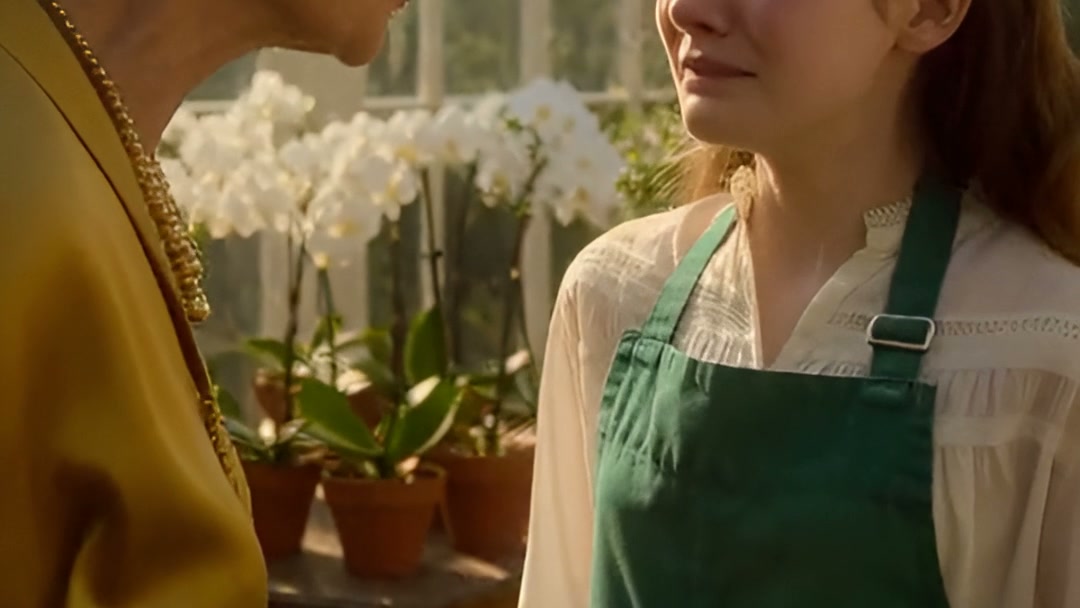
The glass conservatory of the Grand Halcyon Hotel was full of light and the smell of rain-wet earth. Orchids lined every table in pale rows, their white petals catching the afternoon sun like scattered paper prayers. The charity show had drawn two hundred guests in silk and linen, and the judging was about to begin.
Ilse moved through them carefully, the clay pot cradled against her apron, both hands underneath. She was nineteen and had been up since four in the morning preparing the conservatory. The orchid she carried was the rarest in the show, a white Paphiopedilum with a single stem and four open blooms, each the size of a child’s fist.
She had almost reached the judging table when Margarethe Vohl stepped directly into her path.
Margarethe was the show’s chairwoman, sixty-three years old, in a cream linen suit that cost more than Ilse’s monthly wages. She looked at Ilse’s work apron the way a person looks at a smudge on a clean mirror.
“You,” she said, loud enough for the nearest twenty guests to turn their heads. “Who gave a greenhouse girl permission to carry that?”
“The head horticulturist, ma’am,” Ilse said. “Mr. Drewe asked me to bring it directly—”
Margarethe’s hand came down on the edge of the clay pot. It was not an accident. She knocked it sideways with one sharp, deliberate motion, and the pot left Ilse’s hands before the girl could do anything at all.
The sound the clay made on the marble was not loud, but the silence that followed it was total. Two hundred people watched the pot shatter, watched the soil spread dark and damp across the white floor, watched the orchid tip sideways and lie with its stem bent and its four open blooms pressed against the cold marble.
Ilse made a sound that was not quite a word.
She went to her knees on the marble, soil on her hands, and her shoulders began to shake.
“That’s what happens,” Margarethe said to the room rather than to Ilse, “when you let the help handle the exhibition pieces.”
She reached for Ilse’s arm.
She did not get there.
A hand closed around her wrist, not hard enough to hurt, but absolutely firm, and a voice said two words directly into her ear: “Walk out.”
The voice belonged to Dorian Vale. He was forty-one years old, in a pale grey three-piece suit, and he had come to the Halcyon today as a private donor. His name was on the conservatory’s east wing. He had not raised his voice. He did not need to.
Margarethe looked at his hand around her wrist, then at his face, and whatever she found there made her pull her arm back and walk toward the exit without another word.
The room breathed again, slowly.
Dorian lowered himself to one knee on the marble beside Ilse. He did it without hesitation, pale grey suit and all, and he began to lift the orchid very gently from the soil with both hands. His fingers moved the way a person moves who has done this before, sliding under the root ball, pressing the loose earth back around it.
“It’s not broken at the stem,” he said quietly, more to himself than to her. “The roots are intact. It can survive this.”
Ilse was still crying, silently, the kind of crying that happens when you are nineteen and have been working since four in the morning and have just been humiliated in front of two hundred people. Dorian held the orchid out to her.
“Here,” he said. “Take it. It’s yours to carry.”
She took it in both hands. Her breathing steadied, the way breathing sometimes steadies when you are given something to hold onto.
“I’m sorry,” she said. “I shouldn’t be crying. It’s just—I’ve been talking to this one every morning for eight months. I know that sounds—”
“It doesn’t sound anything,” he said.
He was still crouched at her level. He was looking at the orchid, not at her face, and something in his expression had shifted from calm authority into something much quieter.
“Does it have a name?” he asked. It was an odd question for a donor to ask at a charity show, and his voice had gone very careful around the edges of it, the way a person’s voice goes when the answer matters enormously.
Ilse looked at the four white blooms.
“I don’t know its official label,” she said. “Mr. Drewe catalogued it. But I always called it something else. Something I—” She paused. “My mother used to say that every plant deserves a true name, not just a number.”
“What did you call it?” Dorian asked.
Ilse said the name.
It was not a botanical name. It was not anything that appeared on any label or any show programme or any document in the Halcyon’s horticultural records. It was a small private name, two words in soft half-English, the kind of name that two people invent together on a particular afternoon in a particular greenhouse when they think no one is listening and no one will ever need to know.
Dorian Vale went completely still.
He stayed crouched on the marble for a moment that stretched out longer than it should have. Then, slowly, he looked up at Ilse’s face. Really looked, the way he had not done before because he had been focused on the orchid, on the soil, on the practical task.
He looked at her eyes.
He looked at the shape of her jaw.
He looked at her hands, which were the hands of someone who works with growing things.
“Who is your mother?” he said. His voice had lost all its steadiness.
Ilse blinked. “She passed away. Two years ago. She was a horticulturist, she worked with rare orchids her whole life, she—” Ilse stopped because the man in the pale grey suit had pressed his hand over his mouth and his eyes had gone bright with something that was not anger. “She used to say she propagated this variety from a single cutting. That she only ever told one other person the name she gave it. She said—” Ilse’s voice faltered. “She said that person never came back.”
“What was her name?” Dorian said, and the question came out barely above a whisper.
Ilse told him.
Dorian Vale sat back on his heels on the marble floor of the Grand Halcyon conservatory and covered his eyes with one hand. Around them, the guests had gone quietly back to looking at orchids, the way people do when they sense they are witnessing something that belongs to someone else.
The crying Ilse had been doing, the kind from exhaustion and humiliation, stopped. Something else was happening now.
“You knew her,” Ilse said. It was not a question.
“Yes.” He lowered his hand. His face was entirely open in a way it probably had not been in a very long time. “I knew her. I was young and I was cowardly and I left when I should have stayed, and I have thought about it every day since.” He looked at the orchid in Ilse’s hands. “She must have—” He stopped. “She kept it.”
“She kept everything that mattered,” Ilse said.
He looked at her again. The shape of the jaw. The eyes.
“Did she ever—” He could not finish the sentence.
“She said the man who gave her the cutting told her the name,” Ilse said slowly. “She said she always hoped he would come back one day and hear her say it.”
Dorian nodded, once, and his throat moved.
“She said one other thing,” Ilse added. Her voice was very steady now, steadier than his. “She said if I ever met him, I should tell him she forgave him a long time ago, and that the orchid was proof.” She lifted the repotted flower slightly in her hands. “Because it lived.”
For a moment no one spoke.
Then Dorian Vale, donor of the east wing, man who had sent Margarethe Vohl out of a room with two words, did something that none of the two hundred guests who saw it would ever fully agree on how to describe: he pressed both hands over the clay pot, over Ilse’s hands, over the soil still dark from the broken floor, and he bowed his head.
“I’m sorry,” he said. “For leaving. And I am very glad she sent you in her place.”
Later that afternoon, Margarethe Vohl was formally removed as show chairwoman by a board vote that Dorian did not attend and did not need to. Three witnesses had already given their account to the hotel management. The head horticulturist submitted the incident in writing. The board voted without dissent.
The white orchid was placed at the head of the judging table where it was always meant to stand, undamaged, its four blooms open under the glass conservatory light. Ilse stood beside it.
She won the show’s highest distinction, presented to her not as a greenhouse assistant but as the orchid’s primary cultivator, her name on the card in full.
Dorian Vale sat in the front row and watched, and when they announced her name, he was the first person to stand.