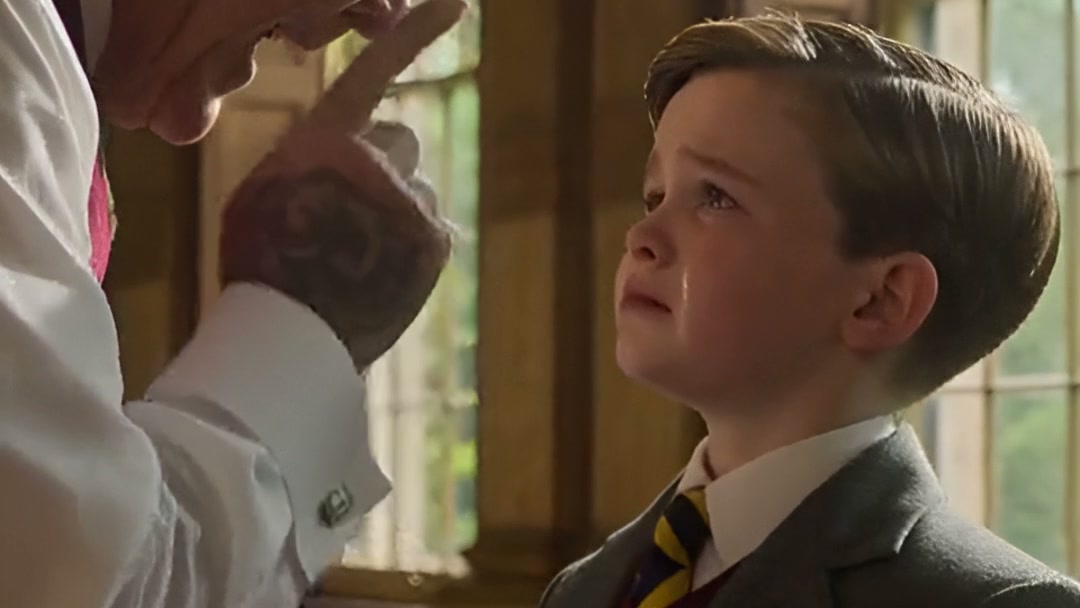
Mafia boss Marcus Hale caught a steward throwing a twelve-year-old out of his private library… But when the boy held up the pressed flower and said, “It’s always fresh, sir — someone changes it every morning,” Marcus’s coffee cup slipped from his fingers and shattered on the marble floor.
The Halcyon Club had stood on Beacon Hill for one hundred and forty years, and in all that time, no child had ever gotten past the front door.
Marcus Hale had bought the building six years ago. Not for the leather armchairs or the sixty-year-old bourbon. He’d bought it because his wife, Celeste, had loved the library on the second floor. She used to say the light came through the tall windows in a way that made every book look like it was glowing from inside.
She’d been dead for four years.
Marcus came to the library every Tuesday at noon. He sat in the same chair, read the same kind of books she used to read, and left at one o’clock sharp. The staff knew not to disturb him. The members knew not to approach. The whole city, in fact, knew that Marcus Hale’s grief was a closed door with a very thick lock.
Then came the Tuesday with the boy.
Declan Marsh was twelve years old, small for his age, with a mop of dark red hair and the kind of stubborn jaw that meant he was used to being told no. He’d slipped past the front desk by following a delivery cart and had made it all the way to the second floor before anyone noticed.
He was sitting cross-legged on the rug in the center of the library, a large hardback open across his knees, completely absorbed, when Steward Connell found him.
Gerald Connell was fifty-eight, barrel-chested, with the particular pride of a man whose authority rested entirely on the institution behind him. He crossed the floor in four strides, grabbed the book with both hands, and yanked it away.
“Members only,” he said. “Out.”
Declan stumbled to his feet. “I wasn’t hurting anything.”
“Out,” Connell said again, and shoved him toward the door by the shoulder.
The book hit the rug. Its spine cracked open at page forty.
And a small pressed flower fell out — a single blue cornflower, brilliant as if it had been picked that morning — and drifted down to land at Declan’s feet.
The hand that caught Connell’s wrist came from the doorway.
Marcus Hale was six foot two, broad across the shoulders, with close-cropped silver hair and a jaw like something carved rather than grown. He wore a grey three-piece suit, no tie, and the particular stillness of a man who had not been surprised by anything in a very long time.
He was surprised now.
His grip on Connell’s wrist was gentle but absolute. “That’s enough,” he said.
Connell went white. “Mr. Hale, the boy was trespassing — “
“I said that’s enough.”
Connell stepped back and left the room without another word. The two remaining staff members at the far end of the library became very interested in a bookshelf.
Marcus looked at the boy.
The boy looked at Marcus.
Then Declan looked down at the flower in his hand, and back up. “Is this yours, sir?”
Marcus didn’t answer immediately. He walked forward, slowly, and crouched down — not to Declan’s eye level exactly, but close enough that he wasn’t looming. He looked at the cornflower.
“Where did that come from?” His voice came out wrong. Rougher than he intended.
“Page forty.” Declan held the flower out carefully, stem first, as though he understood it was fragile. “It was in the book. The one the man took.” He glanced at the door. “The big one. With the blue cover.”
Marcus picked the book up off the rug. *Middlemarch*. Celeste’s copy — her name was written in her handwriting inside the front cover, in green ink. He’d put it back on the shelf after she died because he couldn’t make himself move it, and couldn’t make himself open it.
His hands were not entirely steady.
“She said it’s always fresh,” Declan said, quieter now, watching him. “Page forty. It’s always a new one.”
Marcus looked up. “What did you say?”
Declan blinked. “The flower. It’s always fresh. Somebody changes it.” He paused. “I’ve been coming here on Tuesdays for two months. I checked every time. It’s never dried out. I figured — ” he stopped himself, suddenly uncertain. “I’m sorry. I didn’t mean to touch something that wasn’t mine.”
Marcus sat down on the rug.
It was not a graceful movement. He simply sat, right there on the Persian carpet in his three-piece suit, as if his legs had made a decision without consulting him. He turned the book over in his hands. Then he opened it to page forty.
The page was blank except for a small notation in the margin, in green ink: *Tuesday light is best. Come back.*
He had never seen those words before. He had never opened the book.
His throat tightened until he couldn’t speak.
“Are you okay?” Declan asked.
“No,” Marcus said. Then, after a moment: “Sit down.”
Declan sat, cross-legged again, the way he’d been before all of this started. He waited with the patience of a child who spent a lot of time in libraries.
“How did you find this?” Marcus asked finally. “The flower.”
“I was reading and it just fell out,” Declan said. “But then I put it back, and the next Tuesday it was a new one. So I started checking.” He picked at a thread on his sleeve. “My mum used to press flowers. She’d put them in books she wanted me to find later. Like notes, kind of.”
“Used to,” Marcus said.
“She died two years ago,” Declan said simply. “Cancer.”
Something shifted in Marcus’s chest. A lock, or maybe a door. “I’m sorry.”
“Me too.” Declan looked at the flower, still in his palm. “I know it’s weird that I kept coming back. I just — this place felt like something was still happening in it. You know? Like it wasn’t finished yet.”
Marcus looked at him for a long moment. “How do you get in? Every Tuesday.”
Declan’s mouth almost curved. “The delivery cart. I figured out the timing.”
Marcus stood. He held out his hand.
Declan took it and stood up.
“Come with me,” Marcus said.
He led the boy down the hall to the club manager’s office, where a baffled manager was summoned from lunch, and where Marcus Hale dictated, in precise and absolute terms, that Declan Marsh was to have full library access every Tuesday from noon to two o’clock, effective immediately, and that anyone who interfered with this arrangement would be looking for new employment before the week was out.
The manager wrote it all down without a word of objection.
On the way back to the library, Marcus stopped at the main staircase.
“The flower,” he said. “My wife put the first one there. Before she got sick, she used to come here on Tuesdays. I didn’t know she’d written in the margin.” He paused. “I haven’t been able to open that book since she died.”
Declan nodded. He seemed to understand that no response was required.
“I don’t know who’s been changing the flowers,” Marcus said quietly.
“Maybe someone on the staff knew her,” Declan said.
Marcus thought of Celeste — how she talked to everyone, how she remembered the names of people other people overlooked. Of course someone on staff knew her. Of course someone had kept the flower fresh because she had asked them to, or because they wanted to, or because grief does strange and faithful things.
“Yes,” he said. “Probably.”
He found out the following Tuesday.
It was Helena, the head librarian, who had worked at the Halcyon Club for thirty years. She’d been the one Celeste always spoke to when she came in. After Celeste died, Helena had kept up the flower without telling anyone because, as she explained with considerable dignity and not a single apology, Mrs. Hale had asked her to.
“She said you’d come back eventually,” Helena said. “She said when you did, you might need the door to still be open.”
Marcus stood in the library doorway for a long time after Helena went back to her work.
Then he sat down in Celeste’s chair, in the Tuesday light, and opened *Middlemarch* to the first page.
Declan came back every Tuesday for the rest of that year, and the year after. Marcus was usually already there when he arrived. They didn’t always talk. Mostly they read, in the way that people who have both lost someone learn to be quietly present with each other without making it a performance.
On the Tuesday of Declan’s fourteenth birthday, Marcus left an envelope on the reading table.
Inside was a card, and inside the card was a membership certificate — full, permanent, unrestricted — in Declan Marsh’s name.
Declan read it twice.
“This is real?” he said.
“Don’t be tiresome,” Marcus said, turning a page.
Declan sat down in his usual chair. He put the certificate flat on the table, very carefully, the way you handle something you don’t want to crumple.
“Thank you,” he said.
“Mm,” said Marcus.
On the table between them, in a small glass of water, was a fresh blue cornflower.
Neither of them mentioned it. They didn’t need to.