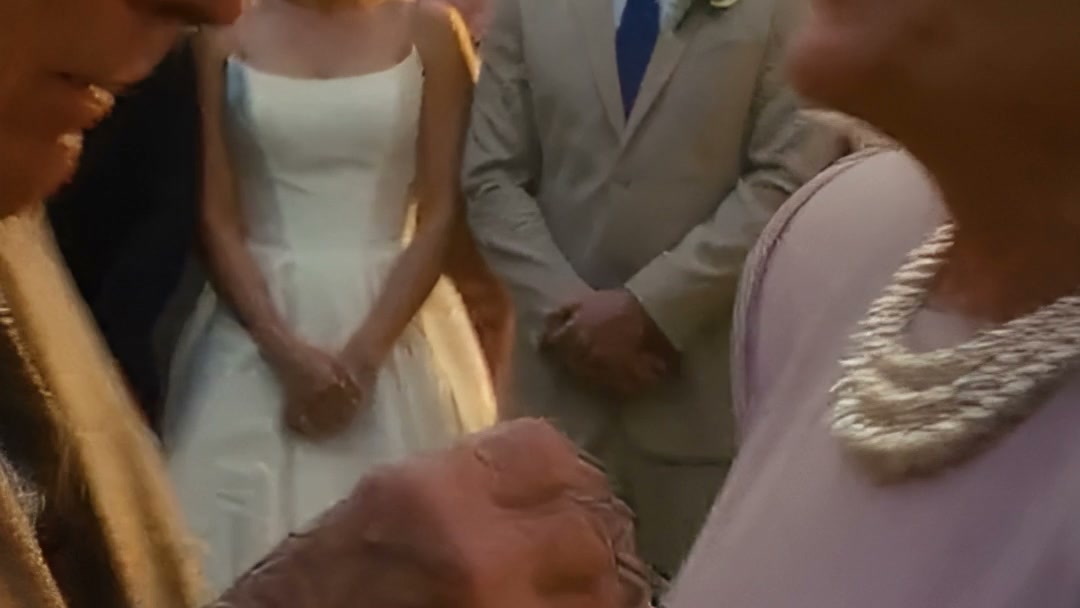
A groom’s mother shoved the bride’s father out of the family photo and ripped the flower from his chest… But the old man in the cheap suit had paid for every inch of that wedding.
The country club garden was perfect. White peonies on every table, string lights threaded through the oak trees, and late afternoon gold pressing through everything like a blessing. Two hundred guests lifted champagne flutes and laughed and the photographer called out positions for the family portrait.
Margaret Holloway smoothed her lavender Chanel dress and stepped into frame first. She had opinions about every detail of this wedding — the napkin fold, the entrée, the seating chart — and she had opinions about this photograph too.
Gerald Marsh didn’t know any of that. He just wanted to be in the picture with his daughter.
He walked up slowly, his old brown suit pressed as carefully as he could press it, a single white rose pinned to his lapel. His hands were rough from thirty years of construction work — cracked at the knuckles, scarred at the palms — and they were trembling slightly as he found his place next to Emma.
Margaret moved before anyone registered what was happening.
She stepped in front of him, planted both hands flat on his chest, and shoved. Hard. Gerald stumbled backward, one foot twisting on the grass, and grabbed at a nearby chair to keep from falling. As he caught himself, Margaret reached out and snatched the rose from his lapel. She dropped it on the lawn without looking at it.
The photographer lowered his camera.
“Family only.” Margaret’s voice was crisp, bright, the tone she used with waitstaff. She looked at Gerald the way she’d look at a smudge on crystal. “Move, janitor.”
The garden went quiet. Two hundred people and the only sound was the string lights buzzing softly and a champagne flute being set down very carefully on a table.
Gerald looked at the rose on the grass. He bent down and picked it up with both hands, the stem bent, the petals already bruising. He straightened up slowly. His chin was shaking.
“I just wanted one picture with her.”
His voice broke on the last word. A tear ran down the side of his face and he didn’t wipe it. He stood there holding the crushed flower like he didn’t know what else to do with his hands, and nobody moved, and nobody said a word.
Nobody except Emma.
She’d been thirty feet away when it happened, talking to her maid of honor, and she’d turned just in time to see the shove. Now she was already moving — gathering the front of her dress in both fists, white satin and tulle bunched up over her knees, running across the lawn in her heels.
She reached her father and put her arms around him first. Just held him. Gerald’s shoulders came up and then collapsed and he pressed his face into her veil and cried quietly for a moment while his daughter held on.
“Dad.” She pulled back and looked at his face. “Dad, look at me.”
He looked at her.
“You’re okay,” she said. “You’re okay.”
She squeezed his hands once. Then she turned around.
Emma Marsh had been gentle her entire life. She’d been quiet in arguments and patient with difficult people and she had spent eleven months of wedding planning absorbing Margaret Holloway’s corrections and adjustments and barely concealed contempt with nothing but a calm smile. Every guest at that reception knew it. Her maid of honor knew it. The photographer knew it. Even the bartender had remarked on it.
What they were watching now was something different.
Emma walked across the grass toward her mother-in-law and stopped three feet in front of her. Her dress caught the afternoon light. Her voice was completely steady.
“That’s my dad.” She didn’t raise it. She didn’t need to. “He paid for this wedding. Every table, every flower, every bottle of champagne you’ve been drinking since two o’clock. He worked construction for thirty years to give me this day. And you just shoved him out of a photograph and called him a janitor.”
Margaret opened her mouth.
“Don’t,” Emma said.
Margaret closed it.
“I want you to think,” Emma continued, “very carefully, about what happens next. Because what happens next is the thing my children will hear about when they ask how their parents’ wedding day went.”
The photographer had stopped pretending to adjust settings. The string quartet had stopped playing. Every single guest was facing the same direction.
Then there was footfall on the grass. Firm, deliberate.
Ryan Holloway crossed the lawn in his wedding suit and stopped beside his wife. He didn’t look at his mother. He looked at Gerald, still standing at the edge of the gathering with the bent rose in his hands and tears drying on his face.
“Mr. Marsh,” Ryan said. “I’m sorry. I should have been standing closer.”
Gerald looked at him.
“Would you stand next to Emma?” Ryan said. “For the photo. In the center.”
A long pause. Gerald looked at his daughter. Emma nodded, her eyes bright, and held out her hand.
Gerald walked to her. He took her hand. He let her tuck the broken rose back into his lapel — stem bent, petals bruised, still there.
Ryan turned to his mother then. His voice was quiet and final.
“Mom. The car’s out front. I’ll call you tomorrow.”
Margaret’s face had gone the color of chalk. Her hand had come up to her mouth at some point and hadn’t come down. She looked at her son. She looked at the guests. She looked at the two hundred faces that were all watching her, waiting, not even trying to look away anymore.
She picked up her clutch from the table. She walked across the lawn toward the car park without another word. The guests parted to let her through and no one said anything and no one moved to join her.
The photographer raised his camera.
“Okay,” he said gently. “Let’s get this shot.”
Emma stood in the center in her white dress, and Ryan stood on her left, and Gerald Marsh stood on her right — work-worn hands, cheap brown suit, bent white rose — and when the photographer said smile, Gerald smiled, and it was the most unguarded, overwhelmed, full-faced smile anyone in that garden had ever seen on a man.
The photo came out perfectly.
That night, after the cake and the first dance and the toasts, Ryan found his father-in-law sitting alone at a garden table, jacket off, tie loose, watching the string lights sway.
“She’s lucky to have you,” Ryan said, sitting down across from him.
Gerald was quiet for a moment. Then he said, “I know she is. I’m luckier.”
He picked up his champagne glass and raised it slightly.
“To good kids,” Gerald said.
Ryan picked up his own glass and touched it to the old man’s.
“To good dads.”
They sat there together in the golden dark while the party went on around them, and the broken rose sat in a water glass between them on the table, and it was still, somehow, perfectly white.