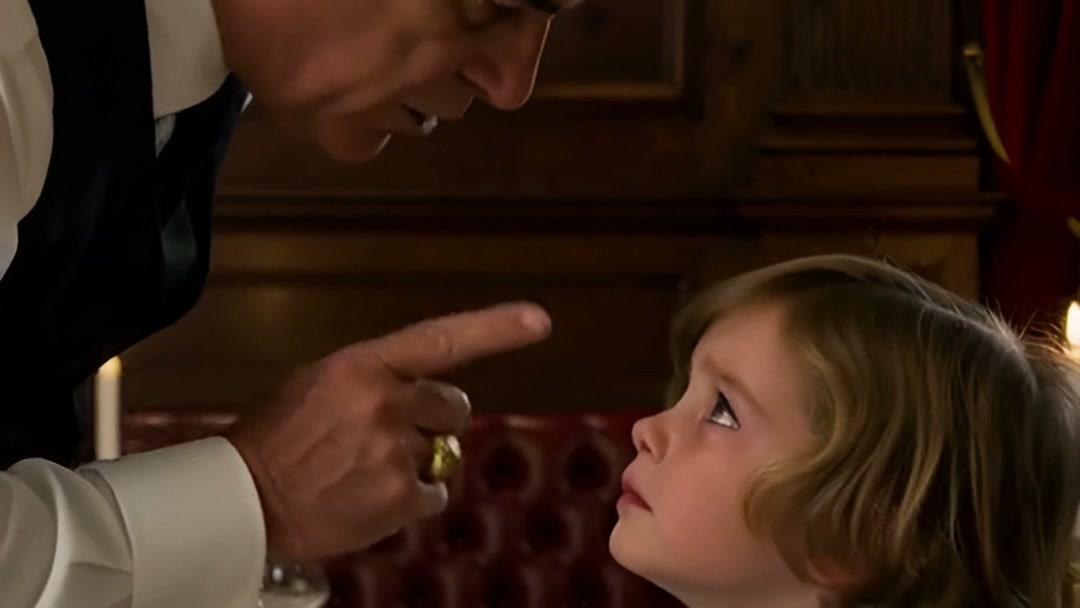
Mafia boss Dante Ricci caught his restaurant manager dragging a hungry six-year-old by the collar… But when the boy opened a gold locket and whispered “Mommy says this is my daddy,” Dante’s blood turned to ice.
The sign on the door of Ricci’s read *Closed — Private Event*. It always read that. Dante Ricci didn’t need the public. He needed silence, loyalty, and a table in the back where he could think.
Tonight, the dining room held eight of his men, red candles guttering in heavy glass, plates of food nobody had touched yet because Dante hadn’t touched his. That was the rule. Everything waited for him.
Nobody noticed the small shape slip through the kitchen door.
Marco was six years old and had been hungry since noon. His mother, Elena, had been scrubbing pots in the back since five, and she’d told him to stay on the crate by the mop sink and not move. He’d stayed for two hours. Then his stomach overruled him.
He crept out in his grey hand-me-down sweater, the sleeves so long they covered his knuckles, and he made it all the way to the boss’s own table before he saw the bread basket. One roll. Round and soft and warm, the kind that came wrapped in a cloth. He took it with both hands like it was fragile.
“You little thief.”
Sal Conti, the restaurant manager, had a voice like a door slamming. He was sixty, barrel-chested, twenty years in Ricci service, and he crossed the room in five strides. He snatched the bread from Marco’s hands and grabbed a fistful of his sweater collar, lifting him half off the floor.
“Get out. Now. And tell your mother she’s done tonight too.”
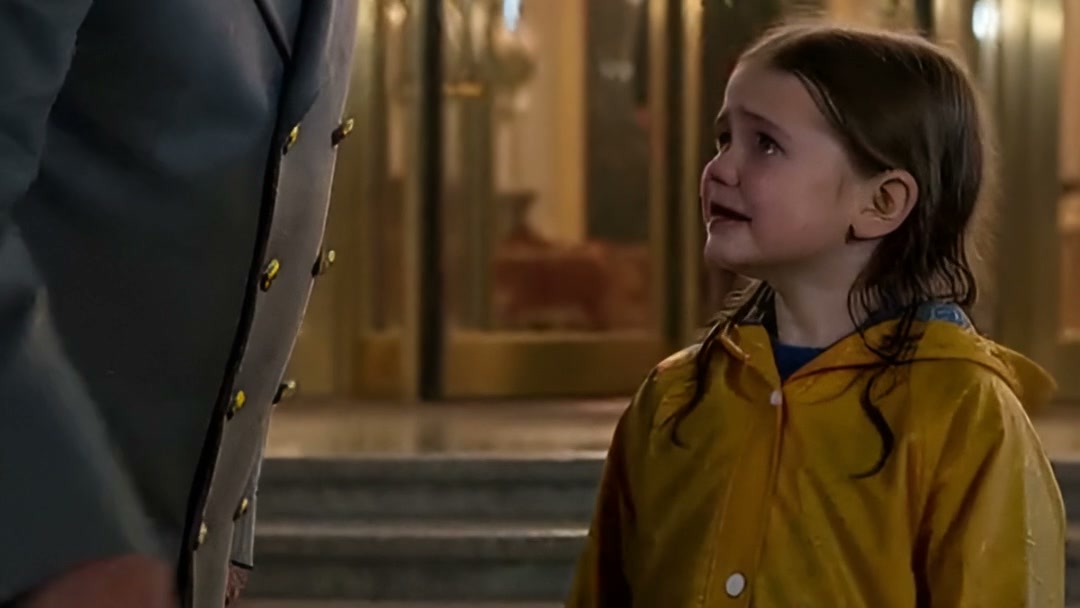
Marco’s lip trembled. Tears spilled down his cheeks. He didn’t cry loudly — he’d learned not to — but his small face collapsed completely, chin tucked, shoulders shaking.
Every man in the room looked at the tablecloth.
Dante Ricci looked at the boy.
He’d been at the head of the table, untouched wine in front of him, watching. He hadn’t moved in thirty seconds, but something had shifted behind his eyes, something cold and old that the men who worked for him had learned to read like weather.
He stood up.
He crossed the room and his hand shot out and locked around Sal’s wrist — the one gripping the collar — and he stopped him dead.
“Let go of him.”
His voice was quiet. That was always the danger sign. Sal released the boy instantly and took a step back. Marco dropped to his feet and stumbled, catching himself on the edge of the table. The room was completely silent. One of the men near the window had stopped mid-reach for his glass and hadn’t moved.
Dante Ricci, forty-two years old, head of the Ricci family, a man who had never once knelt in front of anyone, got down on one knee in front of a six-year-old boy in a too-big sweater.
“You’re hungry,” he said. It wasn’t a question.
Marco stared at him. His cheeks were still wet. He nodded once, very small.
Dante picked up the bread roll from where Sal had dropped it on the table. He put it back in Marco’s hands. He closed the boy’s fingers around it.
“Eat,” he said. “Nobody’s going to touch you.”
Marco ate two bites, eyes still fixed on Dante’s face with an expression that was hard to name. Not fear. Something more searching than that, like he was trying to match a thing in his head to a thing in front of him.
Then he reached under his sweater with one hand and pulled out a small gold locket on a thin chain.
He opened it carefully, the way a child opens something they’ve been told is precious and breakable. He held it out toward Dante, flat on his palm.
Inside was a photograph. Old, slightly creased. A young man, maybe twenty-five, laughing, arm around a young woman with dark hair and bright eyes. The young man was Dante Ricci. He recognized the jacket. He’d worn it to a restaurant in Naples. He remembered the night because it was the happiest he’d ever been.
He hadn’t seen that photograph in seven years.
He hadn’t seen that woman in seven years either.
Marco looked up at him with Elena’s eyes, which Dante was only now registering, only now understanding why the sight of the boy had stopped him cold from thirty feet away.
“Mommy says this is my daddy,” Marco whispered.
Dante Ricci did not move. He did not breathe. The candle nearest him threw his shadow long across the floor and his face had gone the color of wax, jaw tight, eyes fixed on the photograph the size of a postage stamp in his son’s small hand.
Seven years ago, Elena Vasquez had been a language student in Rome. Dante had loved her for eight months with a recklessness that was entirely unlike him, and he had been on the verge of something he couldn’t name — leaving, or restructuring, or simply building something outside the machinery of the family — when she vanished.
His father, Enzo Ricci, had told him she took money. Two hundred thousand euros, wired to an account in her name. “She was always practical,” Enzo had said, lighting a cigarette, watching his son’s face. “Don’t embarrass yourself.”
Dante had believed him. He’d had no choice but to believe him. Elena was gone, the account was real, and he was twenty-five years old and had just inherited a criminal organization and no room for grief that made him look weak.
He buried it. He buried her. He became what he became.
Now he stood up slowly from his knee and turned to look at Sal Conti.
Sal was already reading the room. He’d spent twenty years reading rooms, and this one was telling him something he didn’t like. He straightened his jacket.
“Boss,” he started. “The woman, she showed up at the back door six weeks ago asking for kitchen work. I thought it was just —”
“You knew who she was,” Dante said.
Not a question. A fact. Dante had spent his life around men who lied and he knew what knowing looked like when it was trying to pass itself off as ignorance.
Sal’s jaw tightened. “Your father —”
“My father has been dead for three years.” Dante’s voice had gone to something below quiet. “And you still work for him.”
He looked at Luca, his head of security, at the table to the left.
“Get him out of my building,” he said. “His keys, his phone, every piece of paper he’s carrying. I’ll decide what comes next in the morning.”
Two men stood. Sal opened his mouth, closed it, and was walked to the door.
Marco watched all of this from the table, bread roll still in his hands, eyes moving from the men to Dante and back.
“Is he in trouble?” he asked.
“Yes,” Dante said.
“Because of me?”
“Because of himself.” Dante crouched down again so they were level. “What’s your name?”
“Marco.”
“Marco.” He said it once, like he was setting it down somewhere carefully. “Where’s your mother right now?”
“Kitchen,” Marco said. “She told me not to come out here.”
“She was right.” He paused. “I’m going to go find her. Will you stay here and finish eating?”
Marco looked at him for a long moment, the way children look at adults when they’re deciding whether the words match something true.
“Okay,” he said.
Dante walked into the kitchen and the two prep cooks near the door stepped back fast without being told to.
Elena was at the far sink, her back to him, dark hair tied up, a worn grey apron over her clothes, hands in the water. She hadn’t heard him over the noise of the faucet and the extractor fan.
He stood there for a moment. He hadn’t seen her in seven years and he hadn’t let himself picture her in six, and she was right there, older, thinner, and completely real, and his chest felt like something structural had given way.
“Elena.”
She turned.
The color left her face. The ceramic bowl she was holding slipped and he crossed the room in four steps and caught it before it hit the floor. He put it on the counter. They were two feet apart.
“I didn’t know this was your restaurant,” she said. Her voice was steady and he could hear how hard she was working to keep it that way. “I saw the sign — Ricci’s — but there are other Riccis. I thought —”
“Stop,” he said. Not unkindly. “Just stop.”
“Dante —”
“The money,” he said. “The two hundred thousand. Did you take it?”
She stared at him. Something moved across her face — old pain, or old anger, or both.
“Your father put it in an account in my name and told me that if I didn’t leave Italy in forty-eight hours, he would have me killed,” she said. “And then he told you I took it to leave.” She looked at her own hands. “I never touched a euro of it. I didn’t even know how.”
Dante stood very still. Seven years of a story he’d told himself rearranging into something he couldn’t recognize.
“He told me I had to disappear completely,” she continued. “No contact. He said if I called you or wrote to you or tried to find you, his people would know. I believed him.” Her voice cracked slightly. “I had no money. I went home to my sister in Valencia. I was already pregnant and I didn’t know it yet.”
“How long before you knew?”
“Six weeks.” She looked up at him. “I thought about telling you. Every day for a year I thought about it. But your father was still alive, and I was terrified, and I didn’t know how to reach you safely, and then more time passed and it felt —” She stopped. “It felt like I’d already made the choice, even though I hadn’t.”
Dante exhaled slowly. “He threatened you,” he said. “His own grandchild.”
“He didn’t know. I was just the inconvenient woman.” She met his eyes. “I’m not here asking for anything. I needed work and I was running out of options. I needed to feed Marco. I thought the risk was low now that your father was gone.”
“The manager,” Dante said. “Conti. Did he recognize you?”
Something flickered across her face. “He looked at me a certain way when I came in for the interview. I told myself I was imagining it.”
“You weren’t.” He looked at the door, then back at her. “He was my father’s man. He’s gone now.”
She absorbed that.
“Marco’s out front,” Dante said quietly. “He took a bread roll from my table.”
Her hand went to her mouth. “Oh God. I told him to stay —”
“He’s fine. He’s eating.” He paused. “He showed me the locket.”
Elena closed her eyes. When she opened them they were bright and full. “He’s known about you since he was four. I didn’t know what else to give him. I told him his father was a good man who didn’t know he existed.” She pressed her lips together. “I didn’t want him to grow up hating you for something that wasn’t your fault.”
“Elena.”
“What?”
He’d spent twenty years keeping his face exactly where he wanted it. He gave up on that entirely.
“I have a six-year-old son,” he said, and his voice on that sentence did something he hadn’t heard from himself since he was a boy. “He came out of a kitchen in a sweater three sizes too big and stole a bread roll from my table. He could have taken anything in this building and he took one bread roll because he was hungry.”
She made a sound that was almost a laugh and also wasn’t.
“He’s very brave,” Dante said.
“He’s very hungry,” she said. “He’s also very brave.”
He walked back out to the dining room. Marco was still at the table. He had finished the bread roll and was sitting with the locket open in his lap, looking at the photograph.
He looked up when Dante came back.
“Is Mommy okay?”
“She’s okay. She’s going to come out in a minute.” Dante sat down across from him at the table — his own table, in his own restaurant — and looked at his son. “Marco. I need to tell you something.”
Marco looked at him steadily.
“Your mother told you your father didn’t know you existed,” Dante said. “That’s true. I didn’t know. But I know now.” He held the boy’s gaze. “And I’m not going anywhere.”
Marco looked down at the locket. He turned it over in his hands once.
“You look older,” he said, “than the picture.”
“Yes,” Dante said.
“Mommy does too.”
“Yes.”
Marco seemed to weigh this with the seriousness of someone doing important accounting.
“Okay,” he said.
Elena came out of the kitchen. She’d taken off the apron. She stood at the edge of the room, uncertain, and Marco slid off the chair and crossed to her and took her hand, and then looked back at Dante, and the three of them held that arrangement for a moment in the candlelight while eight men in black suits studied their tablecloths with tremendous focus.
Dante’s lawyer arrived at nine the next morning with a folder three inches thick. By eleven, a private investigator had confirmed what Dante had already known in his bones: the wire transfer had been set up under Elena’s name using documentation forged by a notary on Enzo Ricci’s payroll. Elena had never signed anything. There was a paper trail going back seven years, running through Sal Conti as the point of contact.
Conti was walked into a meeting with two of Dante’s lawyers at noon. By two o’clock he had signed a full written account of what he’d done and why, in exchange for a conversation about his future that made it very clear what the alternative looked like. He resigned in writing and left the city by evening.
Dante made two calls. One to his accountant and one to his property manager.
Three weeks later, Elena stood in the kitchen of a house in the hills north of the city — a real kitchen, with a window and afternoon light, in a house that was now in her name, no strings, no conditions, paperwork confirmed by her own lawyer whom Dante had had no hand in choosing.
“I don’t want you to feel like I’m —” she started.
“I know,” he said.
“I need to do this correctly. For Marco, and also for myself. I need it to be slow.”
“I know that too.” He looked out the window. “I’m not asking for anything back. That’s not why.”
She looked at him for a long moment.
“He asked me this morning if he could call you something,” she said.
“What did you tell him?”
“I told him to ask you.”
Dante was quiet. Through the window he could see Marco in the garden below, chasing something across the grass with the whole-body enthusiasm of someone with no concept of dignity.
“I’ll ask him what he wants,” Dante said.
He went down into the garden, and Marco looked up, and Dante held out his hand, and the boy took it without hesitation, because he was six years old and brave and had crossed a room full of dangerous men for a bread roll, and this was considerably less frightening than that.
Above them, Elena watched from the kitchen window. She didn’t wipe her eyes. She just let herself look.
For the first time in seven years, nothing was taken from her. The man in the garden below was holding her son’s hand, and her son was telling him something at length and with great authority, and Dante Ricci — the most feared man in the city — was listening like it was the most important briefing of his life.
Because it was.