Feared billionaire Elliot Crane watched a tiny girl in a faded pink dress press her palm against his dead wife’s portrait… But when she whispered “That’s my mommy — she sings to me,” his champagne glass shattered on the marble floor.
The gala was in full swing when five-year-old Lily slipped out of the kitchen.
Her mother, Clara, had told her to stay put. But the music was so pretty, and the hallway so long and golden, that Lily’s small feet carried her forward before she could stop them.
She stopped in front of the painting.
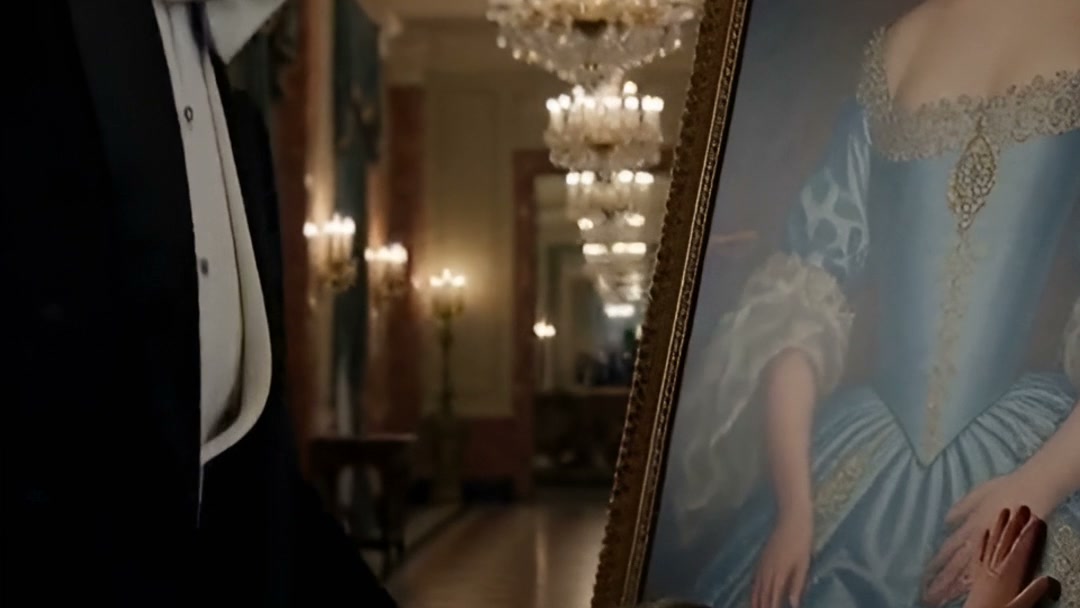
It was enormous — a woman in a blue gown, dark hair swept up, eyes warm and laughing. Lily stared. She pressed one small palm flat against the gilded frame.
“I know you,” she whispered.
“Remove your hand.” The voice came from behind her, sharp as a slap. “Now.”
Thomas, the head butler — sixty years old, silver-haired, rigid in his black uniform — grabbed Lily’s sleeve and pulled her back two full steps. His face was bloodless with alarm.
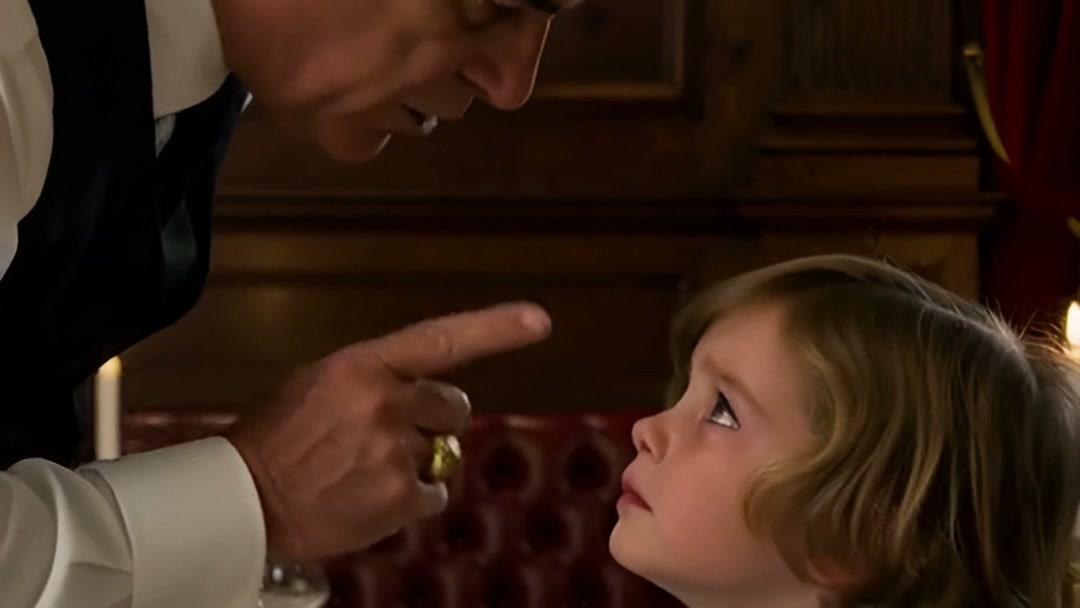
“You cannot be here,” he hissed. “This hall is off-limits. If Mr. Crane sees you—”
“I see her.”
The voice was quiet, but it cut through everything. Thomas went rigid. The two junior staff members at the hall’s far end stopped breathing.
Elliot Crane stood in the arched doorway, champagne flute in one hand, black tuxedo immaculate. Forty-two years old, dark-haired, broad-shouldered, with the kind of face that closed deals and ended conversations. He looked at Thomas first — one look, and the butler released Lily’s sleeve and stepped back.
Then Elliot looked at the child.
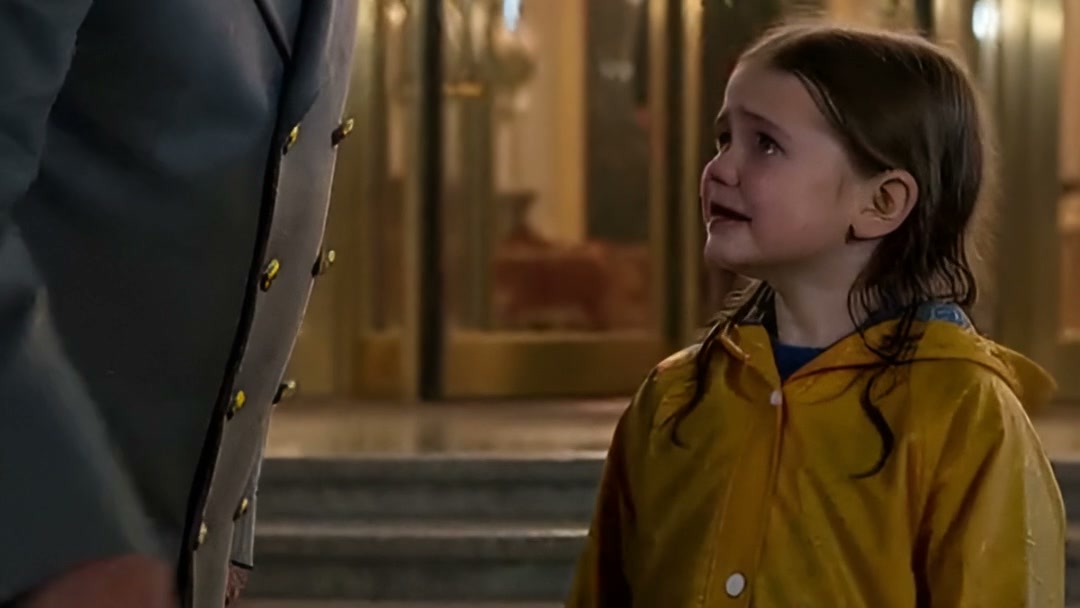
Lily didn’t run. She looked up at him with enormous brown eyes, her lip trembling, two tears already tracking down her cheeks.
Elliot set the champagne flute on the side table. Slowly, without a word, he walked to her. He stopped. And then — to the absolute disbelief of every person in that hallway — Elliot Crane, the most feared man in three industries, lowered himself to one knee on the marble floor.
He was eye to eye with a five-year-old in a faded pink dress.
His hand came up. He wiped the tears from her left cheek with his thumb, the gesture so gentle it looked like it belonged to a different man entirely.
“Did he hurt you?” Elliot asked quietly.
Lily shook her head. She sniffled. Then, very carefully, she put her small hand on top of his big one.
She turned her head toward the portrait.
“That’s my mommy,” she whispered. “She sings to me. At night, when I can’t sleep. She sings the one about the river.”
Elliot Crane did not move.
The champagne flute on the side table tipped and fell. Nobody caught it. It shattered on the marble and nobody flinched, because nobody was looking at the floor.
They were all looking at Elliot’s face.
“What did you say?” His voice was barely a sound.
“My mommy.” Lily pointed at the portrait with total certainty, the way only a five-year-old can point at something — as if the whole world ought to already know. “In the painting. She has a blue dress. She’s pretty.”
“She—” Elliot stopped. He looked up at the portrait. His jaw worked. When he looked back at Lily, his eyes were bright in a way Thomas had never seen in twenty years of service. “What song? The one she sings.”
Lily hummed four bars, quietly, off-key and perfect.
Elliot’s hand turned over under hers and gripped it.
That was the song. The exact song. The one his wife, Diana, had sung to herself in the garden. The one nobody had recorded. The one nobody else alive would know.
“Find the maid,” Elliot said, not looking up. “The new one. Clara. Bring her here. Now.”
Thomas moved fast.
Clara appeared in the hallway sixty seconds later, a dish towel still in her hands, face white with fear. She was thirty-four, dark-haired, brown-eyed. She stopped when she saw Elliot kneeling on the floor holding her daughter’s hand.
“Mr. Crane, I’m so sorry — she wandered out, I told her to stay in the kitchen—”
“Look at me,” Elliot said. He stood, slowly. He did not let go of Lily’s hand. He stared at Clara. “Look at me and tell me your full name.”
Clara swallowed. “Clara Merritt.”
A long silence.
“Merritt was Diana’s name,” Elliot said. “Before she married me.”
Clara’s chin lifted. Her eyes filled. “Yes.”
“You’re her sister.” It wasn’t a question. “Her twin sister. Diana talked about you. She said you’d had a falling out — years before we met. She said she didn’t know where you were.”
“I found her,” Clara whispered. “When she got sick. When she was pregnant. I came back. And then she — and then the night she died, her aunt — your Aunt Ruth — she came to the hospital. She took the baby before you arrived. She told me the baby died too.” Her voice broke. “She told me the baby died. I didn’t know. I swear to God, I didn’t know. I found Lily on my doorstep three days later with a note that said she was a charity case and I should raise her quietly and never ask questions.”
Elliot looked down at Lily, who was watching the adults with calm, attentive five-year-old eyes, swinging his hand gently back and forth.
“Lily,” he said carefully. “What’s your birthday?”
Lily held up her free hand, fingers spread. “March the eleventh. I’m going to be six. Clara says I can have a cake with strawberries.”
March 11th. His daughter had been born on March 11th. He had been told she was stillborn. He had a grave marker in the east garden with her name on it.
His daughter did not have a grave. His daughter was holding his hand and asking for a strawberry cake.
“Thomas.” Elliot’s voice was very steady. Very quiet. The kind of quiet that meant a storm had already made its decision.
“Sir.”
“Call Dr. Harmon. Tonight. I want a DNA test.” He paused. “Then call Marcus Webb.”
Thomas blinked. Marcus Webb was Elliot’s attorney — a man who didn’t receive calls after eight p.m. unless something catastrophic was about to happen to someone.
“And then,” Elliot continued, “call the police. And tell them I need to speak with someone about my Aunt Ruth.”
The DNA results came back forty-one hours later.
Elliot read the report standing at his desk, alone, the door closed. He set the paper down. He picked it up again. He set it down again.
99.998% probability of paternity.
He called Marcus Webb. “File everything,” he said. “Every document. The birth record, the hospital log, Clara’s testimony, the note she received. All of it.”
“Elliot,” Marcus said carefully. “Ruth is seventy-three. She has connections—”
“She stole my daughter,” Elliot said. “File everything.”
Aunt Ruth Crane was arrested on a Tuesday morning at her estate in Connecticut.
She had done it, she admitted eventually, because Diana had never been good enough — an outsider, a woman without money or name who had somehow bewitched Elliot and stood to give birth to the heir of everything Ruth had spent decades positioning herself to control. A dead baby and a grieving widower were so much more manageable than a living child and a recovered father.
She had paid the attending nurse. She had intercepted the records. She had delivered the infant to Clara with a forged note and a warning, banking on Clara’s own estrangement and fear.
She had miscalculated by approximately five years and four months.
Ruth was charged with child abduction, falsification of records, and conspiracy to defraud. She did not attend her arraignment in a fur coat. She attended it in a gray holding-facility jumpsuit, and the photograph was on the front page of every financial news outlet by noon.
Her board seats were revoked within the week. Her name was removed from the Crane Foundation’s donor wall. The marble plaque came down on a Wednesday. Nobody held a ceremony.
Elliot sat on the floor of the nursery — a room he’d kept locked for six years, still painted pale yellow — with Lily in his lap. She was wearing new pink pajamas and holding a worn cloth rabbit she’d brought from Clara’s apartment.
“This is where you would have slept,” Elliot told her. “When you were a baby.”
Lily looked at the yellow walls, the empty white crib. “It’s nice,” she said seriously. “But can I have a different color? I like green.”
“You can have any color you want.”
She leaned back against his chest and looked up at the ceiling. “Clara says I have to call you Daddy,” she announced. “She said I don’t have to if I don’t want to, but she said that’s what you are.”
“She’s right,” Elliot said. “That’s what I am.”
Lily thought about this. She turned his hand over in both of hers and studied the lines on his palm with intense focus, the way she studied everything.
“Okay,” she said finally. “Daddy.”
Elliot pressed his lips to the top of her head and closed his eyes.
Down the hall, in the room that had been made up for her the night before — with a proper bed, proper closet, and a standing invitation to all meals — Clara Merritt was sitting on the edge of her bed, crying quietly into a dish towel out of sheer exhausted relief.
She was not the maid anymore. She was family. Elliot had said it in four words, simply, while handing her a door key with her name on the tag: “You’re staying. Both of you.”
She had not argued.
On Friday, Elliot had the painting moved.
Not removed. Moved — from the formal hallway to the yellow nursery, hung low on the wall at the height of a small child who might want to look at it.
Lily stood in front of it for a long time that evening, her cloth rabbit under her arm. She studied the blue gown, the dark hair, the laughing eyes.
“Hi, Mommy,” she said quietly.
Then she turned around and went to find her father, trailing her rabbit behind her, already calling his name down the hall: clear, certain, entirely at home.
Elliot Crane answered. He always would.