She Came To Drop Off His Forgotten Lunch — Found This Instead
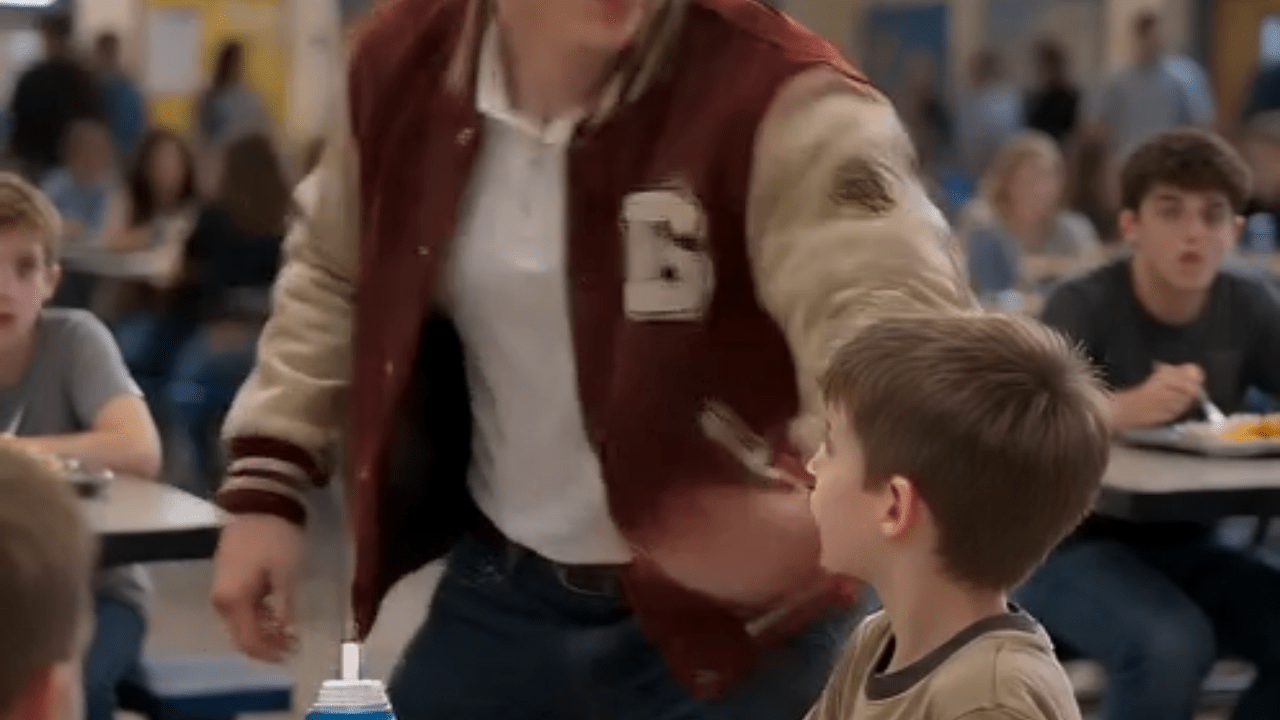
A senior bully shoved a small kid off the lunch bench in front of the whole cafeteria… But the kid’s big sister had just walked through the door in her Army Ranger uniform — still carrying his forgotten lunch bag.
The cafeteria at Jefferson High was loud the way it always was at 12:15 — trays clattering, chairs scraping, a hundred conversations happening at once.
Danny Calloway, nine years old, sat at the far end of a long table near the wall. He was small for his age, the kind of small that made him easy to overlook. He was unwrapping a granola bar he’d found at the bottom of his backpack, trying to make it look like a real lunch.
He’d forgotten his bag on the kitchen counter that morning. He’d realized it two blocks from home and kept walking anyway.
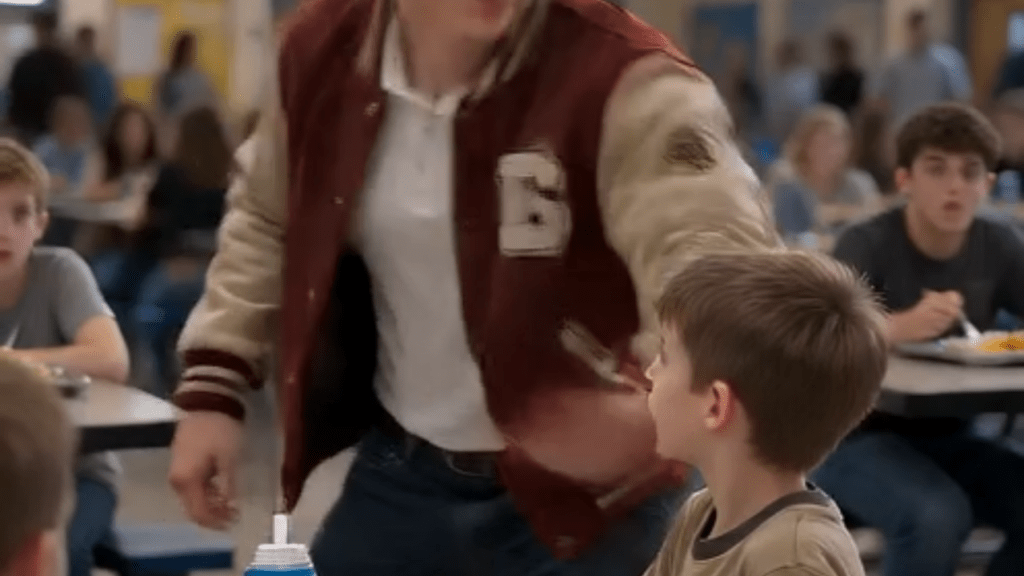
Tyler Marsh was seventeen, broad-shouldered, wearing a red and white letterman jacket with his name stitched across the chest. He moved through the cafeteria the way people move through spaces they believe belong to them — slowly, without watching where he was going, because nothing in his experience had ever required him to.
He was walking back from the food line with two of his friends.
He passed Danny’s table.
Nobody could say afterward whether it was intentional from the start or whether Danny’s smallness just made him a convenient target in the moment. Either way, Tyler’s hand came out sideways as he passed — a hard, flat shove directly into Danny’s shoulder.
Danny went sideways off the bench completely.
The tray flipped. The granola bar wrapper, a half-empty water bottle, and a bag of crackers hit the linoleum. Danny hit the linoleum right after them, catching himself on both palms, one knee.
Tyler didn’t stop walking.
He laughed — a short, dismissive sound — and said something to his friend that made the friend laugh too.
The tables nearest Danny went quiet first. Then the quiet spread outward in a ripple the way quiet does when something crosses a line. A girl two seats down stood halfway up, then sat back down. A boy across the table looked at Danny, then looked away. Nobody moved toward Tyler.
Danny pushed himself up from the floor. His palms were red. He didn’t cry. He was the kind of kid who’d learned that crying in public made everything worse, so he’d stopped doing it.
He reached for the tray.
The cafeteria entrance doors opened.
The sound they made was ordinary — the hydraulic hiss of a heavy door on a slow closer. Nobody would have looked up for that.
They looked up because of what came through them.
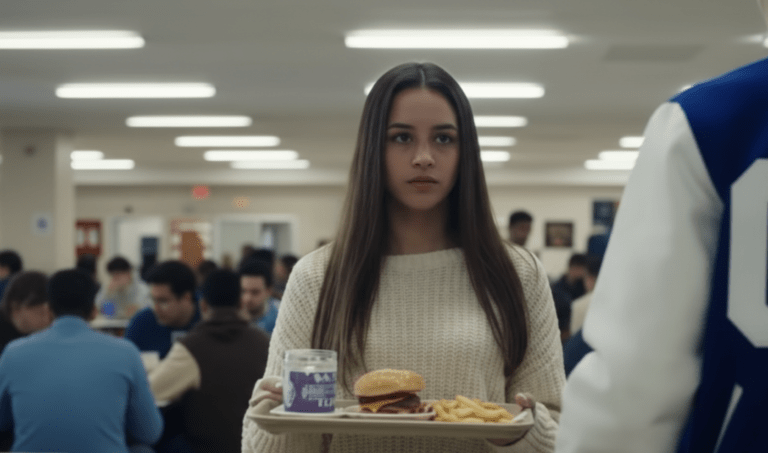
Staff Sergeant Mara Calloway was twenty-two years old. She was in full Army Ranger uniform — the tan beret, the combat boots, the patrol cap clipped to her left shoulder strap. Her deployment bag was slung over her left shoulder. In her right hand, she was carrying a child’s lunch bag. Blue. Cartoon rocket ship on the side. The same lunch bag she’d seen sitting on the kitchen counter at 7:40 that morning when she’d come downstairs for the first time in eight months, jet-lagged and quiet, still figuring out how to exist in a house that had furniture and carpet and a refrigerator with a note on it that said *Welcome home Mara!!* in Danny’s handwriting.
She’d picked it up without thinking. His school was three blocks off her route. She’d thought she’d surprise him.
She cleared the doorway.
She saw Danny on the cafeteria floor before she fully registered the room.
She stopped.
One second. Maybe less.
Then she set the deployment bag down in the entrance. Just set it down on the floor beside the door, carefully, the way you set something down when you’re freeing your hands for something else.
She kept the lunch bag.
She walked forward.
The cafeteria had gone the way cafeterias go when something shifts the air — not fully silent, but the noise had dropped a register, conversations tapering off, heads turning. A Ranger uniform in a high school cafeteria at noon was not a common sight. The beret alone was enough to stop people mid-sentence.
Mara didn’t look at any of them.
She crossed the room to Danny’s table, crouched down beside him, and put one hand on his arm to help him up. She looked at his face — not his palms, not the floor, his face — the way you check someone when you want to know how they actually are, not just whether they’re bleeding.
“Hey,” she said. “You okay?”
Danny looked at her. Something moved across his face — surprise, relief, the particular complicated expression of a kid who has been holding it together and suddenly doesn’t have to anymore.
“Yeah,” he said. His voice was steadier than his eyes.
She stood. She set the lunch bag on the table beside him.
“I brought your lunch,” she said. “You left it on the counter.”
“I know,” he said. “I thought you were—”
“I just got back this morning.” She straightened the lunch bag so it sat flat. “Eat something.”
Then she turned around.
Tyler Marsh was still visible at the far end of the cafeteria. He’d stopped walking. He and his two friends had turned around at some point — probably when the room went quiet — and they were standing near the far wall watching whatever was happening by the entrance.
Tyler saw the uniform before he understood what he was looking at.
Mara started walking toward him.
The cafeteria noise dropped the rest of the way. Not staged, not dramatic — just the natural silence of two hundred people recognizing that something was happening that they should pay attention to.
She crossed the room at an even pace. Not fast. Not slow. The pace of someone who has covered ground before and knows how to do it without wasting energy.
Tyler’s friends took two steps to the side.
Tyler didn’t move. He was seventeen and broad-shouldered and he had never in his life been made to feel small, so he didn’t know what to do with the feeling that was starting in his chest.
Mara stopped in front of him. She was five-seven. He had four inches and sixty pounds on her.
She looked at him for a moment without saying anything.
“That’s my brother,” she said.
Her voice was level. Not loud. She wasn’t performing for the room.
Tyler opened his mouth. “I didn’t—”
“I watched it happen,” she said. “From the door.”
He closed his mouth.
“He’s nine,” she said. “What’s your reason?”
Tyler looked at his friends. They were both studying the floor.
“It was just—” he started.
“What’s your reason,” she said again. Not a question the second time.
The silence in the cafeteria was complete. Two hundred students, not one of them moving.
Tyler Marsh, for the first time in his high school career, had nothing to say.
A teacher had appeared at the edge of the room — Mr. Donahue, who ran the cafeteria lunch period and had been in the back office when the shove happened. He’d come out when the noise dropped. He stood at the perimeter of the situation, reading it.
Mara turned to him.
“He shoved a nine-year-old off a bench,” she said, the same level voice. “My brother. I’d like to know what the school’s process is.”
Mr. Donahue looked at Tyler. Tyler looked at the floor.
“I saw the tail end of it,” Donahue said. “Tyler. My office. Now.”
Tyler picked up his tray without looking at anyone and walked toward the office door.
One of his friends started to follow.
“Just Tyler,” Donahue said.
Mara walked back across the cafeteria.
The noise came back gradually, the way it always does — one conversation restarting, then another, chairs shifting, someone laughing nervously at something unrelated. By the time she reached Danny’s table, the room was most of the way back to normal.
She sat down across from him.
Danny had opened the lunch bag. He was looking at the sandwich inside — turkey, the way he liked it, cut diagonally, which was the way their mother had always cut it and which Mara had apparently remembered.
“You cut it right,” he said.
“I know how you like it,” she said.
He took a bite. Chewed. Looked at her across the table.
“Are you in trouble?” he asked. “For coming in here like that?”
“I didn’t do anything,” she said. “I just talked to him.”
“You walked across the whole cafeteria in your uniform.”
“I walked across the cafeteria,” she said. “The uniform is just what I’m wearing.”
Danny considered this. He took another bite.
“He does it a lot,” Danny said. “Not just to me.”
“I know,” she said. “That’s why I asked him in front of everyone.”
Danny looked up.
“Because now everyone heard him not have an answer,” she said.
Tyler Marsh received a three-day suspension. The school called his parents that afternoon. Two other students came forward to Donahue’s office by end of day to report separate incidents — they’d seen what happened in the cafeteria, and something about the silence after Mara’s question had made it feel, finally, like reporting might actually do something.
Tyler’s letterman jacket stayed in his locker for the rest of the week when he came back. He didn’t stop wearing it permanently — but he stopped wearing it like armor.
Mara walked Danny home after school.
He carried his lunch bag — empty now — and she carried the deployment bag, and they walked the three blocks without saying much because they were both the kind of people who didn’t need to fill silence.
At the corner before their street, Danny said, “I’m glad you came.”
“I came because you forgot your lunch,” she said.
“I know,” he said. “I’m still glad.”
She looked at him. He was looking at the sidewalk, the way kids do when they’re saying something that matters and don’t want to make eye contact.
“Yeah,” she said. “Me too.”
They walked the last block home.
She’d been back for eleven hours. She’d already done the one thing she hadn’t known she needed to do — walk back into a room and stand between her brother and something that shouldn’t have been allowed to keep happening.
The deployment bag was heavy on her shoulder.
The lunch bag, empty now, weighed almost nothing.
She held onto it anyway.