
Hello, puzzle friends!
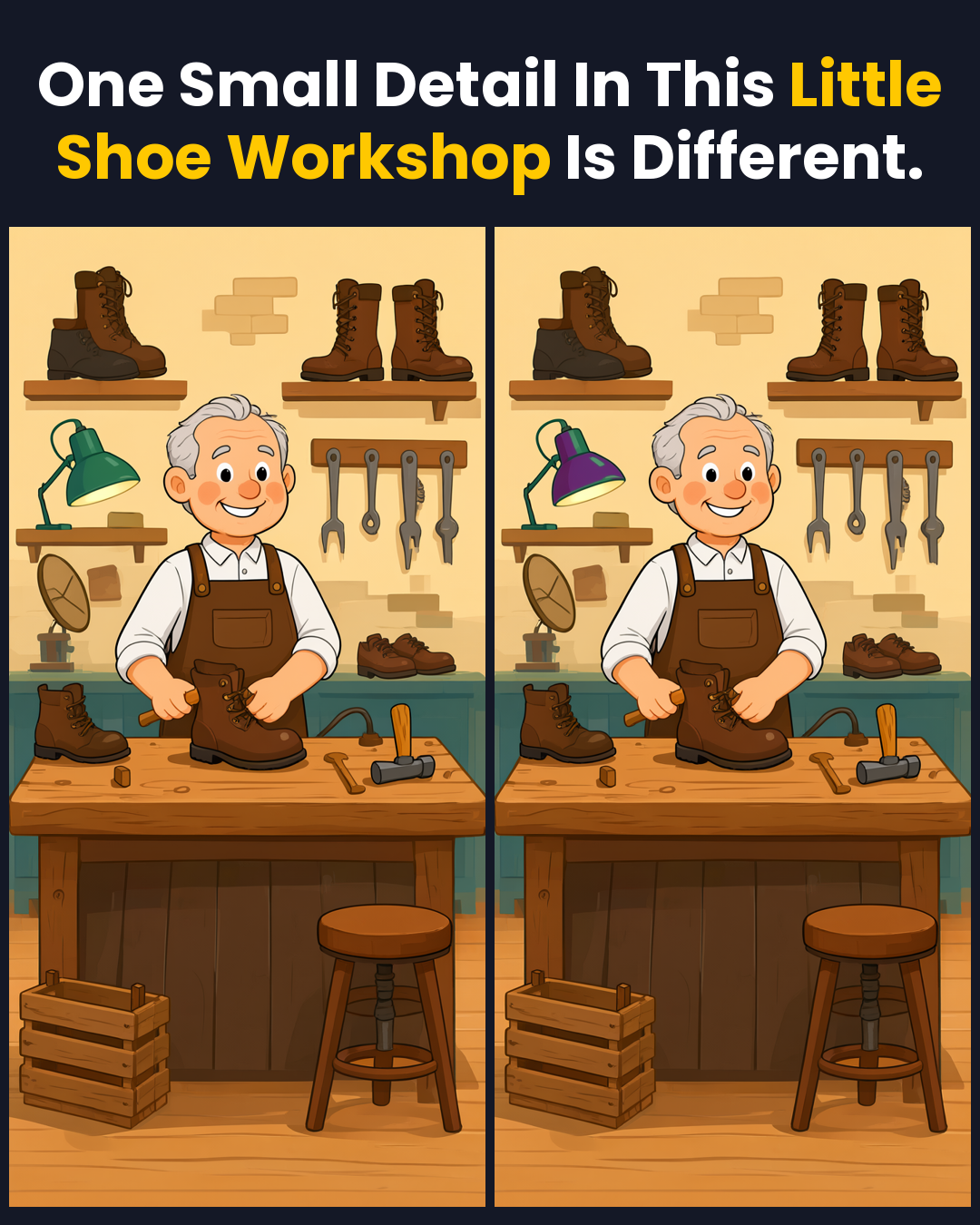
Today we are visiting a little shoe workshop, the kind that used to stand on every main street.
The old cobbler is smiling over his workbench, boots are lined up on the shelf, and his tools hang neatly on the wall.
Below you will find two pictures of his workshop.
They look identical, but one small detail in the second picture has been changed.
Check the shelves, the tools, the workbench, the stool and the wooden crate.
A gentle tip: look at the things that are not brown. In a workshop full of leather and wood, colour is where the secrets live.
Take your time, there is no rush at all.
Take your time and look closely before you scroll down!
How To Tackle A Picture Like This
A workshop is a difficult place to search, because it is full of small objects that all look rather similar. Boots, shoes, tools, wooden boards. Our eyes slide over them like a hand over gravel, and nothing really sticks.
The trick is to search by category rather than by place. First look only at the footwear, counting it in both pictures. Then look only at the tools on the wall. Then only at the furniture. Then only at the man himself.
Searching by category keeps your memory tidy. Instead of trying to hold a whole workshop in your head, you are only ever holding one small group of things, and a change inside that group jumps out far more easily.
Why Our Brain Finds It Hard
Our eyes are very good at noticing movement and very poor at noticing quiet change. In the wild, something that moved could be dinner or danger, while something that simply changed shade was never worth the effort.
That ancient wiring is still with us. When two pictures sit side by side, nothing is moving, so the alarm bells never ring. We have to search on purpose, slowly, with the thinking part of the brain, and that part gets tired and impatient very quickly.
A busy scene makes it worse. The more objects there are, the more places your attention has to visit, and the more likely it is to declare the job finished before it really is.
A Fun Fact From The Workshop
Shoemaking is one of the oldest trades we know of. Leather shoes more than five thousand years old have been found still laced, and village cobblers were once as common as bakers.
A good cobbler worked almost entirely by eye and by feel, judging a fraction of an inch without ever reaching for a ruler. That is a kind of trained attention, built over many years, and it is exactly the skill these puzzles ask of us for a few minutes.
So if you find this one quickly, you have the eye of a craftsman. If you do not, remember that the cobbler needed years of practice too.
Your Friendly Challenge
Most people need about thirty to forty seconds here, and plenty of people need longer, because the workshop gives the eye so many places to wander.
Set yourself a minute. If you find it sooner, try again with the clock running and see whether you can explain to somebody else exactly where to look without pointing. That is much harder than it sounds, and it is a lovely way to share the puzzle.
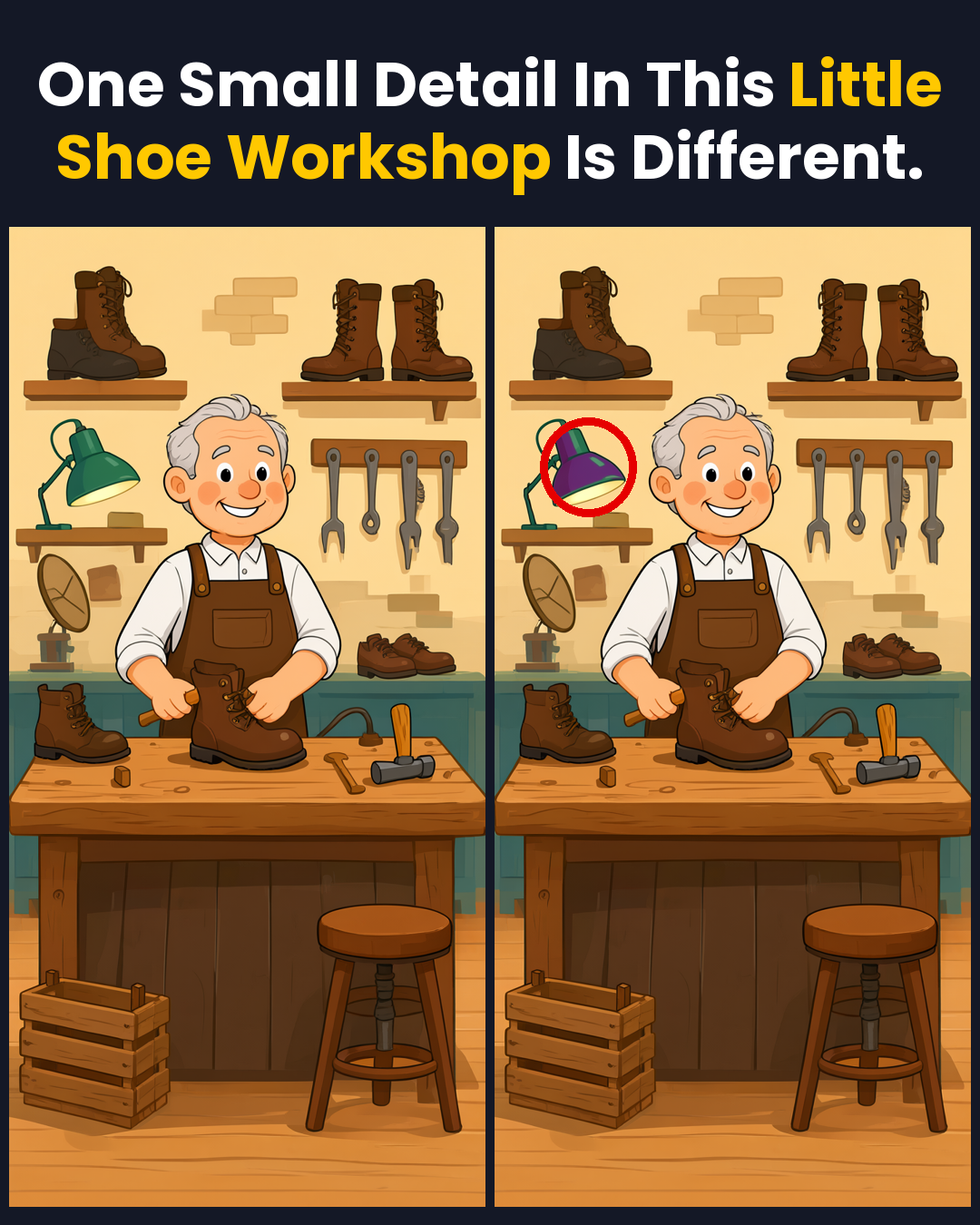
ANSWER: The shade of the desk lamp has changed from green to purple.
Where The Change Is Hiding
Look at the little desk lamp on the shelf to the left of the cobbler, the one bending its head over his bench. In the first picture its shade is a deep green, the colour of an old office lamp. In the second picture that shade has turned purple, while the stand and the base stay green.
The bulb still glows warmly, the shape is unchanged, and the lamp sits in exactly the same place. Only the colour of the metal hood is different.
Why It Is So Easy To Miss
The cobbler’s cheerful face is almost exactly in the centre of the picture, and faces are the strongest magnet our attention has. We look at him first, we look at him again, and we keep drifting back to him without realising it.
The lamp also sits at the edge of the scene, where our vision is much less sharp. We can tell that something lamp-shaped is there, but the fine detail of its colour never properly reaches us unless we deliberately turn our eyes that way.
And because both pictures show a lamp, in the same spot, pointing the same way, the brain happily ticks it off as checked.
How Did You Do?
Under 10 seconds: eagle eyes. Very little gets past you.
10 to 30 seconds: excellent. You searched the edges as well as the middle, which is exactly right.
30 to 60 seconds: very good, and the most common result by far.
Over a minute: perfectly normal, and nothing to worry about. Busy pictures are meant to be stubborn, and now you have a new habit: always check the lamps.