
Hello, puzzle friends!
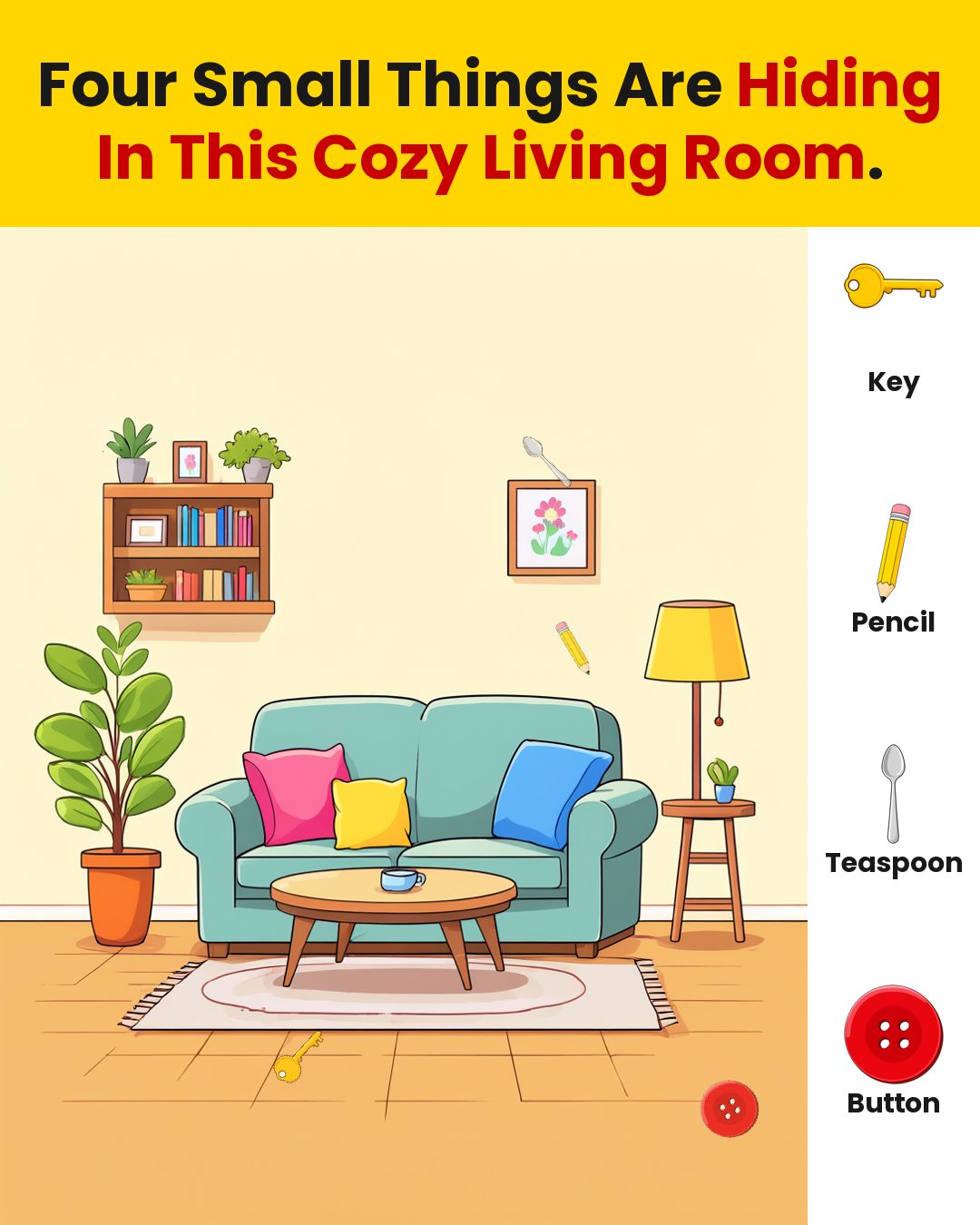
Welcome into a warm little living room, with a soft sofa, bright cushions, a bookshelf and a big leafy plant by the window.
It looks like the perfect place to sit down with a cup of tea, but four small things have gone missing in here.
A key, a pencil, a teaspoon and a button are all hiding somewhere in this room, and you can see exactly what you are looking for in the list beside the picture.
Some of them are sitting out in the open and some have blended in beautifully with the furniture and the floor.
Look low as well as high, and remember that small things love edges and corners.
Can you find all four of them?
Take your time and look closely before you scroll down!
Give The Room A System
Hidden object pictures reward patience far more than speed. The common mistake is to let your eyes dart from one interesting thing to another, the plant, the cushions, the lamp, until the whole room feels searched when in truth you have only glanced at it.
A much better approach is to sweep. Start at the top left corner and move your eyes slowly across to the right, as if you were reading a line of text. Then drop down and sweep back the other way. Keep going until you reach the bottom of the picture.
It feels slow for the first few seconds and then it feels wonderful, because objects simply appear in front of you that you would have walked straight past.
Know The Shape Before You Search
There is a second habit that makes a real difference, and it costs you nothing. Before you start hunting, look properly at the four little pictures in the list. Really take in their shapes. A key is a long stem with a round head. A teaspoon is an oval on a thin handle. A button is a small circle. A pencil is a slim stick with a point at one end.
Once a shape is clear in your mind, your eyes begin working for you almost automatically, flagging anything with that outline. Search without doing this and you are asking your brain to look for everything at once, which usually means finding nothing.
It also helps to search for one object at a time. Find the key first, then hunt the pencil. Four separate searches are far easier than one confused one.
Why Small Things Disappear So Well
Our eyes only see fine detail in a very small patch at the centre of our vision, roughly the size of your thumbnail held at arm’s length. Everything else is blur and guesswork, filled in by the brain from memory and expectation.
That is why a tiny button on a wooden floor vanishes so completely. Unless your central vision lands directly on it, you are not really looking at it at all, no matter how much you feel you are.
Colour adds another layer. A golden key on a warm wooden floor shares the same family of tones as its background, and things that match their surroundings are far harder to pull out of the scene. This is simple camouflage, the same trick a moth uses on tree bark, and it works just as well on a living room floor.
A Friendly Little Challenge
Most people find three of the four objects quite quickly and then spend twice as long looking for the last one. Thirty to sixty seconds for all four is a very respectable time.
So set yourself a target. Find all four before you scroll down to the answer, and do not peek early, because the last one is always the sweetest.
Then hand the picture to somebody else and watch them. It is remarkable how often the object you struggled with for a minute is the first one they spot.
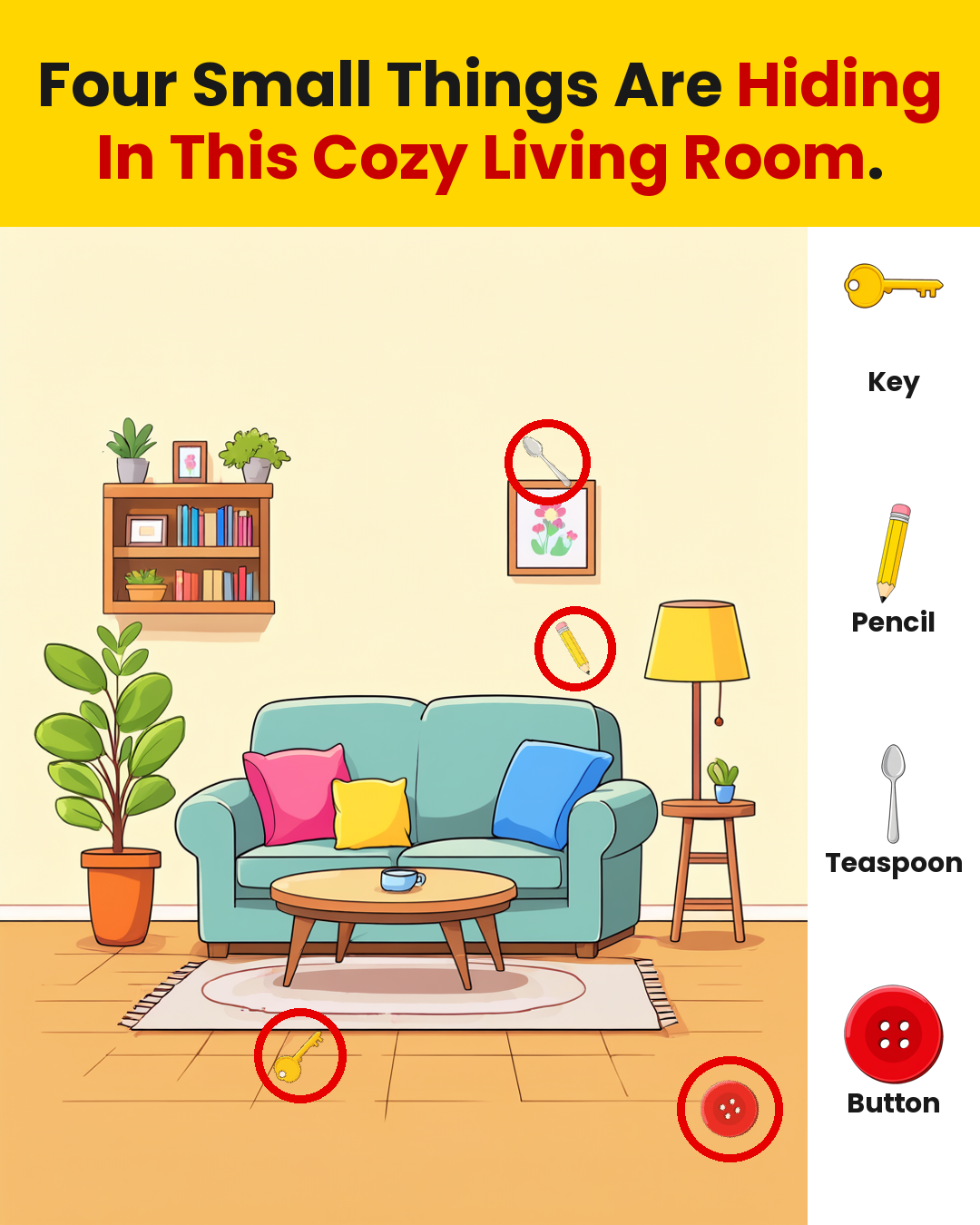
ANSWER: The key is on the floor beside the rug, the pencil floats on the wall above the sofa, the teaspoon is just above the flower picture, and the button is on the floor at the bottom right
Where All Four Objects Are Hiding
The teaspoon is the highest of the four. It is on the wall above the sofa, resting right at the top edge of the framed flower picture, where the silver handle looks almost like part of the frame.
The pencil is lower down on the same wall, in the empty space between the picture and the standing lamp. It is small, tilted at an angle, and because it is yellow it blends into the warm cream colour of the wall.
The key is on the wooden floor at the bottom left, just outside the fringe of the rug. Its golden colour sits very close to the colour of the floorboards.
The button is the lowest and furthest right, a small red circle lying on the floor near the bottom corner of the picture, almost off the edge of the scene.
Why Most People Miss Them
Nearly everyone searches the sofa, the cushions, the bookshelf and the plant first, because those are the busy, interesting parts of the room. That is precisely why the objects are not there. Plain empty wall and plain empty floor are the best hiding places in any picture, because our attention slides over them without stopping.
The button is the one that catches most people out. It sits so far into the bottom corner that many readers simply never look there, and we all have a habit of searching the middle of a picture and treating the edges as a frame.
The teaspoon comes second for difficulty, because it is touching the picture frame. When an object touches another object, the eye tends to read the two as one thing.
So, How Did You Do?
All four in under twenty seconds means you have genuinely sharp eyes and you almost certainly searched in a pattern rather than at random.
Twenty to sixty seconds is a strong result and where most careful readers finish. You found the easy ones quickly and stayed patient for the last.
Three out of four is nothing to be ashamed of at all, and the one you missed was most likely the little red button in the corner. If you found all four without any hints, you have an excellent eye for detail, and this room had no secrets from you.