
Hello, puzzle friends!
Today’s picture takes us up the stairs and into a warm, quiet attic.
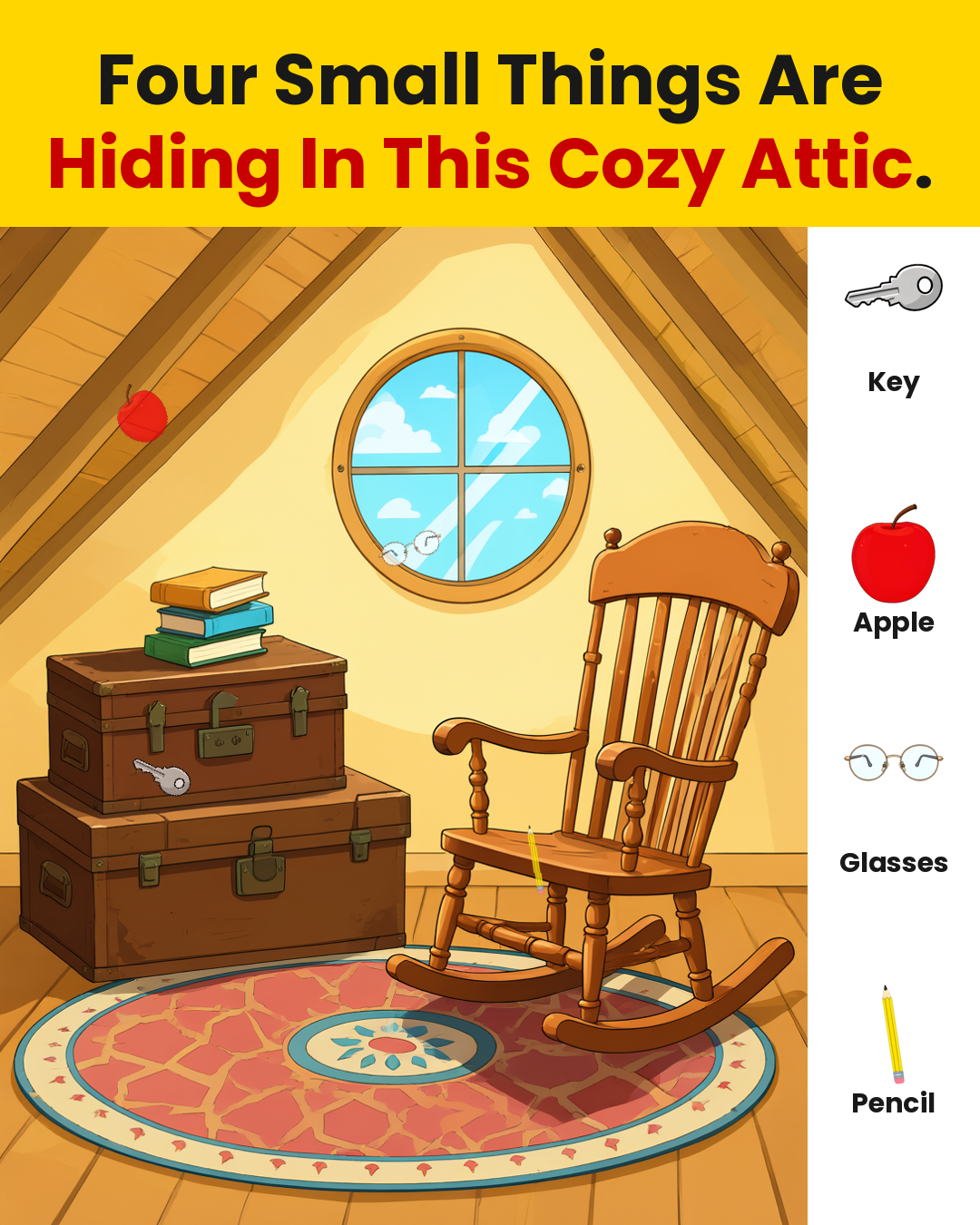
There are two old traveling trunks, a stack of books, a wooden rocking chair, a round window and a soft round rug.
Four small everyday things have been tucked into this room: a key, an apple, a pair of glasses and a pencil.
They are all in plain sight, not behind anything, but each one blends into whatever it is resting on.
Most people find two of them quickly and then spend a long time staring at the other two.
Look slowly, corner by corner, and see how many you can gather before you give up.
The marked picture is waiting for you at the bottom of the page.
Take your time and look closely before you scroll down!
Search In Squares, Not In Circles
When we are told to find something, most of us scan a picture in loose loops. The eye drifts to whatever looks interesting, wanders off, and comes back to the same bright corner three or four times while a whole side of the room goes unvisited.
A better method is to divide the picture into four imaginary squares and finish one square completely before moving to the next. Top left, top right, bottom left, bottom right. In each square, let your eyes travel slowly along every surface rather than across the open space, because small objects almost always sit on something.
It also helps to hold one object in mind at a time. Think only of the shape of a key and sweep the room for keys. Then clear your head and think only of a pencil. Searching for four things at once is far harder than searching for one thing four times.
Why Things Vanish In Plain Sight
Nothing in this attic is truly hidden. Every object is fully visible and nothing covers it. They disappear for a different reason, and it is one of the most studied effects in the science of attention.
When a small object shares the color and tone of the surface beneath it, our eyes stop treating it as a separate thing. The edges that would normally shout for attention are softened, and the object is absorbed into the background. A warm wooden pencil on a warm wooden chair is almost invisible for exactly this reason.
There is a second effect at work too. We expect certain objects in certain places. An attic full of trunks and books tells our brain to look for attic things, so an apple up on a roof beam is so out of place that the eye slides straight past it without stopping.
The Long Life Of The Hidden Object Picture
Pictures packed with hidden items have delighted families for generations. Children’s weeklies printed them a hundred years ago, often as a farm scene or a busy kitchen with a list of things to find along the edge.
The idea never grew old because it suits everyone. There is no time limit, no score to beat and nothing to remember. You simply look, and the pleasure comes from that small bright moment when a shape you have stared at twenty times suddenly separates itself from the background.
Your Friendly Challenge
Most people find all four objects in about forty-five seconds, and almost everybody finds one of them much later than the other three.
Try to get all four without scrolling. Then hand the picture to somebody else and keep quiet while they search. Watching a friend stare straight at the pencil and not see it is the best part of the whole puzzle.
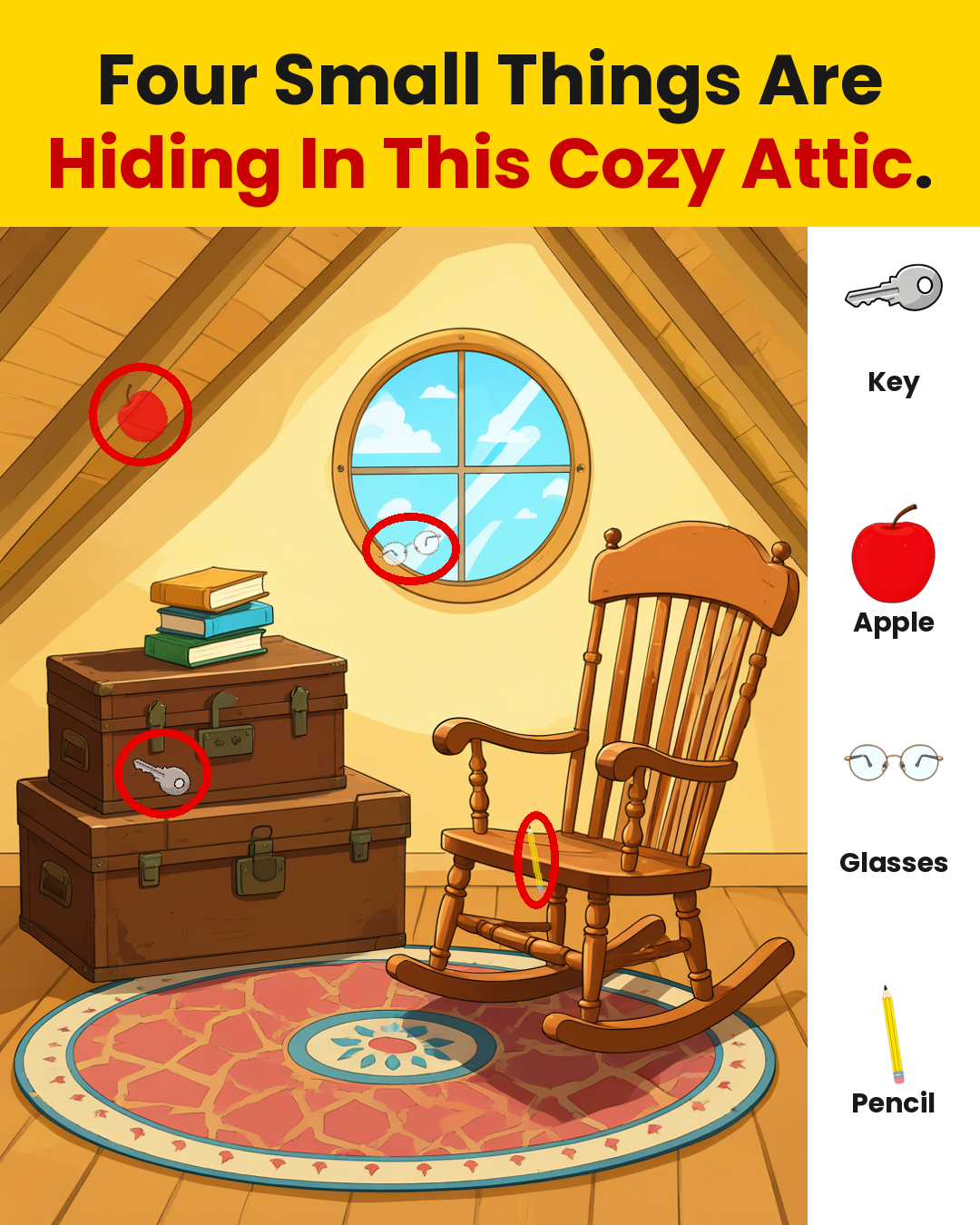
ANSWER: The key is on the lid of the upper trunk, the apple sits on the wooden roof beam at the top left, the glasses rest on the ledge inside the round window, and the pencil is lying on the seat of the rocking chair.
Exactly Where The Four Things Were
The key is the easiest of the four. It is lying flat on the lid of the upper traveling trunk, just left of the big brass lock. Its silver color helps it stand out against the brown leather, which is why most people pick it up first.
The apple is high in the top left corner, resting on the sloping wooden roof beam. Its red is bright, but it sits far from everything else in the room and away from the natural path of our eyes, so it is often found last of all.
The glasses are the sneakiest. They are sitting on the ledge inside the round window, where the pale blue sky and the little white clouds behind them hide their thin frames almost completely.
The pencil is on the seat of the rocking chair, standing on end against the wooden back. Yellow on warm honey-colored wood is the perfect camouflage, and many people look straight at the chair several times before it appears.
How Did You Do?
All four in under thirty seconds means you have a genuinely sharp eye and a very orderly way of searching.
Three out of four is a fine score and what most readers manage. The one that gets away is usually the glasses in the window or the pencil on the chair.
Two out of four simply means you searched the way almost everyone does, following the interesting objects instead of the quiet surfaces. Try the square-by-square method on the next picture and watch your score climb.