
Hello, puzzle friends, and welcome into the greenhouse.
The glass roof is full of sunshine, the shelves are crowded with pots, and green leaves spill out of every corner.
It smells of warm earth and tomato plants, and it is the perfect place to lose something small.
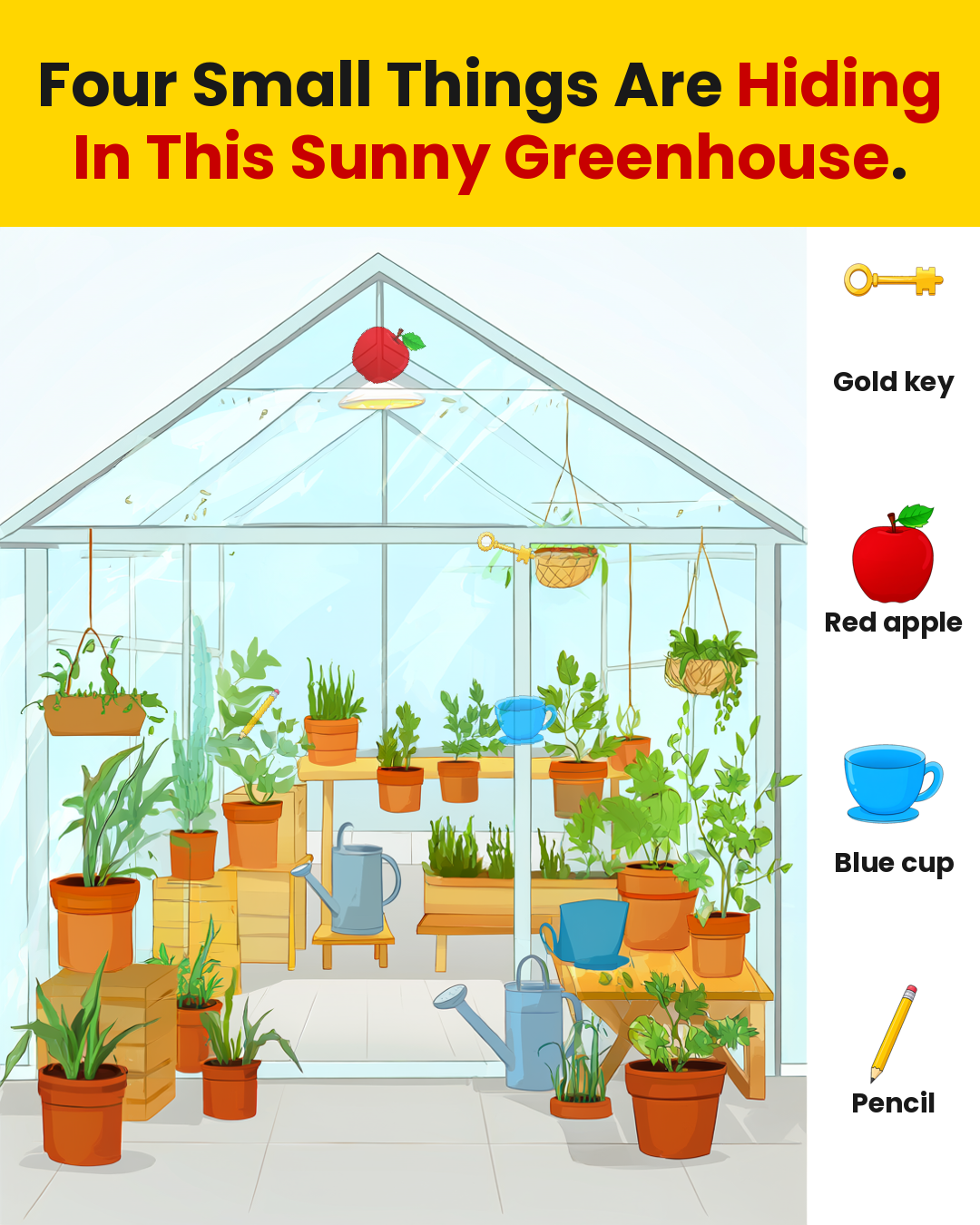
Four everyday objects have been hidden somewhere among the plants and the watering cans.
They are shown down the side of the picture: a gold key, a red apple, a blue cup and a pencil.
Every one of them is really there, in plain sight, at its normal size or smaller.
Nothing is behind a pot or under a leaf, so there is no need to imagine anything.
How quickly can you find all four?
Take your time and look closely before you scroll down!
Hunt By Object, Not By Area
Most people search a picture like this the same way they search a drawer: eyes everywhere at once, hoping something will catch their attention. In a busy greenhouse, everything catches your attention, so nothing does.
A far better method is to hunt one object at a time. Look at the gold key in the list, fix its colour and shape in your mind, and then sweep the whole picture looking only for that. Ignore the apple completely while you do it. When the key is found, clear your head and start again with the next one.
It sounds slower, and it is roughly twice as fast. Searching for one thing gives your brain a clear target, and a clear target is what makes something jump out of a crowded scene.
Why A Greenhouse Is Such A Good Hiding Place
Camouflage is not only about matching colour. It is also about matching clutter. A greenhouse is full of small, repeated shapes: dozens of leaves, dozens of pot rims, dozens of thin stems. Once your eye accepts that this is a place full of little shapes, one more little shape barely registers.
There is a second trap here too. We expect objects to be where they belong. A pencil in a greenhouse is slightly odd, so the brain quietly files the pencil shape as a stem or a label stick and carries on.
The apple is the opposite case. It is bright red in a sea of green, and yet many people miss it entirely, because it is sitting where nobody thinks to look.
Where Hidden Object Puzzles Came From
Pictures with things hidden in them are far older than the puzzle page. Illustrators in the eighteen hundreds drew woodland scenes with faces concealed in the trees, and families would pass the magazine around after supper to see who found them first.
The modern version arrived with cheap colour printing, when whole books of search-and-find pictures became a children’s favourite. Adults took to them just as quickly, and today hidden object games are among the most played puzzle games in the world.
The reason is simple. There is no skill barrier and no wrong way to play. You only need patience and a pair of eyes.
Try To Beat The Clock
Most people find three of the four objects in under thirty seconds. The fourth one is where the time goes, and it is different for everybody. Some people miss the key for a full minute; others walk straight to it and cannot see the cup.
Give yourself a minute, find as many as you can, and remember which one gave you the most trouble.
Then share the picture with a friend and ask them which one they found last. Comparing the two answers tells you more about how you each look at the world than any quiz ever will.
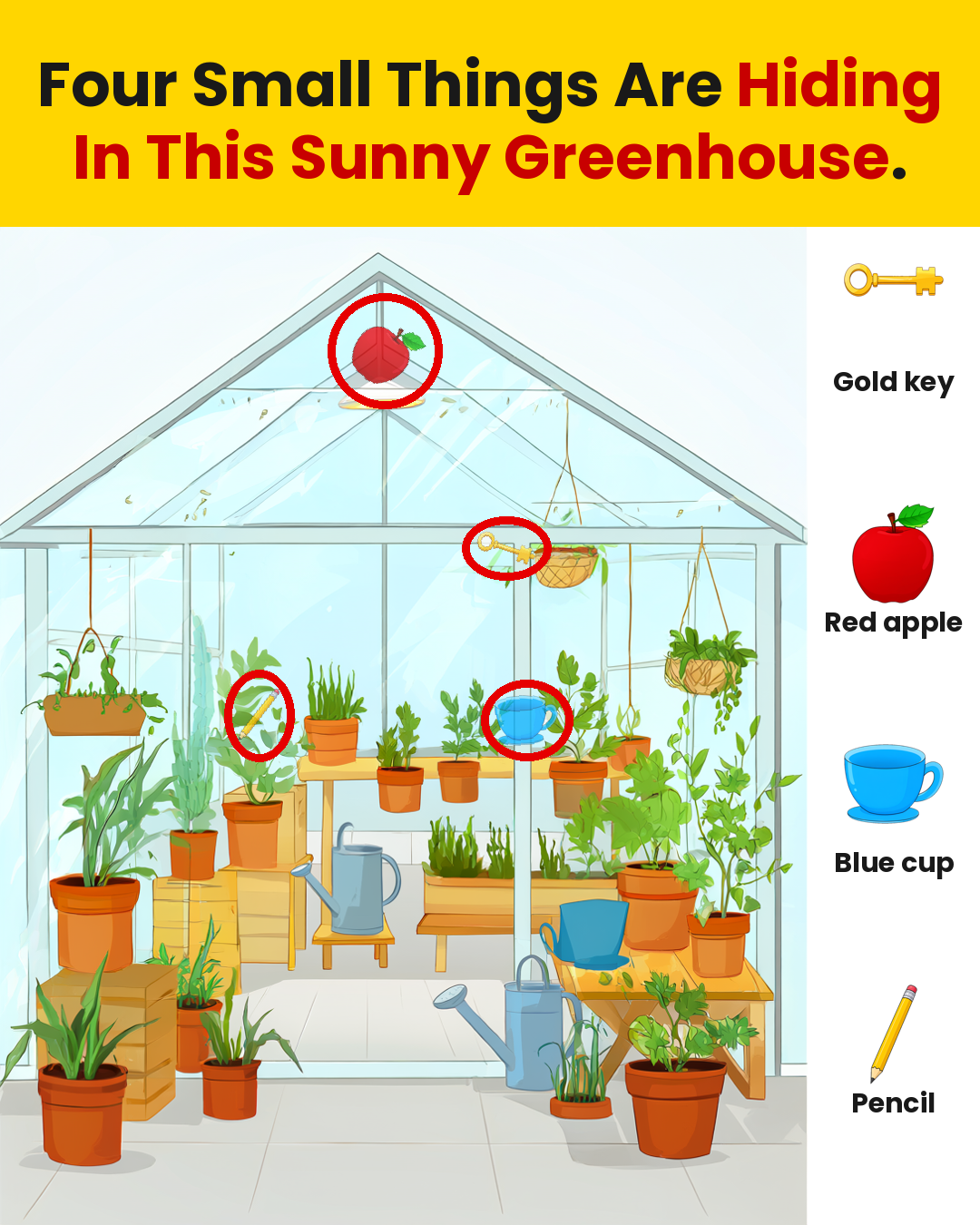
ANSWER: The apple sits on the roof beam at the very top, the gold key hangs on the frame beside the hanging basket, the pencil leans among the leaves on the left shelf and the blue cup stands on the middle shelf between the herb pots.
All Four, One By One
The red apple is the highest object in the picture. It is balanced on the roof beam right at the top of the glass peak, just above the little ceiling lamp. It is bright, it is big, and almost nobody looks up there.
The gold key is halfway down on the right of the centre, hanging against the vertical frame just to the left of the woven hanging basket. Its warm yellow colour melts into the basket beside it.
The pencil is on the left, standing upright among the leaves of the tall plant beside the small shelf, with its pink rubber at the top. The blue cup is in the middle of the picture, sitting on the shelf among the herb pots, slightly to the left of the central post.
Why They Are So Easy To Miss
Each object is hidden by a different trick. The apple uses position: we search at eye level, because that is where objects normally live, and the roof beam is far above it.
The key uses colour. Gold against pale wood and wicker is almost the same tone, so there is no edge for the eye to grab. The pencil uses shape, because a thin yellow stick among stems and leaves reads as part of the plant. And the blue cup uses company, standing in a row of pots so that it looks like one more container.
That mix is what makes the puzzle fair. If one trick does not catch you, the next one will.
How Did You Do?
All four in under thirty seconds: eagle eyes, with no help needed.
All four in about a minute: a very solid result and a genuinely good search.
Three out of four: the normal score, and the one you missed was almost certainly the key.
Two or fewer: do not be hard on yourself. Look again now that you know where they are, and notice how obvious every single one of them suddenly becomes.