Hello, puzzle friends!
Today we are stepping into a little candy shop, the kind with a bell over the door and glass jars on every shelf.
There are two pictures of the same shop: the jars of sweets, the weighing scale, the tall vase of lollipops, the little chalkboard and the chequered floor.
They look like twins, but one small thing in the picture on the right is not the same.
Nothing has been moved and nothing has been taken away, so do not waste time counting the jars.
Look slowly, from the top of the picture down to the floor.
The answer is at the bottom of this page, but please give your eyes a fair chance first!
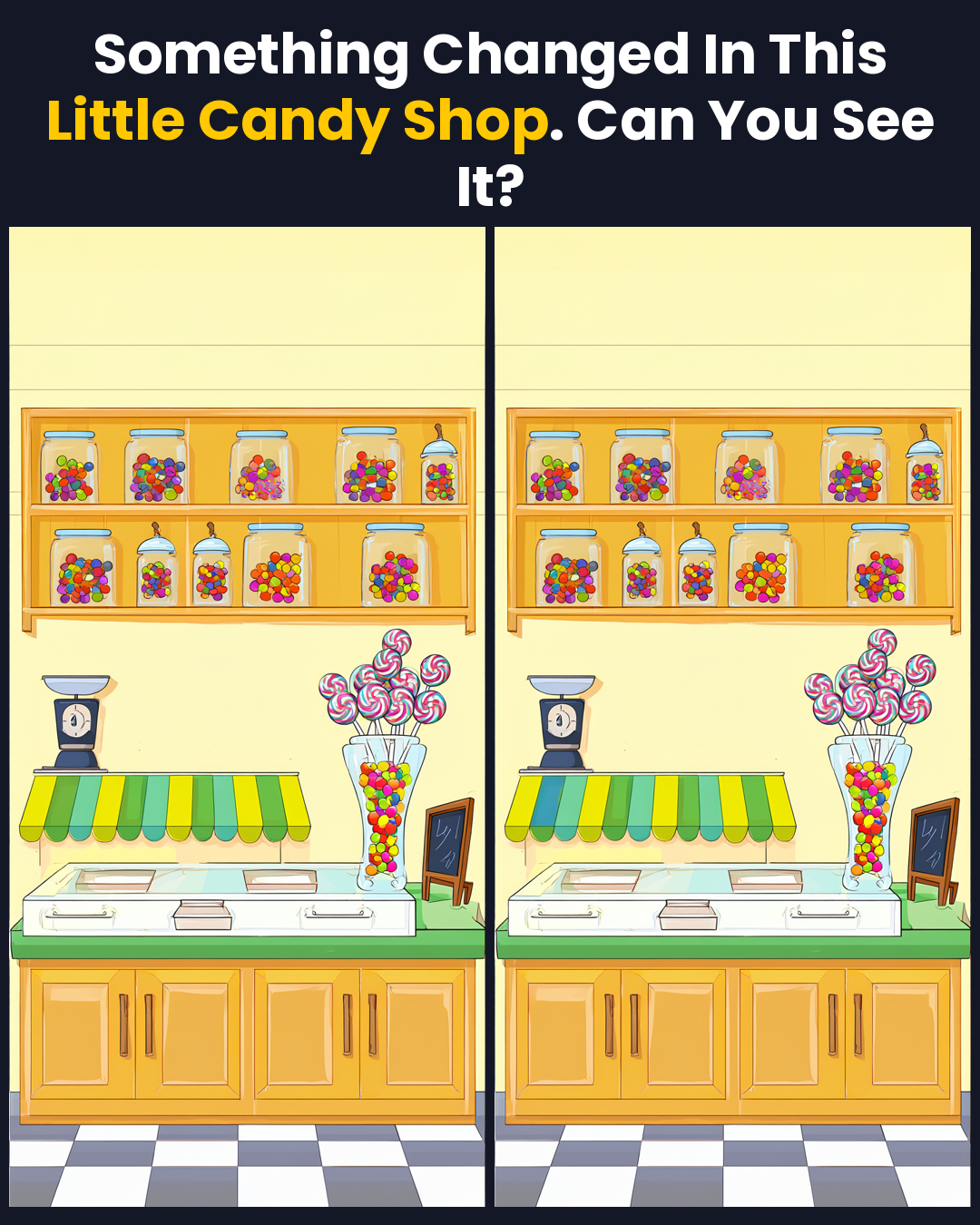
Take your time and look closely before you scroll down!
Where To Look First
In a picture full of sweets, almost everyone starts with the sweets. That is exactly what the puzzle is counting on. The jars are bright, round and busy, and they pull your eyes like a magnet, which means you can spend a full minute there and learn nothing at all.
A calmer method works better. Begin at the top edge of both pictures and work your way down in strips, as if you were reading a page. Shelves first, then the counter, then the floor. Each strip is small enough for your eye to handle honestly.
And when you reach something striped or repeated, slow right down. Stripes, tiles and rows of jars are the classic hiding places, because our eyes read the pattern instead of reading the parts.
Why Our Brain Misses It
Your brain does not photograph a room. It builds a quick summary and keeps only what it thinks you will need. In a candy shop, that summary says: lots of colour, lots of sweetness, stripes over the counter. The details inside the summary are thrown away almost at once.
This is why a change of colour inside an already colourful pattern is so good at hiding. The pattern still looks like a pattern, so nothing feels wrong, and no little voice in your head says look again.
There is also a simple matter of habit. We expect a striped awning to have a repeating colour, and the moment we recognise stripes, we stop inspecting them. Expectation is a comfortable chair, and it is very hard to get out of.
A Sweet Little History
Candy shops and picture puzzles grew up together. A hundred years ago, the weekly paper often carried a pair of almost identical drawings on the children’s page, right next to the sweet shop advertisements, and whole families would argue over them at the kitchen table.
The form has barely changed since, because it does not need to. A pair of pictures, one honest difference, and a little patience: that is the entire recipe. It needs no instructions, works in any language, and is just as enjoyable at seventy as it is at seven.
Your Friendly Challenge
Most people need around forty seconds for this one. Under twenty seconds is a very fine score indeed.
If you find it quickly, try the kind thing: show it to a friend without saying a word, and watch their eyes travel over the jars again and again.
One more look before you scroll down. The answer is not hiding in the sweets.
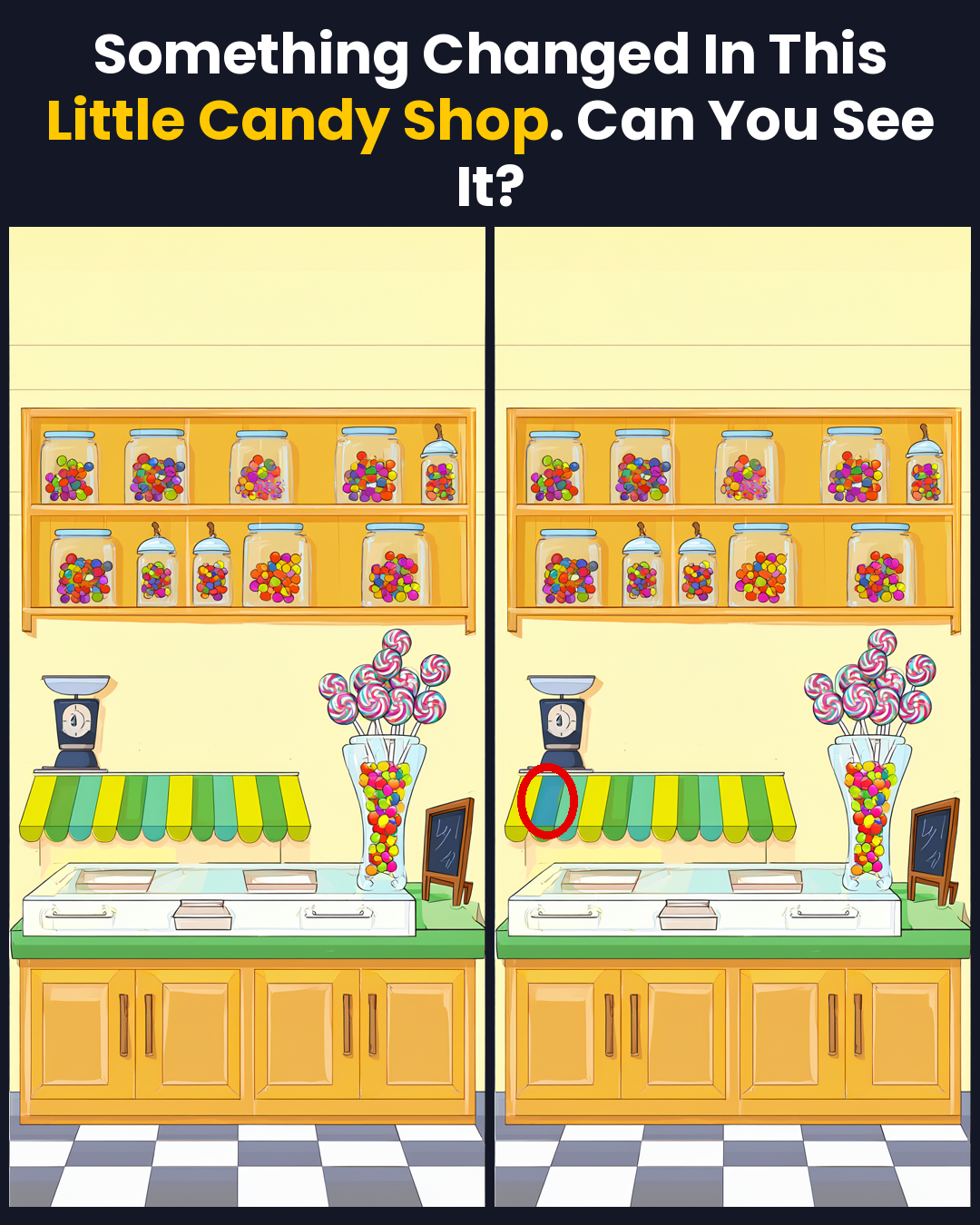
ANSWER: The striped awning over the counter changed colour – the first stripe on the left is green in one picture and blue in the other.
The Change Is Over The Counter
Look above the white counter, at the green and yellow striped awning. Follow it to its left-hand end. In one picture that first stripe is green, exactly like the other green stripes along the awning. In the other picture it has turned a clear sky blue.
It is a plain, honest difference, sitting in the middle of the picture in good light. There is nothing sneaky about the way it is drawn. And still, most people look straight past it, sometimes three or four times, before they finally see it.
Why It Hides So Well
The answer is in the stripes themselves. The moment your eye meets a repeating pattern, your brain switches to its fastest setting: it identifies the pattern, labels it striped awning, and moves on to something more interesting. It never checks the stripes one by one.
The position helps too. The awning sits between the shelves of jars and the counter display, which are the two places your eyes want to be. It is scenery, not a star, and scenery gets glanced at rather than studied.
There is a useful lesson for the next puzzle: whenever you see stripes, tiles, fences or rows of anything, count or compare them deliberately. That is where the difference loves to sit.
How Did You Do?
Under 10 seconds: eagle eyes, and clearly a nose for stripes.
10 to 30 seconds: excellent work. You searched with a plan rather than with hope.
30 to 60 seconds: a solid, healthy score, right where most careful readers land.
Over a minute: you are in very good company. Try the next one starting from the edges and work inwards, and see how much it helps.