Hello, puzzle friends, and welcome to the meadow.
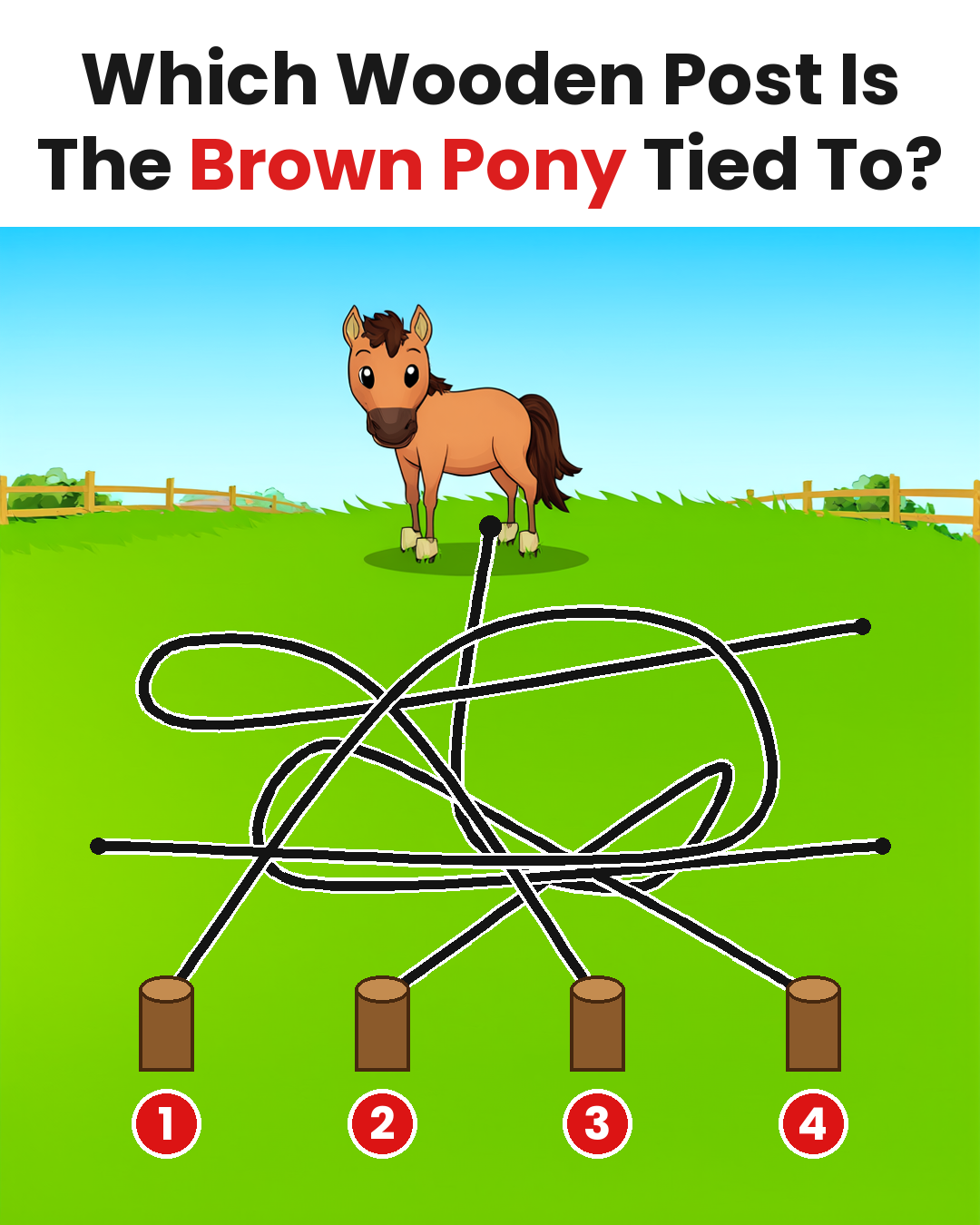
The grass is thick and green, the sky is clear, and a friendly brown pony is standing at the top of the field.
Someone has tied his rope to one of the four wooden posts along the bottom of the picture.
The trouble is that four long ropes lie tangled together in the grass, crossing over and under each other.
Only one of them belongs to the pony.
Your task is to follow his rope with your eyes, from his hooves all the way down to the post.
No pens, no fingers on the screen if you want the real challenge.
Is it post one, two, three or four?
Take your time and look closely before you scroll down!
Follow The Rope, Not The Shape
The natural thing to do is to stare at the whole tangle and hope the right path jumps out. It never does. A tangle of lines is designed to look like one object, and your brain will happily treat it as a single messy knot rather than four separate ropes.
The method that works is almost boringly simple. Put your eye on the rope exactly where it leaves the pony, and move along it a very short distance at a time. A centimetre on the screen is plenty. At every crossing, ask one question only: does my rope go over or under here? Then keep going.
If you lose the thread, do not start from the bottom. Go back to the pony and begin again. Starting from the posts feels faster, but there are four possible starts and only one of them is yours.
Why Crossings Confuse Us
Our visual system loves to join things up. It is the reason we see a complete face behind a pair of sunglasses and a whole chair behind a table. Psychologists call it good continuation: when two lines meet, we assume the one that carries on in the same direction is the same line.
A puzzle like this is built to abuse that habit. At several crossings, the rope that continues most smoothly is not yours at all. Your eye slides onto it without asking permission, and twenty seconds later you are tracing the wrong rope with complete confidence.
That is why the slow, crossing-by-crossing method beats the fast one. You are not really tracing a rope. You are refusing to let your brain take shortcuts.
An Old Game In A New Coat
Tangled line puzzles have been printed in newspapers and children’s annuals for well over a hundred years. They used to show kite strings, fishing lines or balloons, and the instruction was always the same: find out which one belongs to whom.
They survived because they need no words, no language and no education. A child of six and a grandparent of ninety can play the same puzzle side by side and have an equal chance.
There is also something quietly satisfying about them. Unlike a riddle, there is no trick and no wordplay. The answer is sitting in the picture, and patience alone will find it.
Can You Beat Twenty Seconds?
Most people need around twenty to thirty seconds to trace the right rope cleanly. Plenty of people get there in ten by guessing, but a guess among four posts is right only one time in four, so it hardly counts.
Try it properly. Start at the pony, move slowly, and name the post out loud before you scroll down.
Then pass the picture to someone else and watch their eyes. You can usually tell the exact moment they jump onto the wrong rope, and that is half the fun.
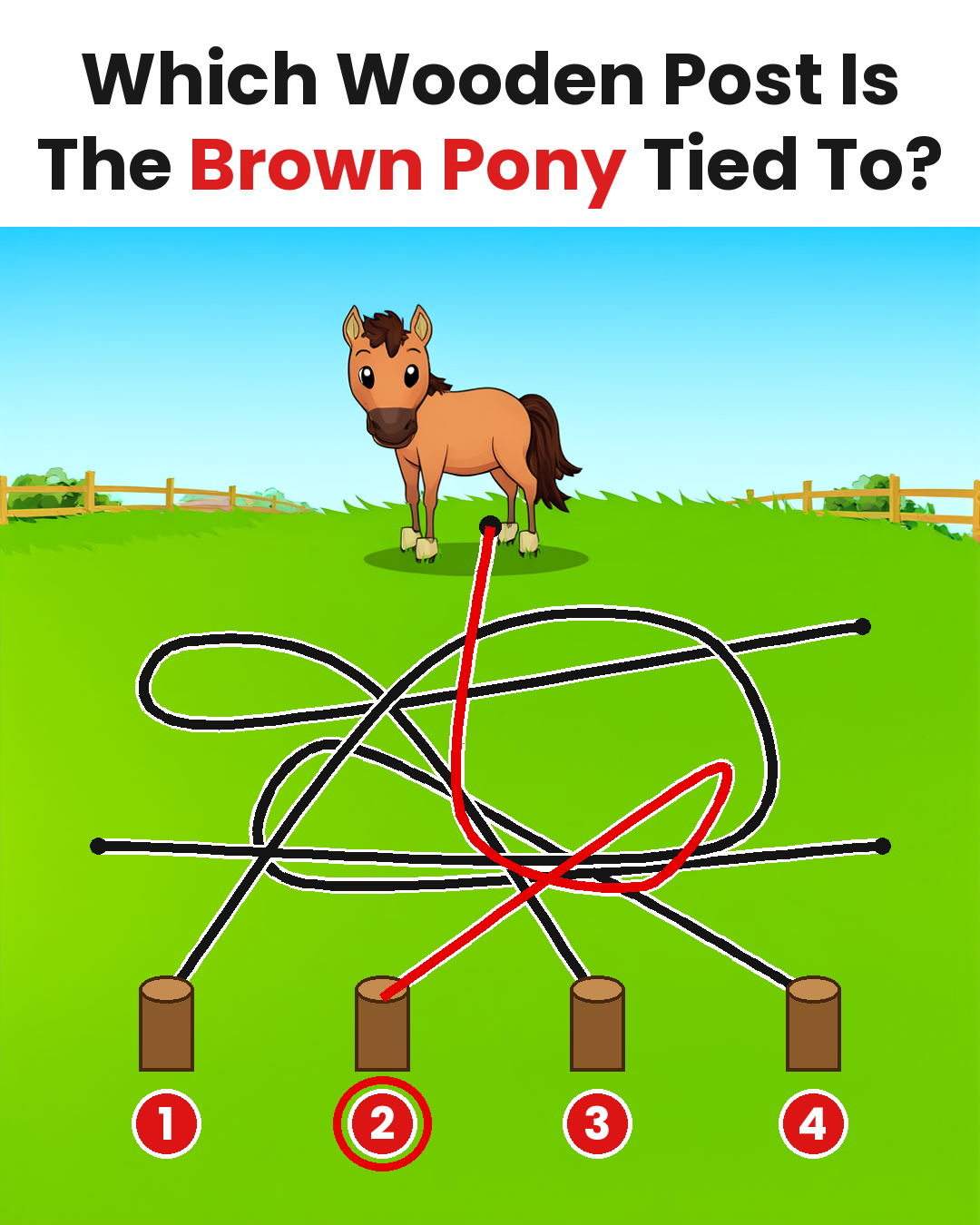
ANSWER: Post number 2
The Rope Really Does Go To Post 2
The pony’s rope leaves his front hooves and runs almost straight down into the middle of the tangle. It then makes a wide loop to the right, swinging out towards the right side of the field before curving back in again.
On the way back it dips low, crosses underneath two of the straighter ropes, and then angles down to the left. That final stretch brings it neatly to the top of the second wooden post, the one marked with the number 2.
In the answer picture the whole path is drawn in red, and once you see it the route looks obvious. Before you see it, it looks like three different ropes.
Why So Many People Say 3
Post 3 is the most popular wrong answer, and there is a good reason for it. The rope that ends at post 3 passes very close to the pony’s rope near the middle of the picture, and it leaves that crossing heading in almost the same direction.
Your eye follows the smoother line, which is the one going to post 3, and the switch happens so quickly that you never notice it. Post 1 catches a few people for the same reason, further down.
The only defence is to slow down at every crossing. The puzzle is not testing your eyesight; it is testing whether you can resist the urge to hurry.
How Did You Do?
Under ten seconds and correct: remarkable. You traced that rope like a sailor.
Ten to thirty seconds: a very good result, and almost certainly an honest one.
About a minute, with one restart: completely normal, and you did the right thing by going back to the pony instead of guessing.
If you said 3, you fell into the trap the puzzle was built around, and so did most of the people who tried it today.